

Views: 253 Author: HELLOKNIFE LTD Publish Time: 2026-09-22 Origin: Site


Content Menu
● Quick Answer: Is Forged Steel More Durable Than Cast Steel?
● What "Forged" and "Cast Steel" Actually Mean
● Why Forged Knives Usually Last Longer
>> Better Structural Design for Daily Kitchen Use
>> Stronger Blade-to-Handle Construction
>> Greater Resistance to Deformation
● The Most Important Truth: Heat Treatment Determines Blade Performance
● Forged vs Cast Steel: Durability by Failure Mode
● OEM Buyer Checklist: How to Specify a Durable Kitchen Knife
>> 2. Specify the Steel, Not Just "Stainless Steel"
>> 3. Match the Edge to the Intended Use
>> 4. Test the Full Product, Not Only the Blade
● HELLOKNIFE LTD: Building Durable OEM Knife Programs
>> What We Prioritize for OEM Customers
● When Cast Steel Knives May Be the Right Choice
● How Buyers Can Verify Durability Claims
● FAQ
>> 1. Are forged kitchen knives always better than cast steel knives?
>> 2. Does forging make a knife sharper?
>> 3. Do forged knives hold an edge longer?
>> 4. Are cast steel knives brittle?
>> 5. What hardness is best for a kitchen knife?
>> 6. Should I choose a full-tang knife for my brand?
>> 7. Can HELLOKNIFE LTD customize forged knives with my logo and packaging?
Forged kitchen knives are usually the more durable choice for demanding culinary use—but only when steel selection, heat treatment, blade geometry, and construction are properly controlled. At HELLOKNIFE LTD, we evaluate durability as a complete manufacturing outcome, not a label applied to a blade: a well-engineered forged knife can outperform a cast knife in impact resistance and long-term structural reliability, while a carefully designed cast-steel knife can still be a practical option for selected designs and price tiers.
For overseas brands, wholesalers, and kitchenware manufacturers sourcing OEM knives, the real question is not simply "forged or cast?" It is: Which production method will deliver the right balance of toughness, edge stability, appearance, consistency, cost, and market positioning for your customer?
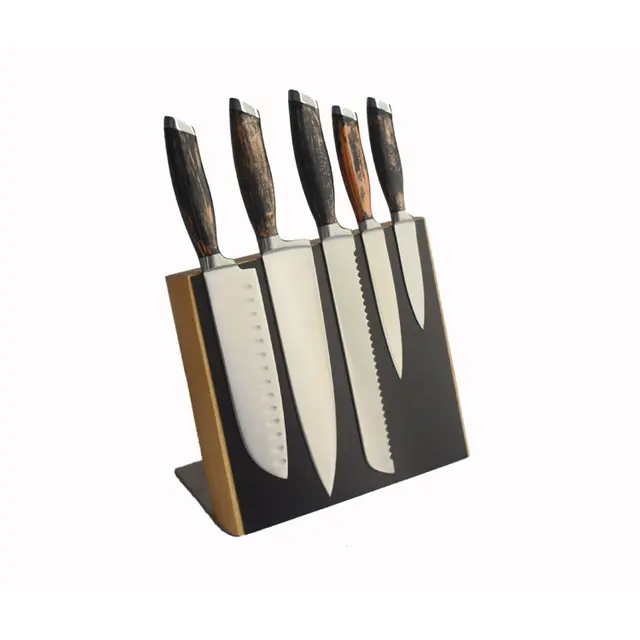
In most professional kitchen-knife applications, forged steel knives are more durable than cast steel knives because forging can create a denser, more structurally continuous blade blank and enables stronger control over blade thickness, tang construction, bolster formation, and weight distribution.
However, the manufacturing method is not the only performance driver. A kitchen knife's real-world durability depends primarily on:
- Steel chemistry
- Heat-treatment accuracy
- Hardness level
- Toughness level
- Blade thickness and grind
- Edge angle
- Tang and handle construction
- Quality-control standards
- The user's cutting habits and maintenance
A forged blade with poor heat treatment can chip, bend, corrode, or lose its edge prematurely. Meanwhile, a cast knife made with an appropriate alloy, carefully controlled casting parameters, precision machining, and validated heat treatment may serve well in lower-impact kitchen applications.
The practical conclusion is simple: forged construction creates a stronger platform for premium durability, but manufacturing discipline determines whether that potential is achieved.
| Factor | Forged Kitchen Knives | Cast Steel Knives |
|---|---|---|
| Structural durability | Typically higher | Can vary significantly by casting quality |
| Resistance to bending | Usually higher with proper blade geometry | Often lower in thin or poorly controlled designs |
| Impact resistance | Generally stronger for demanding use | More dependent on casting integrity |
| Edge retention | Determined mainly by steel and heat treatment | Determined mainly by steel and heat treatment |
| Design flexibility | Excellent for bolsters, thick spines, full tangs | Good for complex shapes and decorative forms |
| Weight and balance | Easier to engineer for premium balance | Often lighter or more variable |
| Best fit | Premium chef knives, steak knives, professional lines | Value ranges, specialty shapes, decorative concepts |
| OEM production cost | Generally higher | Often lower for certain high-volume designs |
The knife industry often uses manufacturing terms loosely. For OEM sourcing, that can create expensive misunderstandings. Buyers should distinguish between forging, stock removal, stamping, and casting before comparing durability claims.
A forged kitchen knife normally begins with a steel bar, billet, or preformed blank. The material is heated and shaped under mechanical pressure, often through drop forging, hot forging, or precision forging. The blade then goes through additional operations, such as trimming, grinding, heat treatment, polishing, sharpening, handle assembly, and inspection.
In a premium forged chef's knife, the process can create useful structural features directly from the blade blank:
- A thicker spine for stiffness
- A tapered blade profile for controlled cutting performance
- An integrated bolster for finger protection and balance
- A full tang for handle stability
- A stronger transition between blade, bolster, and handle
At HELLOKNIFE LTD, forged knife development begins with the intended use case. A 20 cm chef's knife, a serrated steak knife, and a cheese knife should not receive the same blade thickness, hardness range, edge geometry, or handle construction.
A cast steel knife is formed by pouring molten metal into a mold. The mold creates the basic blade shape, after which the manufacturer may machine, grind, heat treat, polish, sharpen, and assemble the knife.
Casting is valuable when a brand wants:
- Complex contours or sculptural handle-to-blade shapes
- Decorative patterns or integrated details
- High-volume production efficiency
- A lower initial cost for specific designs
- A distinctive visual identity that would be costly to forge
But casting demands strict process control. Inadequate control of melt quality, mold design, cooling rate, shrinkage, inclusions, porosity, or finishing can leave internal weaknesses that may affect long-term durability. That is why an OEM supplier should never market a cast knife as "equivalent" to a forged knife without verifying the actual alloy, heat treatment, internal quality, and performance requirements.
The strongest case for forged kitchen knives is not that every forged knife is automatically superior. It is that forging gives an experienced manufacturer more opportunities to engineer a durable, premium blade system.
Forged knives can be made with a thicker heel, a controlled distal taper, and a robust tang. Those details matter when the knife is exposed to repetitive cutting, twisting, pressing, and accidental contact with cutting boards or hard food materials.
For example, a well-designed forged chef's knife can transition from a relatively substantial heel to a thinner tip. This creates strength where the user applies force and precision where the user needs fine slicing control.
A cast blade can imitate that shape, but forging often provides greater freedom to build a high-strength, balanced profile without relying solely on material removal after casting.
Durability is not only about the cutting edge. A knife can have excellent steel but still fail at the handle joint, tang, rivet area, or bolster transition.
For OEM knife brands, a full-tang forged construction is often a strong premium signal because it supports:
- Better resistance to handle loosening
- More stable balance
- Improved confidence during heavy cutting
- A substantial in-hand feel
- Longer-term structural integrity
That said, a full tang is not mandatory for every knife. Cheese knives, lightweight utility knives, and some steak knife designs may benefit from different constructions. The correct choice should reflect the product's intended use, retail price, and target buyer.
A durable kitchen knife must resist multiple failure modes:
- Rolling at the edge
- Chipping at the edge
- Tip breakage
- Bending of the blade
- Cracking near the tang
- Handle separation
- Corrosion damage
Forged blades are frequently engineered with more material in critical areas. This can improve resistance to bending and torsional stress, especially in chef's knives and high-end steak knives.
However, excessive thickness is not automatically better. A blade that is too thick behind the edge can wedge in food and feel inefficient. The objective is controlled strength, not maximum mass.
Many knife listings overemphasize the word "forged" while failing to disclose steel grade, hardness, or heat-treatment controls. This is a critical information gap for buyers.
A blade becomes useful through heat treatment. The core sequence generally includes:
1. Austenitizing the steel at a controlled high temperature
2. Quenching it at an appropriate rate
3. Tempering it to reduce brittleness and establish the desired balance of hardness and toughness
For many quality kitchen knives, manufacturers target approximately 58–63 HRC on the Rockwell C scale, although the ideal range depends on the steel type, blade geometry, intended use, and target market. Higher hardness can improve edge retention, but it can also reduce toughness and increase the risk of chipping if the knife is too thin or misused.
This is why HELLOKNIFE LTD approaches knife durability as a specification package. We do not treat hardness as a marketing number. We match the heat-treatment target to the product category:
| Product Category | Primary Durability Need | Recommended OEM Focus |
|---|---|---|
| Chef's knife | Toughness, edge stability, balance | Forged blank, full tang, controlled taper, balanced hardness |
| Steak knife | Fine edge, corrosion resistance, handle stability | Consistent heat treatment, serrated or plain-edge specification, secure handle assembly |
| Cheese knife | Corrosion resistance, food release, distinctive shape | Stainless steel selection, surface finish, specialized blade profile |
| Cleaver or heavy-duty knife | Strength and impact resistance | Thicker forged structure, robust tang, lower-risk edge geometry |
| Gift-set knife | Appearance and repeatable quality | Finish consistency, logo precision, packaging and handle quality |
Steel toughness refers to resistance to fracture or chipping, while edge retention describes how long a knife maintains cutting ability before maintenance is required. Higher carbide volume and higher hardness can improve wear resistance, but they can also reduce toughness. This trade-off must be intentionally managed rather than ignored.
The following table provides a more useful way for OEM buyers to compare forged and cast kitchen knives: by examining how each construction responds to real failures.
| Failure Mode | Forged Knife Advantage | Cast Knife Risk or Opportunity |
|---|---|---|
| Edge dulling | No inherent advantage if steel and heat treatment are identical | Can perform similarly with equivalent alloy, hardness, and edge geometry |
| Edge chipping | Strong potential when toughness and geometry are optimized | Risk rises if casting quality or heat treatment is inconsistent |
| Blade bending | Forged thickness distribution can improve rigidity | Thin cast designs may bend more easily |
| Tang breakage | Full tang and forged transitions can improve durability | Must be carefully designed and inspected |
| Internal defects | Forging can reduce concerns associated with uncontrolled casting defects | Requires strong melt, mold, and process control |
| Handle loosening | Robust full-tang construction supports long service life | Depends heavily on tang design and bonding method |
| Corrosion | Depends mostly on alloy, finish, and maintenance | Depends mostly on alloy, finish, and maintenance |
One important point deserves emphasis: forging alone does not guarantee better edge retention. Edge retention is strongly influenced by hardness, steel composition, carbide structure, and edge angle. Testing literature on knife steels shows that hardness and carbide content are major variables in cutting-edge retention, while toughness is a separate property related to resistance to fracture.
For a private-label kitchen knife program, buyers should request evidence of the full specification—not only the manufacturing label.
A brand owner should not simply ask, "Can you make this knife forged?" A better request is a detailed durability brief. At HELLOKNIFE LTD, we recommend that overseas customers define the following points before sampling begins.
Start with the user, not the product image.
- Professional chefs need fatigue resistance, edge stability, and balance.
- Home cooks often prioritize corrosion resistance, easy sharpening, comfort, and appearance.
- Steakhouse buyers may need durable serrations and dishwasher-resilient handles.
- Gift buyers may care more about visual impact, packaging, and perceived premium value.
- Cheese-board brands may prioritize food release, matching board materials, and coordinated presentation.
"Stainless steel" is too broad for an OEM specification. Ask for:
- Material grade
- Material certificate where applicable
- Target hardness range
- Corrosion-resistance expectations
- Blade thickness
- Edge angle
- Surface finish
- Heat-treatment procedure and verification method
A brand should also determine whether it needs a high-hardness premium line, an easy-maintenance retail line, or a heavy-duty hospitality line. One steel-and-hardness formula rarely fits every range.
A thin, acute edge can cut beautifully, but it needs responsible use. A more durable edge profile may be better for high-volume foodservice, shared kitchens, or customers who may cut against hard surfaces.
For instance:
- A premium slicing knife may prioritize a thin edge and high sharpness.
- A restaurant steak knife may prioritize edge stability and resistance to abuse.
- A cheese knife may prioritize low friction and corrosion resistance over extreme hardness.
A complete durability evaluation should include:
- Rockwell hardness testing
- Blade straightness inspection
- Edge sharpness testing
- Corrosion-resistance checks
- Handle pull or torque testing
- Rivet and assembly inspection
- Drop or impact evaluation where appropriate
- Packaging tests for export transit
HELLOKNIFE LTD is a China-based OEM manufacturer specializing in cheese knives, cheese boards, steak knives, and customized kitchen knife products for international brands, wholesalers, retailers, and manufacturers.
Our role is not limited to making a blade. We help customers build a coherent, market-ready product program that aligns performance, design, MOQ requirements, packaging, branding, and target price.
- Product-first engineering: We align construction with the use case rather than applying one generic specification to every knife.
- Customized material selection: We help match steel, wood, plastic, resin, stainless steel, and handle materials to the desired market position.
- Brand-ready customization: Logo marking, laser engraving, blade printing, handle colors, packaging, gift boxes, and coordinated cheese-board sets can be developed around your brand identity.
- Quality-control checkpoints: We focus on blade finish, sharpness, assembly, appearance, packaging consistency, and export readiness.
- Practical communication: Clear sampling, specification confirmation, production follow-up, and inspection standards reduce the risk of costly misunderstandings.
For a forged steak knife collection, for example, we may recommend a stable full-tang structure, corrosion-resistant stainless steel, a controlled blade grind, and handle materials selected for restaurant use or premium gift presentation. For a cheese knife and cheese-board gift set, we may place more emphasis on blade shape, food release, handle aesthetics, board finish, logo integration, and retail packaging.
Cast steel knives should not be dismissed automatically. They can be commercially appropriate when the application, design, and quality requirements are clear.
A cast construction may be suitable when:
- The design requires complex three-dimensional forms.
- The product is decorative or gift-oriented rather than heavy-duty.
- The target retail price requires cost discipline.
- The knife is intended for light cutting tasks.
- High-volume design consistency is the leading priority.
- The manufacturer can demonstrate reliable control of casting and finishing quality.
The correct approach is to avoid a false choice. Forged and cast knives serve different product strategies. A successful OEM line may even use both: forged kitchen knives for a premium culinary collection, and cast or alternative constructions for promotional, decorative, or entry-level ranges.
Before placing a bulk order, request proof rather than relying only on product photos or broad promises.
Ask your OEM knife supplier these questions:
1. What is the exact blade steel grade?
2. What hardness range is specified after heat treatment?
3. How is hardness checked and recorded?
4. Is the blade forged, cast, stamped, or cut from rolled stock?
5. What is the blade thickness at the spine, heel, and tip?
6. What is the tang construction?
7. What edge angle is used?
8. How are handles fixed to the tang?
9. What corrosion, sharpness, and assembly inspections are performed?
10. Can the supplier provide pre-production samples for real kitchen testing?
A trustworthy manufacturer should answer these questions clearly. If the supplier cannot explain the material, heat treatment, construction, and inspection process, the term "forged" has little purchasing value.
Forged kitchen knives are generally more durable than cast steel knives when durability means structural strength, blade rigidity, tang reliability, and long-term performance under demanding kitchen use. But the strongest knife is not simply "forged." It is a knife made from the right steel, heat treated correctly, ground to the right geometry, assembled securely, and tested against the way customers will actually use it.
For brands developing premium chef knives, steak knives, or professional kitchen tools, forged construction is often the better foundation. For value-oriented, decorative, or specialized products, cast steel can be viable when supported by sound engineering and rigorous quality control.
Ready to develop your own forged kitchen knife, steak knife, cheese knife, or cheese-board set? Contact HELLOKNIFE LTD with your product concept, target market, logo requirements, materials, and estimated order quantity. Our OEM team can help convert your idea into a durable, brand-ready product line.
No. Forged knives usually offer better potential for structural durability, balance, and premium construction, but steel grade, heat treatment, blade geometry, and quality control are more important than the manufacturing label alone.
Not directly. Sharpness depends mainly on edge geometry, sharpening quality, steel hardness, and the condition of the cutting edge. Forging can support a premium blade design, but it does not automatically create a sharper knife.
Not necessarily. Edge retention is mainly influenced by steel composition, hardness, carbide structure, edge angle, and heat treatment. A properly heat-treated cast or stock-removal knife can outperform a poorly heat-treated forged knife in edge retention.
They can be, but they are not automatically brittle. Brittleness depends on alloy selection, internal quality, heat treatment, blade thickness, and casting controls. Poor casting or improper heat treatment can raise the risk of cracking or chipping.
There is no universal best hardness. Many quality kitchen knives fall around 58–63 HRC, but the ideal target depends on the steel, edge thickness, intended user, and desired balance between edge retention and toughness.
For premium chef knives and many steak knives, a full tang can improve balance, user confidence, and structural strength. For lightweight cheese knives or special designs, other constructions may be more appropriate.
Yes. HELLOKNIFE LTD supports OEM customization for knife shapes, blade materials, handles, logos, laser engraving, packaging, gift boxes, cheese boards, and coordinated product sets.
1. Knife Steel Nerds. "Introduction to Knife Steel Heat Treating from a Metallurgist." Explains austenitizing, quenching, tempering, typical kitchen-knife hardness ranges, and the hardness–toughness trade-off. [https://knifesteelnerds.com/2024/09/17/introduction-to-knife-steel-heat-treating-from-a-metallurgist/] [knifesteelnerds]
2. Knife Steel Nerds. "Knife Steels Rated by a Metallurgist – Toughness, Edge Retention, and Corrosion Resistance." Defines toughness and edge retention and discusses the influence of carbide volume and hardness on knife performance. [https://knifesteelnerds.com/2021/10/19/knife-steels-rated-by-a-metallurgist-toughness-edge-retention-and-corrosion-resistance/] [knifesteelnerds]
3. Knife Steel Nerds. "Testing the Edge Retention of 48 Knife Steels." Provides technical context on edge retention, hardness, cutting angle, and carbide contributions. [https://knifesteelnerds.com/2020/05/01/testing-the-edge-retention-of-48-knife-steels/] [knifesteelnerds]
4. Knife Steel Nerds. "How to Heat Treat ApexUltra Knife Steel." Discusses the importance of grain refinement, normalization, quenching, tempering, and balancing toughness with hardness. [https://knifesteelnerds.com/2022/09/06/how-to-heat-treat-apexultra-knife-steel/] [knifesteelnerds]
5. Science of Sharp. "Carbides in 15V." Provides microscopic context on hardness, carbide distribution, refined edges, and wear performance. [https://scienceofsharp.com/2024/01/18/carbides-in-15v/] [scienceofsharp]
6. KIREAJI. "Cast Knife Manufacturing vs Forged Japanese Knives." Provides background context on the different manufacturing philosophies of casting and forging. [https://kireaji.ca/pages/gkt-casting] [kireaji]
Hot Tags: China, Global, OEM, private label, manufacturers, factory, suppliers, manufacturing company


