


Views: 256 Author: HELLOKNIFE LTD Publish Time: 2026-10-20 Origin: Site


Content Menu
● Wire Cheese Cutter vs Plane Cheese Cutter: Quick Comparison
● What Is a Wire Cheese Cutter?
>> Handheld Roller Wire Cutters
>> Bow-Style and Board-Mounted Wire Cutters
● What Is a Plane Cheese Cutter?
● Which Cheese Cutter Works Best for Different Cheeses?
>> Semi-Soft and Young, Cohesive Cheeses
>> Firm Cheese for Thin Sandwich Slices
>> Very Hard, Dry, or Crumbly Cheese
● What Public User Feedback Reveals About Cheese Slicer Design
>> Can Customers Maintain the Product?
>> Does the Tool Match the Expected Slice?
>> Are Durability Claims Specific?
● How to Use Each Cheese Cutter More Effectively
>> Using a Plane Cheese Cutter
● An OEM Sample-Testing Framework for Brand Buyers
>> Step 1: Define the Intended Use
>> Step 2: Control the Comparison
>> Step 3: Record Observable Results
>> Step 4: Agree Acceptance Criteria
● OEM Design Details That Deserve More Attention
>> Design for Cleaning, Not Just Display
>> Make Packaging Explain the Product
● Choosing an OEM Cheese Cutter Partner: HELLOKNIFE LTD
● FAQs About Wire Cheese Cutters and Cheese Planes
>> 1. Is a wire cheese cutter better than a cheese plane?
>> 2. Can a wire cheese cutter cut Cheddar?
>> 3. Why does my cheese plane stick?
>> 4. Do wire cheese cutters need sharpening?
>> 5. Are cheese planes dishwasher-safe?
>> 6. Should a private-label brand offer both tools?
● Start Your Cheese Cutter OEM Project
At HELLOKNIFE LTD, we approach the Wire Cheese Cutter vs Plane Cheese Cutter question from a practical OEM perspective: which tool will help your customers cut their preferred cheeses comfortably, consistently, and with less frustration? As a Chinese OEM manufacturer serving overseas brands, wholesalers, and manufacturers, we focus on cheese knives, cheese boards, and steak knives.
The short answer is straightforward. A wire cheese cutter generally suits softer, cohesive cheeses and adjustable portions. A plane cheese cutter excels at shaving thin slices from cheeses firm enough to support its blade. Neither tool is best for every cheese.
For buyers developing a private-label collection, understanding that distinction helps connect product design, packaging claims, and customer expectations.

| Buying consideration | Wire cheese cutter | Plane cheese cutter |
|---|---|---|
| Cutting mechanism | Tensioned wire passes through cheese | Sharpened slot shaves the surface |
| Typical strength | Gentle portioning with limited contact | Thin slices for sandwiches and serving |
| Suitable starting point | Semi-soft cheeses and younger, cohesive blocks | Firm, sliceable cheeses |
| Thickness control | Adjustable on some models; manually positioned on others | Influenced by blade geometry and cutting angle |
| Maintenance | Inspect tension, anchors, and replacement wire availability | Protect the cutting edge and inspect handle attachment |
| Main limitation | Excessive resistance can damage the wire | Soft cheese may smear; brittle cheese may crumble |
| Common formats | Handheld roller, bow, and board-mounted cutter | Handheld paddle with a cutting slot |
These categories overlap. Cheese age, moisture, temperature, and the particular tool design all affect performance.
A wire cheese cutter uses a thin, tensioned wire rather than a broad blade. Its small contact area helps it pass through suitable cheeses without the drag associated with a larger cutting surface.
However, "wire cutter" describes several different products.
A roller travels across the cheese while the wire makes the cut. On adjustable designs, changing the distance between the roller and wire changes the intended slice thickness.
These models suit buyers targeting everyday sandwich preparation. Check adjustment security, roller movement, and whether users can replace the wire without unnecessary difficulty.
A bow-style cutter passes a wire through the cheese by hand. A board-mounted version guides the wire downward through a block.
These formats can suit portioning rather than surface shaving. Board-mounted designs also offer an opportunity to combine a serving board and cutter in one retail product.
Their usefulness depends on block clearance, stability, wire alignment, and accessible cleaning areas—not simply the appearance of the board.
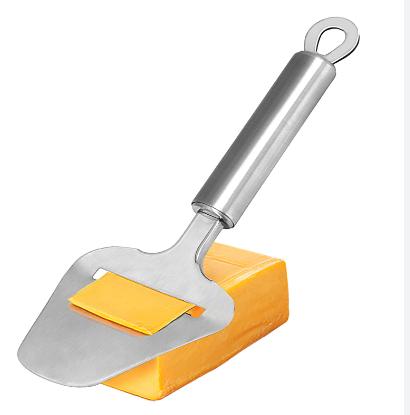
A plane cheese cutter, usually called a cheese plane or cheese slicer, has a paddle-shaped head with a sharpened slot.
The user draws it across the cheese. A thin slice passes through the opening and rests on the head, ready for serving.
A plane is particularly useful when the goal is sandwich layers or delicate slices rather than substantial portions.
From a product-development perspective, the important details include:
- Cutting-edge quality.
- Slot geometry.
- Head stiffness.
- Handle comfort.
- Clearance between the hand and cheese.
- The ease with which slices release.
A polished finish may improve presentation, but appearance alone cannot establish cutting performance.
Choosing by cheese name alone can be misleading. Young Gouda and aged Gouda, for example, behave differently because their textures differ.
Start with texture, then test the actual varieties your customers buy.
Havarti, fontina, young Gouda, and similar cheeses are useful starting points for evaluating wire cutters.
A wire can portion these cheeses with relatively little contact. However, an extremely soft or flowing cheese may not hold a neat slice regardless of the tool.
A suitable plane can also work on some semi-soft cheeses. The question is whether the cheese supports the cutting head instead of compressing or smearing.
A cheese plane is a strong candidate when customers want thin slices from a firm, cohesive block.
Cheddar and Gouda vary considerably with age and storage conditions, so avoid promising identical results across every variety.
For retail buyers, demonstrating a specific cheese and slice style is more useful than claiming that a slicer "cuts all cheese."
Neither a general-purpose wire cutter nor a standard plane should automatically be presented as the answer.
Very hard cheese can overload a wire. Brittle cheese may fracture instead of producing continuous slices with a plane.
For aged Parmesan-style cheeses, a dedicated hard-cheese knife or grater may better match the intended result.
Public discussions about cheese slicers reveal a useful tension: some users prefer the portion control of wire cutters, while others value the thin slices and simpler construction of planes.
These comments are individual experiences, not a representative customer survey. They also are not HELLOKNIFE LTD testimonials.
Nevertheless, they suggest three questions worth testing.
Some users specifically value replaceable wires. That makes replacement availability part of the product experience, not merely an accessory decision.
For an OEM project, define the replacement wire dimensions, attachment method, installation instructions, and intended supply arrangement before finalizing packaging.
A customer wanting a substantial sandwich slice may dislike a plane that produces delicate shavings—even if it functions correctly.
Conversely, someone seeking very thin slices may find a manually positioned board cutter less convenient.
Packaging should show the intended result clearly.
A product with few moving parts is not automatically indestructible. Likewise, a replaceable wire does not necessarily indicate poor construction.
Evaluate the components that actually carry the load: wire anchors, adjustment mechanisms, head-to-handle joints, and board-mounted hinges.
Good instructions help customers distinguish a tool limitation from a technique problem.
1. Place the cheese on a stable surface.
2. Inspect the wire and its attachment points.
3. Set the slice thickness if the model allows adjustment.
4. Apply smooth, controlled pressure.
5. Stop if resistance rises sharply; do not force the cut.
6. Remove residue before cutting another cheese.
For board-mounted cutters, keep fingers clear of the wire path and confirm that the wire reaches its receiving groove.
Do not treat "no conventional blade" as meaning "no injury risk."
1. Position the cheese securely.
2. Begin on an accessible, reasonably flat surface.
3. Draw the plane steadily across the cheese.
4. Use controlled pressure rather than forcing the head downward.
5. Reposition the block when the working surface becomes uneven.
6. Keep fingers away from the sharpened slot.
If the plane smears the cheese, reassess the cheese texture and tool suitability. If it catches or crumbles the block, try a more suitable cutting method rather than increasing force.
A meaningful comparison requires more than inspecting two products in a showroom.
At HELLOKNIFE LTD, our recommended sourcing approach is to turn the intended customer experience into an agreed sample-evaluation brief.
The following is a proposed framework—not a claim that a particular product has already passed these tests.
Specify:
- Target cheese textures.
- Expected slice style.
- Handheld or board-mounted format.
- Intended cleaning method.
- Retail positioning.
- Required replacement components.
A premium gifting product and an everyday sandwich slicer may need different priorities.
Use comparable cheese blocks and record their condition, approximate temperature, and dimensions.
Compare the tools under the same conditions. Otherwise, differences in cheese texture can be mistaken for differences in manufacturing quality.
Evaluate slice consistency, tearing, sticking, user effort, adjustment movement, and cleaning access.
For adjustable wire models, check whether the setting remains stable during repeated use.
For planes, inspect cutting consistency and the security of the handle connection.
Translate observations into a written sample-approval record.
Do not rely on phrases such as "premium quality" without defining what the buyer will accept. Any numerical tolerance, durability requirement, or cleaning claim should be agreed and supported by appropriate testing.
Three considerations can distinguish a useful cheese slicer collection from a visually attractive but poorly specified one.
Inspect the areas around rollers, wire anchors, hinges, and handle joints.
Can users reach trapped residue? Can components dry properly? Does the care instruction match every material in the assembled product?
A stainless-steel component alone does not prove that an entire product is dishwasher-safe.
Use packaging to communicate:
- Suitable cheese textures.
- Intended slice style.
- Basic operating steps.
- Cleaning instructions.
- Replacement information, where relevant.
A short demonstration video can show cutting angle and movement more effectively than a broad performance slogan.
HELLOKNIFE LTD serves overseas brands, wholesalers, and manufacturers seeking OEM cheese knives, cheese boards, and steak knives.
For a cheese cutter project, start the discussion with the end user rather than the logo placement.
Share your target market, intended cheeses, preferred format, material requirements, packaging concept, order quantity, and delivery requirements. Then confirm the specific customization options, sample arrangements, testing needs, and commercial terms for that project.
For coordinated collections, consider how a cheese plane or wire cutter will sit alongside cheese knives and serving boards. Each item should have a distinct purpose rather than duplicating another tool without explanation.
Neither is universally better. A wire cutter generally suits gentle portioning of suitable softer cheeses, while a plane is useful for thin slices from firm, cohesive blocks.
Often, particularly younger, cohesive Cheddar. Very aged, dense, or crumbly varieties may resist the wire or fracture. Evaluate the actual cheese and cutter combination.
The cheese may be too soft for that plane, residue may interfere with movement, or the cutting angle may be unsuitable. Reassess the combination rather than applying more pressure.
The wire is not sharpened like a blade. Inspect it for damage or looseness and replace it according to the product instructions when necessary.
Some are, but the claim depends on the complete product, including its handle and joints. Follow model-specific instructions rather than assuming all metal tools are dishwasher-safe.
Offering both can make sense when customers need different cutting results. Position them clearly: one for suitable portioning tasks, the other for thin slicing.
Contact HELLOKNIFE LTD with your product brief, target cheeses, reference designs, packaging requirements, and estimated order quantity. Request a project-specific discussion covering samples, available customization, replacement components, and quality requirements before approving production.
Hot Tags: China, Global, OEM, private label, manufacturers, factory, suppliers, manufacturing company


