


Views: 266 Author: HELLOKNIFE LTD Publish Time: 2026-11-19 Origin: Site


Content Menu
● Butcher Knife Set vs Meat Cutting Knife: The Core Differences
● Which Knives Belong in a Commercial Butcher Knife Set?
>> Boning Knife: Controlled Work Around Bones
>> Breaking Knife: Larger-Cut Preparation
>> Cimeter or Butcher Knife: Portioning Boneless Meat
>> Slicing Knife: Finishing and Service
● When Is a Butcher Knife Set the Better Choice?
● When Is One Meat Cutting Knife Enough?
● A Practical Five-Step Knife Selection Test
>> 2. Match the Blade to the Work
>> 4. Record Results Consistently
>> 5. Review Maintenance and Replacement
● Compare Total Working Cost, Not Just Purchase Price
● Hygiene and Safe Handling Are Part of the Specification
● OEM Buying Guide: Turn a Knife Concept into a Clear Brief
● How HELLOKNIFE LTD Fits Your Product Strategy
>> Is a butcher knife set better than a single meat cutting knife?
>> Can a chef's knife replace a butcher knife set?
>> Can a butcher knife cut through bone?
>> What is the difference between a steak knife and a meat cutting knife?
>> Should commercial kitchens buy knife sets or individual replacements?
>> What should an OEM buyer confirm before ordering?
At HELLOKNIFE LTD, a China-based OEM manufacturer of cheese knives, cheese boards, and steak knives for overseas brands, wholesalers, and manufacturers, we believe a useful knife collection starts with a clearly defined job—not a larger piece count.
The butcher knife set vs meat cutting knife decision follows the same principle. A butcher knife set combines several tools for different meat-preparation tasks. A meat cutting knife is a broad description of an individual knife used to trim, debone, portion, or slice meat.
These are overlapping options, not competing blade technologies. A meat cutting knife can be part of a butcher knife set.
For commercial kitchens, the right purchase depends on what arrives at the receiving door, what leaves the prep station, and how the team works between those points.

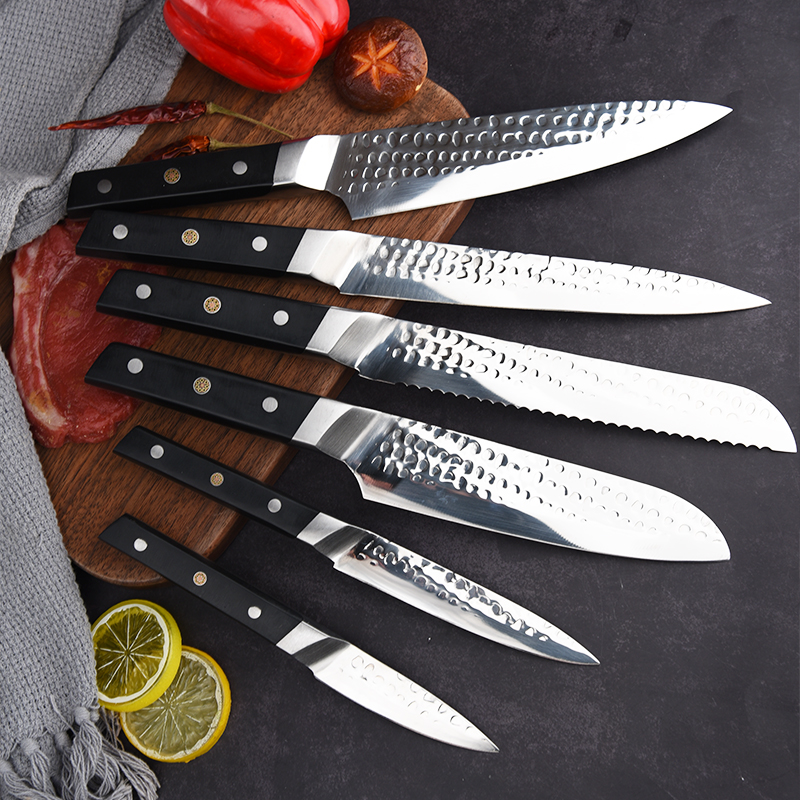
A professional butcher knife set typically contains multiple blade profiles. Depending on the supplier, it may include a boning knife, breaking knife, butcher knife, slicer, or other accessories.
"Meat cutting knife" does not identify one standardized shape. A supplier might use the term for a chef's knife, cimeter, boning knife, or slicing knife.
That makes the product specification more important than the product name.
| Buying factor | Butcher knife set | Individual meat cutting knife |
|---|---|---|
| Main purpose | Cover several preparation tasks | Handle a defined task |
| Typical buyer | Kitchen handling varied cuts | Station with a repeatable workflow |
| Main advantage | Complementary blade profiles | Targeted selection and replacement |
| Main risk | Paying for unused pieces | Choosing an overly general blade |
| Training requirement | Staff must select the correct tool | Staff must understand its limitations |
| Best comparison basis | Useful tools and workflow coverage | Suitability for the intended cut |
Our procurement recommendation is straightforward: list the tasks first, then choose the smallest collection that performs them effectively.
A boning knife uses a narrow blade to work closely around bones, joints, and connective tissue.
It suits tasks such as separating meat from bone and trimming selected areas. Blade stiffness matters: a flexible blade and a stiff blade do not respond identically under pressure.
Specify the meat, cut, and working technique before choosing flexibility. Do not assume that the most flexible option is automatically the most precise.
A breaking knife commonly has a curved blade suited to long cutting strokes when dividing larger meat sections.
It should not be confused with a bone-chopping tool. Cutting through soft tissue and separating a joint differ from forcing an edge through hard bone.
For purchasing purposes, identify whether staff will handle large sections or mostly pre-portioned products.
A cimeter typically has a long, curved profile used for cutting larger boneless pieces into portions.
Supplier terminology varies, and "butcher knife" may describe several related shapes. Compare actual blade drawings, dimensions, and samples rather than relying on names alone.
The useful question is whether the profile supports the operator's cutting motion and the size of the meat.
A slicing knife supports long, controlled strokes through cooked roasts and other suitable boneless products.
A raw-meat preparation knife and a cooked-meat service knife may look similar, but their workflow requirements differ. Keep food-safety procedures central when assigning and storing them.
A dining steak knife is another category: it serves the guest at the table rather than replacing a professional preparation knife.
A set makes sense when the kitchen regularly performs several distinct operations.
For example, a restaurant buying bone-in meat may need to debone, trim, portion, and later slice cooked products. Different profiles can support those separate stages.
Consider a task-based set when:
- Incoming meat varies substantially in size and preparation level.
- Staff perform both close trimming and long slicing cuts.
- Several stations need clearly assigned tools.
- The operation can train employees to select and maintain each knife.
However, a larger set is not automatically more professional.
A knife that stays in storage adds purchase cost without adding working value. Evaluate every included piece against an actual task, including accessories that inflate the advertised count.
An individual knife can be the better starting point when the workflow is narrow and consistent.
A kitchen receiving trimmed, boneless portions may not need the same equipment as an operation processing larger bone-in cuts.
Choose a task-specific knife when:
- One cutting operation dominates the station.
- Existing knives already cover the remaining work.
- The buyer needs a replacement rather than a complete collection.
- A team wants to trial a blade before standardizing it.
"One knife" describes the required profile, not necessarily the total quantity to purchase. A busy station may need several identical knives for staffing, cleaning rotation, and replacements.
That distinction prevents a common purchasing error: confusing fewer knife types with fewer operational tools.
Catalog descriptions cannot fully predict how a knife will perform in your kitchen. Use a repeatable sample trial.
Record the protein, incoming cut, target portion, and expected daily workload.
"Cutting beef" is too broad. "Portioning boneless striploin into steaks" gives the supplier a useful starting point.
Compare blade length, width, curvature, thickness, and flexibility.
Check whether the knife can complete the intended stroke without excessive repositioning. A longer blade is not automatically better if the workstation or product size makes it awkward.
Have trained operators evaluate the handle under normal working conditions and with their usual protective equipment.
Assess grip security, pressure points, balance, and clearance. Avoid treating "ergonomic" or "non-slip" as proven performance without a relevant trial.
Use comparable meat cuts, preparation standards, and operator conditions.
Measure:
- Time required to complete the task.
- Saleable output against starting weight.
- Portion consistency.
- Frequency of edge maintenance.
- Operator feedback after a defined session.
Separate measured observations from preferences. Both matter, but they answer different questions.
Check how the knife fits the kitchen's sharpening system, cleaning procedures, storage, and replenishment plan.
A successful sample should be practical to maintain—not merely impressive when new.
The cheapest knife is not necessarily the least expensive tool to operate. Equally, a higher price does not prove better performance.
A useful internal comparison is:
Total working cost = purchase cost + maintenance + replacement + attributable labor and product-loss costs.
Use your own trial data rather than a supplier's unsupported savings percentage.
For example, if one blade appears to reduce trimming waste, verify the result across repeated, comparable batches. Differences in raw material, operator skill, and trimming standards can otherwise distort the conclusion.
For a butcher knife set, calculate cost per useful working piece—not simply cost per advertised item.
For an individual meat cutting knife, consider whether a more suitable profile reduces the need for additional tools.
Commercial knife selection is also a sanitation decision.
Food-contact materials and construction should support effective cleaning. Inspect handle joints, surface condition, and areas where residue could collect.
Build purchasing requirements around the kitchen's approved procedures:
- Clean and sanitize knives at required task changes and contamination events.
- Prevent cross-contamination between raw products and ready-to-eat foods.
- Use cleaning chemicals according to their instructions.
- Store knives securely and protect exposed edges.
- Remove damaged tools from service when they cannot be maintained appropriately.
Color coding can support task identification, but it does not replace cleaning, sanitizing, or staff training.
Certification claims also require precision. If a buyer requires NSF certification, verify the applicable product listing and model coverage. Do not assume that a supplier's other certified products establish certification for every knife.
Local rules and the operation's food-safety plan should determine the final requirements.
For brands and wholesalers, "professional quality" is not a complete specification.
A useful OEM brief should define:
| Specification area | Details to confirm |
|---|---|
| Intended application | Protein, preparation task, user, and sales channel |
| Blade | Profile, dimensions, material, finish, and flexibility |
| Performance | Agreed hardness range where relevant, edge condition, and trial criteria |
| Handle | Material, dimensions, texture, attachment, and identification |
| Branding | Logo artwork, placement, marking method, and packaging |
| Compliance | Destination-market requirements and supporting documentation |
| Quality control | Approved sample, inspection criteria, and defect definitions |
Hardness should not stand alone as a quality claim. Steel selection, heat treatment, edge geometry, and maintenance requirements must work together.
Agree on acceptance criteria before production. A physical approved sample and written tolerances provide a clearer reference than photographs alone.
Also confirm individual replacement availability. Commercial customers may wear out one frequently used profile long before the rest of a set.
HELLOKNIFE LTD's stated OEM focus includes cheese knives, cheese boards, and steak knives for international business customers.
For a brand building a coordinated dining or serving collection, those categories provide a relevant starting point for discussing design consistency, branding, and packaging.
A professional butcher knife project requires its own technical review. Buyers should confirm available manufacturing scope, materials, sample performance, documentation, and production requirements before treating a new specification as approved.
Our recommended approach is to start with the customer's use case rather than an oversized assortment.
Share your target market, intended cutting tasks, proposed knife list, estimated order quantity, and packaging concept with HELLOKNIFE LTD. Request a project-specific feasibility review and sample plan before finalizing your commercial knife range.
Only when its different blades match tasks the kitchen actually performs. A focused operation may benefit more from several identical task-specific knives than from a mixed set.
It can handle many general boneless-meat tasks. However, its wider profile may be less suitable for close work around bones, and it does not automatically replace a dedicated slicer or specialized preparation blade.
Do not assume so. Many butcher knives are intended for meat and connective tissue, not hard-bone chopping. Use equipment specifically designed for the material and task.
A dining steak knife is intended for cutting served food at the table. "Meat cutting knife" usually describes preparation tools, although supplier terminology can vary.
Buy according to workflow. Sets can establish complementary tools, while individual replacements help maintain the profiles used most often. Confirm replacement availability before standardizing a range.
Confirm intended use, specifications, sample approval, compliance documentation, branding, packaging, inspection criteria, and replacement arrangements. Treat unverified performance or certification claims as questions to resolve—not purchasing facts.
1. Victorinox. "[What Is a Boning Knife and What Is It Used For?]"
2. Victorinox. "[Which Knife Does What]"
3. U.S. Food and Drug Administration. "[2022 Food Code, Chapter 4: Equipment, Utensils, and Linens]
4. USDA Food Safety and Inspection Service. "[Sanitation Performance Standards Compliance Guide]
5. NSF. "[NSF Product and Service Listings: Food Equipment]"
6. ChefTalk. "[Butcher Knives—How to Choose? How to Use?]


