
Views: 236 Author: HELLOKNIFE LTD Publish Time: 2026-10-27 Origin: Site


Content Menu
● Damascus Knife Set vs Single Chef Knife: The Wholesale Verdict
● Start with HELLOKNIFE LTD: Define the Commercial Brief
● Why a Single Chef Knife Can Be the Better First Wholesale Product
>> A Focused Product Makes Positioning Easier
>> A Smaller Commitment Can Improve Testing Flexibility
>> A Hero Product Creates an Expansion Path
● When a Damascus Knife Set Has Better Wholesale Potential
>> Gift-Led Channels Can Benefit from Presentation
>> Useful Configurations Beat Inflated Piece Counts
>> Sets Require More Coordination
● Verify Damascus Construction Before Selling the Story
>> Distinguish Layered Steel from Decorative Patterning
>> Evaluate the Cutting Core and Finished Blade
>> Align Packaging Claims with Evidence
● Compare Wholesale Profit with a Transparent Financial Model
● Run a Controlled Wholesale Pilot Before Scaling
>> Step 1: Select Two Comparable Offers
>> Step 2: Approve Samples Against Written Criteria
>> Step 3: Track Commercial and Quality Results
>> Step 4: Set Expansion Rules in Advance
● Use Customer Reviews Without Inventing Social Proof
● Build Product Pages That Answer Wholesale Buying Questions
● FAQ: Damascus Knife Sets and Single Chef Knives for Wholesale
>> 1. Which product is better for a new knife brand?
>> 2. Are Damascus knife sets always more profitable?
>> 3. Can a single chef knife also be Damascus?
>> 4. Does a higher Damascus layer count mean better quality?
>> 5. What should an OEM knife quotation include?
>> 6. Should wholesalers launch both formats together?
● Discuss Your Wholesale Product Plan with HELLOKNIFE LTD
HELLOKNIFE LTD helps international brands, wholesalers, and manufacturers develop OEM cheese knives, cheese boards, steak knives, and related kitchen products. For buyers expanding into premium cutlery, one question deserves careful consideration: Damascus Knife Set vs Single Chef Knife: Which Product Has Better Wholesale Potential?
Our recommendation is straightforward: a single chef knife is often the more manageable starting point for demand testing, while a Damascus knife set can offer stronger gifting appeal and higher order value when buyers already understand their market.
Neither format automatically produces better returns. The stronger wholesale product is the one that matches your customers, sales channels, quality expectations, and available working capital.
Before comparing prices, separate two different decisions.
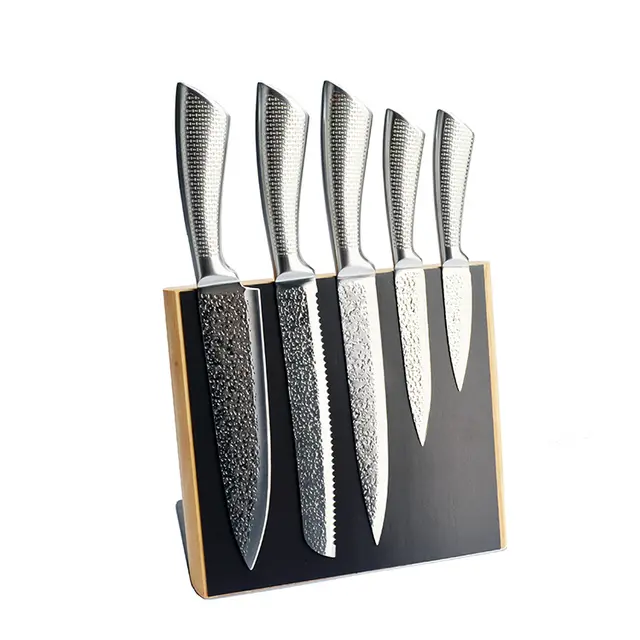
"Damascus" describes a blade construction or, in some products, a claimed decorative appearance. "Set" describes how products are bundled. A single chef knife can also have genuine Damascus construction.
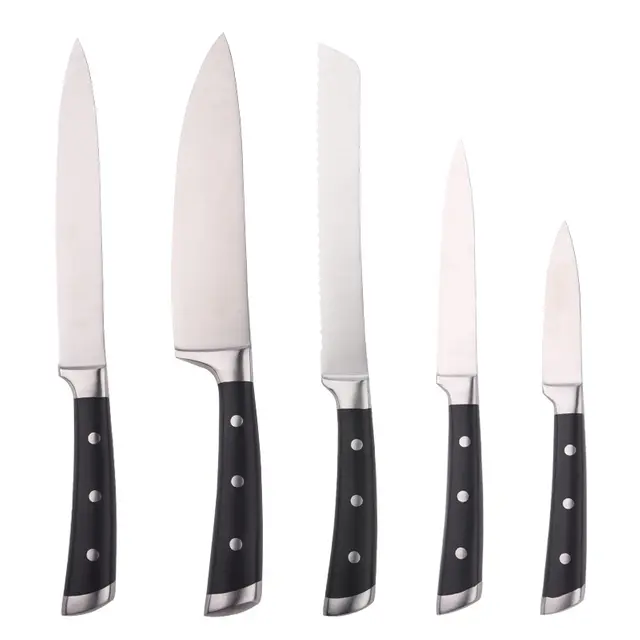
For a fair comparison, evaluate a Damascus set against a single chef knife with comparable materials, workmanship, and positioning.
| Buying consideration | Damascus knife set | Single chef knife |
|---|---|---|
| Best-fit opportunity | Gifting and coordinated collections | Entry products and focused launches |
| Selling proposition | Complete presentation and matching design | One clearly defined cutting tool |
| Initial inventory commitment | Often higher per sellable package | Often lower per sellable package |
| Quality-control scope | Multiple knives and accessories | One primary product |
| Packaging requirements | Larger, more complex presentation | More compact packaging |
| Expansion opportunity | Additional coordinated products | Matching knives and future bundles |
| Main commercial risk | Paying for pieces customers rarely use | Weak differentiation in a crowded category |
These are planning considerations, not universal market outcomes. Actual performance depends on your negotiated costs and customer response.
At HELLOKNIFE LTD, we recommend beginning with the buying brief rather than the blade pattern.
Our established product focus includes OEM cheese knives, cheese boards, and steak knives. This provides a useful starting point for brands developing coordinated kitchen and tabletop collections.
For any proposed Damascus project, buyers should confirm the exact manufacturing scope, available construction, sample specifications, and supporting documentation before making product claims.
A useful inquiry should include:
- Target country and sales channel.
- Intended customer and retail positioning.
- Preferred knife types and bundle configuration.
- Target landed cost and initial order quantity.
- Branding, packaging, and delivery requirements.
- Required material documentation and inspection criteria.
This approach makes quotations more comparable and reduces the risk of approving an attractive product that does not fit the business.
A single chef knife gives buyers one central benefit to communicate: a versatile cutting tool with a defined size, handle, steel specification, and intended user.
That focus can simplify product photography, demonstrations, packaging copy, and retailer training.
For a new private-label kitchen brand, a focused launch also makes feedback easier to interpret. If customers reject the product, you can investigate its price, weight, grip, or cutting performance without disentangling reactions to several different knives.
A single knife can require less inventory investment per sellable package than a comparable multi-knife set.
However, do not assume it always means a lower minimum order quantity. Custom handle materials, packaging, tooling, and production arrangements can each create separate minimums.
Ask suppliers to identify those minimums individually. A seemingly flexible knife order can become less flexible once custom packaging is included.
A successful chef knife can become the anchor of a broader collection.
Possible extensions include a utility knife, bread knife, steak knife set, or complementary serving product. For HELLOKNIFE LTD customers, cheese knives and cheese boards also offer opportunities to develop a coordinated brand appearance across preparation and entertaining categories.
Expand because customers demonstrate demand, not simply because additional products are available.
A coordinated Damascus knife set gives retailers a complete visual story.
Matching handles, consistent blade patterns, and carefully designed packaging can support gift-oriented positioning. This makes sets worth evaluating for corporate gifts, seasonal promotions, and premium kitchen collections.
Presentation alone is insufficient, however. Buyers still need a credible explanation of what each knife does and why the combination deserves its price.
A compact set can be commercially stronger than a larger assortment containing unnecessary pieces.
For example, a chef knife, utility knife, and paring knife offer clearly differentiated functions. A larger package needs an equally clear reason for every additional item.
Specify whether advertised piece counts include storage blocks, sheaths, sharpeners, or other accessories. Counting accessories as pieces without clear labeling can create avoidable disappointment.
Every additional component introduces another inspection point.
Buyers should check:
- Handle color and finish consistency.
- Blade markings and logo placement.
- Fit within trays, blocks, or protective sleeves.
- Edge protection during transportation.
- Availability of replacement components.
A set is one customer purchase, but it remains several manufactured items that must perform consistently together.
Genuine modern Damascus construction can involve multiple metal layers that create a visible pattern. Some knives use Damascus cladding around a separate cutting core.
A surface-applied pattern is not equivalent to layered construction.
For private-label Damascus knives, request a written specification covering the actual blade structure. Do not rely on photographs, the word "premium," or an unexplained layer count.
A high layer count does not independently establish superior cutting performance.
Buyers should examine the core steel, heat treatment, blade geometry, edge finish, and consistency of production samples. Different constructions require different evaluation criteria, so avoid treating every Damascus knife as technically identical.
Ask which claims the supplier can substantiate and which tests support them.
Descriptions such as "Japanese steel," "hand-forged," and "professional grade" need careful review.
Confirm what each statement means, what documentation supports it, and whether the wording accurately describes the finished product.
Trustworthy specifications are more valuable than dramatic claims that cannot survive a buyer's questions.
The most useful comparison is not selling price alone. It is contribution after the relevant variable costs.
Use this planning formula:
Contribution per unit = net selling revenue − landed product cost − variable selling costs − expected return and warranty allowance.
The following figures are hypothetical. They are not HELLOKNIFE LTD quotations, market averages, or forecasts.
| Illustrative assumption | Single chef knife | Damascus knife set |
|---|---|---|
| Net selling revenue | $50 | $130 |
| Landed product cost | $20 | $65 |
| Variable selling costs | $10 | $26 |
| Return and warranty allowance | $2 | $6 |
| Contribution per sold unit | $18 | $33 |
| Contribution as a share of revenue | 36% | Approximately 25.4% |
The set generates more contribution per sale in this example. The single knife produces a higher contribution percentage.
Inventory changes the picture again. At these assumed landed costs, 100 single knives require $2,000, while 100 sets require $6,500.
Neither result establishes the winner. Compare contribution over the same selling period, including how much inventory remains unsold.
Also remember that contribution is not net profit. Salaries, premises, development costs, and other fixed expenses still need to be covered.
Test one single chef knife and one compact Damascus set.
Keep the intended customer and quality tier reasonably aligned. Comparing an entry-level single knife against a luxury set mainly measures positioning differences, not the merits of bundling.
Create a sample checklist covering:
- Blade construction and declared materials.
- Dimensions, weight, and handle fit.
- Edge condition and cutting consistency.
- Surface finish and visible defects.
- Packaging protection and labeling accuracy.
Retain an approved reference sample for production comparisons.
Measure sell-through, realized contribution, customer acquisition cost where applicable, returns, defects, and reorder requests.
Record results separately by channel. A product that performs well with gift distributors may behave differently in a specialist kitchen store.
Choose your own approval thresholds before the pilot begins.
For example, require acceptable contribution, manageable returns, and evidence of repeat retailer interest. Do not invent a universal "good" conversion rate or assume one successful promotion proves lasting demand.
The aim is to replace preference with evidence.
No verified customer reviews were supplied for this article. Rather than manufacture testimonials, build a review-analysis process into the launch.
Group genuine feedback into practical themes:
| Feedback theme | What to investigate |
|---|---|
| "The knife feels heavy" | Weight, balance, and intended user |
| "The handle is uncomfortable" | Grip shape, dimensions, and finishing |
| "The set looks impressive" | Whether presentation also supports use |
| "The packaging arrived damaged" | Protective structure and shipping conditions |
| "I only use one knife" | Whether the bundle contains unnecessary pieces |
These are illustrative feedback categories, not actual customer quotations.
Use verified reviews with permission where required. Preserve context, disclose incentives, and avoid presenting exceptional experiences as typical results.
An effective B2B page should help a buyer evaluate the product before requesting a quotation.
Include a specification table, configuration options, packaging details, customization scope, and a clear inquiry route. Distinguish confirmed capabilities from options that require technical review.
Recommended visual placements include:
1. After the comparison table: a side-by-side photograph of the single knife and complete set, including packaging.
2. After the construction section: a clearly labeled blade cross-section diagram.
3. After the financial example: a chart comparing contribution and inventory commitment.
4. Near the inquiry form: a short sample-inspection video showing the actual proposed product.
Use accurate descriptive alt text rather than repeating keywords in every image.
A single chef knife is often the more manageable test product because it concentrates product development and messaging. Confirm that its production and packaging minimums fit your budget.
No. A higher selling price can accompany higher landed costs, shipping costs, and return exposure. Compare realized contribution and inventory turnover rather than revenue alone.
Yes. Damascus construction and product bundling are separate characteristics. A single Damascus chef knife can combine a focused assortment with a patterned-blade presentation.
Not by itself. Buyers should evaluate the actual construction, cutting core where applicable, heat treatment, geometry, finishing, and production consistency.
Request the blade specification, handle material, dimensions, branding method, packaging, order minimums, sample arrangements, delivery assumptions, and inspection requirements.
Only when their budget and channels justify the added complexity. Otherwise, validate one core product first and use the results to guide a coordinated expansion.
The practical choice is not "sets are better" or "single knives are better." It is the format that earns sustainable returns for your particular channel.
Send HELLOKNIFE LTD your target market, preferred configuration, estimated quantity, branding requirements, and target landed cost. Ask for a product-specific review of available specifications, customization options, samples, and quotation terms.
For established cheese knife, cheese board, and steak knife projects—or a proposed kitchen knife extension—start with a clear brief and confirm capabilities before committing.
Contact: sales@helloknife.com
1. HELLOKNIFE LTD — Company website and OEM product positioning
Supports the company's public positioning in custom cheese knives, kitchen knives, steak knives, knife sets, and OEM/ODM services. Company-owned information is not independent verification of every product claim.
[https://www.helloknife.com/] [helloknife]
2. HELLOKNIFE LTD — Kitchen And Knife: Expert OEM Solutions
Supports the stated focus on cheese knives, cheese boards, steak knives, customization, and overseas B2B buyers.
[https://www.helloknife.com/kitchen-and-knife-expert-oem-solutions-for-cheese-knives-cheese-boards-and-steak-knives-from-helloknife-ltd.html] [helloknife]
3. Shun Cutlery — Damascus, Tsuchime, and San Mai Edge
Explains layered Damascus construction and examples of Damascus layers surrounding a cutting core. It supports the construction discussion, not the performance of untested HELLOKNIFE products.
[https://shun.kaiusa.com/damascus-tsuchime-san-mai-edge] [shun.kaiusa]
4. Google Search Central — Creating Helpful, Reliable, People-First Content
Informs the editorial approach: useful buyer guidance, clear sourcing, transparent limitations, and avoidance of invented experience. Google states that E-E-A-T is not itself a specific ranking factor.
[https://developers.google.com/search/docs/fundamentals/creating-helpful-content] [developers.google]
5. Google Search Central — Google Search's Guidance About AI-Generated Content
Supports prioritizing original, high-quality, people-first content rather than treating the production method as a substitute for quality.
[https://developers.google.com/search/blog/2023/02/google-search-and-ai-content] [developers.google]
Hot Tags: China, Global, OEM, private label, manufacturers, factory, suppliers, manufacturing company


