


Views: 247 Author: HELLOKNIFE LTD Publish Time: 2026-10-15 Origin: Site


Content Menu
● What Is a Forged Kitchen Knife?
● What Is a Handmade Damascus Kitchen Knife?
● Forged vs Handmade Damascus: Performance Comparison
● Which Knife Holds Its Edge Longer?
● The Hidden Factor: Blade Geometry
● Expert Insight: What We See in OEM Production
● Maintenance: Which Knife Is Easier to Care For?
● How to Choose the Right Knife for Your Brand
● Final Verdict: Which Performs Better?
>> 1. Are handmade Damascus kitchen knives better than forged knives?
>> 2. Does the Damascus pattern improve cutting performance?
>> 3. Which type of knife is better for steak knives?
>> 4. Are Damascus knives hard to maintain?
>> 5. What HRC hardness is best for kitchen knives?
>> 6. Can HELLOKNIFE LTD produce custom OEM knife designs?
Forged kitchen knives and handmade Damascus kitchen knives can both deliver excellent cutting performance—but they excel in different ways. Forged knives usually offer superior toughness, balance, and durability for daily professional use, while handmade Damascus knives combine advanced edge performance with distinctive layered patterns and artisan value. The better choice depends on the steel core, heat treatment, blade geometry, and how the knife will actually be used.
As an OEM manufacturer of cheese knives, cheese boards, and steak knives, HELLOKNIFE LTD works with overseas brands, wholesalers, and producers to develop knives that balance performance, safety, appearance, and cost. From our factory-floor experience, the real question is not simply "forged versus Damascus." It is: which construction and steel specification best matches your target customer, price point, and intended kitchen task?
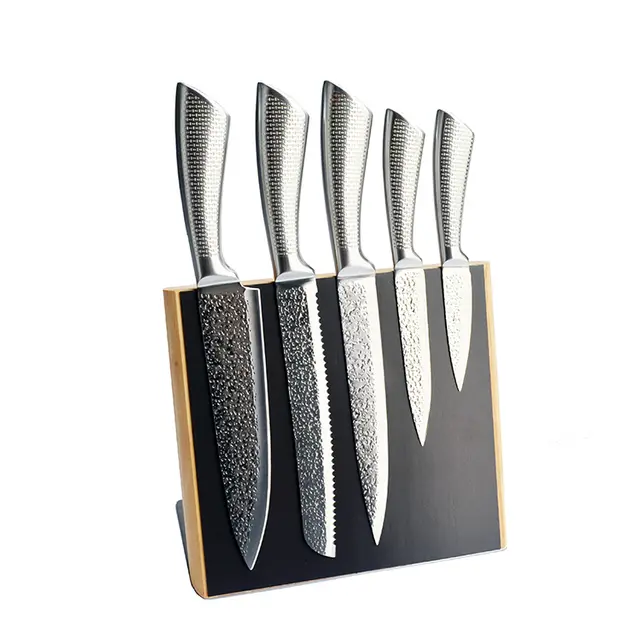
A forged kitchen knife is typically made from a single bar of steel that is heated, shaped under pressure, ground, heat-treated, and finished. Unlike a stamped blade, which is cut from a sheet of steel, a forged blade generally has a denser structure, a pronounced bolster, and a more substantial feel in the hand.
In practical terms, forged knives are often chosen for:
- Strength and toughness
- Balanced weight distribution
- A full tang or partial tang construction
- Consistent mass production for OEM programs
- Durability in busy home and commercial kitchens
For brands selling steak knives, cheese knives, or everyday chef knives, forged construction is often the safer default. It tolerates repeated washing, cutting boards, and less-than-perfect user habits better than many delicate premium blades.
A handmade Damascus kitchen knife is created by forge-welding multiple layers of steel, then folding, hammering, and shaping the billet to create the familiar flowing surface pattern. Many modern Damascus kitchen knives use a decorative layered cladding around a high-performance core steel, such as VG-10, AUS-10, or another hardened stainless or carbon steel.
The Damascus pattern is visually striking, but it is important to be clear with customers: the pattern itself does not automatically make a knife sharper. Performance depends mainly on the cutting core, heat treatment, edge angle, grind, and finishing quality.
A well-made handmade Damascus knife can offer:
- A very sharp, thin cutting edge
- Excellent food release
- Strong perceived value and gift appeal
- A premium look that supports higher retail pricing
- A unique appearance for limited-edition or branded collections
| Performance Factor | Forged Kitchen Knife | Handmade Damascus Kitchen Knife |
|---|---|---|
| Toughness | Usually higher, especially with stainless German-style steel | Varies; depends heavily on core steel and heat treatment |
| Edge retention | Good to very good, depending on steel | Often excellent when built around a hard core steel |
| Sharpness potential | Very good | Often exceptional with a thin, refined edge |
| Maintenance | Generally easier | Often needs more careful drying and oiling |
| Appearance | Clean, professional, versatile | Highly distinctive and premium |
| Best use case | Daily cooking, steak knives, commercial kitchens | Chef knives, gift sets, premium retail, collector lines |
| OEM scalability | Strong for consistent volume production | Strong for premium and differentiated product lines |
Edge retention is determined more by steel chemistry and heat treatment than by whether a knife is forged or Damascus. A harder steel generally holds a finer edge longer, but it is also more vulnerable to chipping when twisted, dropped, or used on bones or frozen food.
Kitchen knives commonly fall between roughly 55 HRC and 64 HRC on the Rockwell C hardness scale. Softer steels around the lower end are easier to maintain and more forgiving, while harder steels can retain a keen edge longer but require more careful handling.
For example:
- X50CrMoV15-style stainless steel is often used in forged Western knives because it offers a practical balance of corrosion resistance, toughness, and ease of sharpening.
- VG-10, frequently used as a Damascus knife core, is commonly specified around 60–62 HRC and is valued for strong edge retention and corrosion resistance.
- SG2/R2 powder steel can reach approximately 63–64 HRC, offering longer edge life but requiring more careful sharpening and handling.
Our expert view: For a steak knife or cheese knife intended for broad retail distribution, we usually recommend a well heat-treated forged stainless blade. For a premium chef knife or Damascus gift set, a hardened core steel with controlled edge geometry can justify the higher price.
Forged knives usually win on toughness. Their simpler single-steel construction, thicker geometry, and robust heat treatment make them better suited to heavy daily use.
Handmade Damascus knives can also be tough, but their performance depends on the entire build:
- The core steel determines much of the cutting performance.
- The cladding layers influence appearance and can contribute to the blade's overall character.
- The heat treatment determines whether the knife is resilient or brittle.
- The edge angle determines whether the knife slices cleanly or chips under stress.
A Damascus knife with a hard core can chip if a user cuts through pumpkin skin, hits a bone, twists the blade, or uses a glass cutting board. This is why HELLOKNIFE LTD advises brand owners to include clear usage guidance on packaging and product pages.
Many buyers focus only on steel, but blade geometry often affects cutting performance more than the forging method.
A thin blade with a refined edge will slice tomatoes, herbs, cheese, and cooked proteins more cleanly. A thicker blade may feel stronger, but it can wedge into dense food and create more friction.
For OEM development, we evaluate:
- Blade thickness behind the edge
- Edge angle
- Grind consistency
- Spine thickness
- Handle balance
- Bolster shape
- Tip strength
- Corrosion resistance
Two knives made from the same steel can perform very differently if one has a thin, well-ground edge and the other has a thick, poorly finished edge.
At HELLOKNIFE LTD, we produce and develop OEM knife programs for international brands, wholesalers, and producers. In our experience, successful products are not defined by a single "best" construction. They are defined by the match between product positioning and real-world use.
Forged stainless steak knives are usually the better commercial choice. They resist corrosion, survive repeated restaurant use, and maintain a dependable edge after professional sharpening.
Cheese knives need a different balance. A forged blade provides durability, while specialized features—such as holes to reduce sticking, forked tips, or open handles—improve function. The best cheese knife is not necessarily the hardest; it is the one that cuts cleanly without crushing soft cheese or cracking hard cheese.
This is where handmade Damascus kitchen knives perform strongly. A Damascus-clad blade with a quality core can create a premium product story, strong gift appeal, and higher perceived value.
Forged stainless knives are generally easier to maintain. They tolerate moisture better and require less specialized care.
Handmade Damascus knives, especially those with carbon-steel layers, need more attention. Moisture is the main enemy of carbon-based Damascus steel. After use, the blade should be rinsed, dried immediately, and lightly protected with food-safe oil when necessary.
Recommended care routine:
1. Hand wash with mild soap and warm water.
2. Dry immediately with a soft cloth.
3. Avoid dishwashers, prolonged soaking, and acidic food residue.
4. Store in a dry knife block, sheath, or magnetic rack.
5. Use a honing rod for routine alignment.
6. Sharpen with a whetstone when the edge becomes dull.
For brands, these care instructions should not be hidden in a manual. They should appear on the product page, packaging insert, and after-sales email sequence.
Use this simple decision framework:
- Choose forged kitchen knives if your priority is durability, consistent supply, lower service risk, and broad everyday appeal.
- Choose handmade Damascus kitchen knives if your priority is premium positioning, visual differentiation, gift-market appeal, and higher margins.
- Choose a Damascus-clad forged knife with a quality stainless core if you want both premium appearance and practical performance.
- Avoid choosing based on layer count alone. A high layer count does not guarantee better cutting performance.
For pure toughness and everyday reliability, forged kitchen knives usually perform better.
For sharpness potential, premium appearance, and gift-market value, handmade Damascus kitchen knives can perform better—provided the core steel, heat treatment, and grind are high quality.
The best answer for most brands is not to treat them as competitors. Use forged knives for dependable everyday lines and handmade Damascus knives for premium collections. That approach gives customers a clear choice while protecting your brand from unrealistic performance claims.
Looking for a reliable OEM partner for forged cheese knives, cheese boards, and steak knives? Contact HELLOKNIFE LTD to discuss custom blade steel, handle materials, packaging, private labeling, and product development for your market.
- Knife Depot — [Knife Steel Hardness & Rockwell Scale Explained]
- Gyuto Club — [Knife Steel & Hardness Guide: VG10, HRC & More Explained]
- Japanese Knife Lab — [Knife Edge Retention Explained: Steel, Geometry, and More]
- Best Chef Knife Reviews — [Knife Steel Chart 2026: Compare Common Blade Alloys]
- Tharwa Valley Forge — [Care and Maintenance of Damascus Steel]
- JW SteelCrafts — [Damascus Knives & Axes]
- New West KnifeWorks — [About Hand-Forged Damascus Chef Knives]
- HELLOKNIFE LTD — OEM manufacturing experience in cheese knives, cheese boards, and steak knives.

Not automatically. Handmade Damascus knives can be excellent, but performance depends on the core steel, heat treatment, edge geometry, and craftsmanship. A high-quality forged knife may outperform a poorly made Damascus knife.
The pattern mainly comes from layered steel and contributes to appearance. Cutting performance comes primarily from the core steel, heat treatment, grind, and edge angle.
Forged stainless steak knives are usually better for restaurants, retailers, and frequent use because they offer strong corrosion resistance, durability, and consistent performance.
They require more care than many forged stainless knives, especially if carbon steel is involved. Users should hand wash, dry immediately, avoid dishwashers, and occasionally apply food-safe oil.
For most kitchen applications, 58–62 HRC is a practical range. It provides a good balance between edge retention, toughness, sharpening ease, and resistance to chipping. [bestchefknifereviews]
Yes. HELLOKNIFE LTD provides OEM and ODM services for cheese knives, cheese boards, steak knives, and related kitchen products, including custom materials, finishes, branding, and packaging.
Hot Tags: China, Global, OEM, private label, manufacturers, factory, suppliers, manufacturing company


