

Views: 280 Author: Site Editor Publish Time: 2026-08-15 Origin: Site


Content Menu
● Why Stainless Steel Is a Strong Choice
● What a Stainless Steel Salad Servers Set Includes
>> Handle and Serving Head Connection
● Understanding Stainless Steel Grades
>> What the Grade Does Not Tell You
>> Matte Black
>> Gold, Brass, and Rose-Toned Finishes
>> Hammered and Textured Finishes
>> Long Servers
● Matching the Set to Your Salad Bowl
>> Glass Bowls
>> Wooden Bowls
>> Flat Handles
>> Textured or Engraved Handles
● Using Stainless Steel Salad Servers Effectively
>> Pasta Salad
>> Fruit Salad
>> Grain Bowls
>> Potato Salad
>> Cold Noodles
● Dishwasher Safety and Cleaning
>> Before Loading the Dishwasher
>> Choosing a Dishwasher Position
>> Hand Washing
● Preventing Corrosion and Discoloration
>> Dry Promptly
>> Keep Different Metals Separate
● Sustainable and Long-Term Considerations
● Buying for Restaurants and Catering
>> Choosing Servers That Are Too Short
>> Selecting an Oversized Set for a Small Kitchen
>> Assuming Colored Finishes Are Maintenance-Free
>> Using Metal Aggressively Against Delicate Bowls
● A Practical Pre-Purchase Checklist
>> What is the best stainless steel grade for salad servers?
>> Are stainless steel salad servers dishwasher-safe?
>> What length should salad servers be?
>> Can stainless steel salad servers scratch a bowl?
>> Are stainless steel servers suitable for hot food?
>> Which finish is easiest to maintain?
>> Can one set serve foods besides salad?
>> Is a heavy stainless steel set better?
>> How should stainless steel salad servers be stored?
>> How can water spots be prevented?
>> Are black or gold stainless steel servers durable?
>> Should restaurants use decorative stainless steel servers?
A stainless steel salad servers set is one of the most practical serving tools for a modern kitchen. It usually includes a large serving spoon and a matching serving fork, allowing you to toss, lift, portion, and present salads with greater control than ordinary tableware. Because stainless steel is strong, hygienic, and easy to clean, it has become a popular choice for everyday meals, dinner parties, restaurants, buffets, and outdoor entertaining.
A good set should do more than look attractive beside a salad bowl. It should feel balanced in the hand, reach the bottom of the bowl, handle both delicate greens and heavier ingredients, and remain easy to maintain after repeated use. The finish, steel grade, handle design, and connection between the handle and serving head all influence its long-term performance.
This article explains how to select, use, clean, style, and maintain a stainless steel salad servers set. It also explores the differences between polished, brushed, black, gold-toned, and mixed-material designs, helping you choose an option that matches both your cooking habits and your table setting.
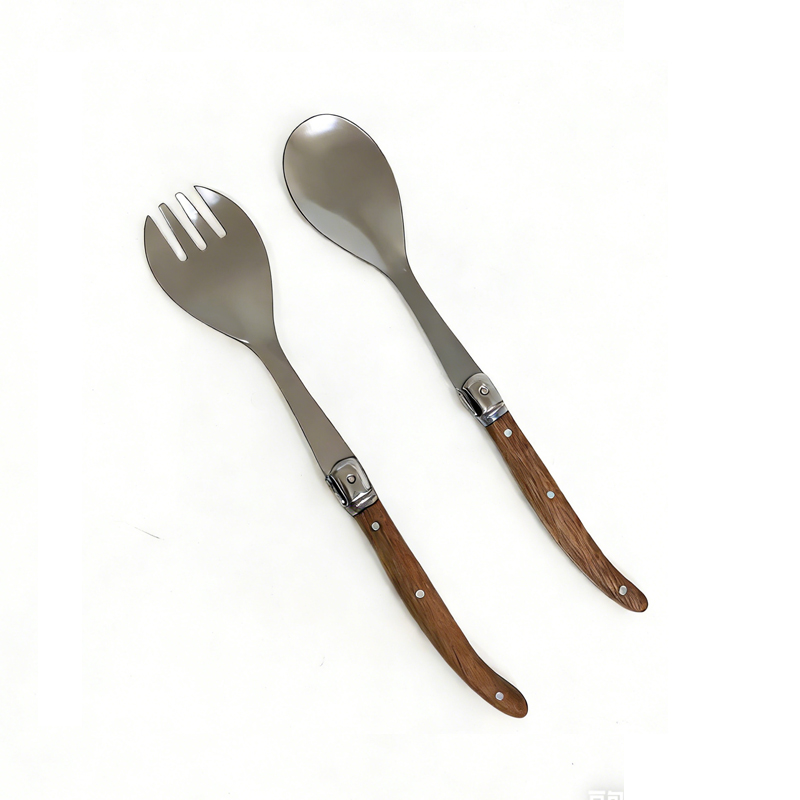
Stainless steel is an alloy that combines iron with chromium and, in many grades, nickel and other elements. The chromium content helps create a protective surface that resists staining and corrosion. The quality of the alloy still varies, however, so not every stainless steel salad servers set performs identically.
For everyday flatware, 18/10 stainless steel is often regarded as a premium option because it contains approximately 18 percent chromium and 10 percent nickel. The nickel contributes to corrosion resistance, shine, and a smoother appearance. Serious Eats identifies 18/10 stainless steel as a particularly durable and dishwasher-safe choice when weight and construction are also appropriate.
An 18/8 set can also perform well and may offer a balance between price and durability. An 18/0 set contains chromium but no nickel, which generally makes it more affordable and sometimes more magnetic. It can be suitable for budget-conscious buyers, although it may have lower resistance to staining and corrosion than higher-grade alternatives.
- Durability: Stainless steel resists bending, cracking, and ordinary kitchen wear.
- Low absorption: Unlike wood, it does not absorb oils, dressings, or food colors.
- Easy cleaning: Many classic stainless steel sets are dishwasher-safe.
- Neutral appearance: Silver-toned steel works with almost any bowl or tableware.
- Versatility: It can serve green salads, pasta salads, fruit, grains, vegetables, and noodles.
- Hygienic surface: A smooth, nonporous finish is easy to rinse and clean.
- Long service life: A well-made set can remain useful for many years.
Stainless steel is not perfect for every situation. It can feel heavier than nylon or plastic, especially in a large deep bowl. It may also scratch delicate ceramic finishes if dragged forcefully across the surface. Colored coatings such as black, gold, or rose tones may require gentler care than plain silver-colored steel.
The traditional set contains two pieces: a serving spoon and a serving fork. These pieces work together to move ingredients through a bowl without compressing them.
The spoon should have a broad, smooth bowl capable of lifting a useful portion. A shallow spoon is excellent for leafy greens, herbs, cucumber, and sliced vegetables because food releases easily. A deeper spoon is better for potato salad, bean salad, pasta, and grain-based dishes.
The spoon's edges should be rounded or smoothly finished. A rough or sharply squared edge can damage ingredients and make the utensil uncomfortable to use.
A serving fork usually has two or more wide tines. Its purpose is not to pierce food like an ordinary dinner fork. Instead, it supports, separates, and guides ingredients while the spoon carries them.
Wide tines are useful for lettuce, pasta, roasted vegetables, and fruit. Very narrow tines may allow smaller ingredients to fall through, while excessively sharp tines can tear delicate greens.
The joint is one of the most important quality details. A one-piece stainless steel design eliminates many weak points. Sets made from separate pieces may use welding, riveting, or another joining method.
Inspect the transition between the handle and serving head. It should look even, stable, and free from gaps where food residue could collect. A well-designed joint also makes cleaning easier.
The product description may list a grade such as 18/10, 18/8, 18/0, or 13/0. These numbers describe the approximate percentage of chromium and nickel in the steel.
This is commonly associated with premium flatware. It usually offers a bright finish, strong corrosion resistance, and a comfortable feel when the set is properly weighted. It is a good choice for households seeking a long-term stainless steel salad servers set.
18/8 steel contains approximately 18 percent chromium and 8 percent nickel. It can provide good resistance and attractive appearance, often at a slightly lower price than 18/10 products.
18/0 steel contains chromium but no nickel. It is often less expensive and may be magnetic. It can work well for casual kitchens, but it may be more vulnerable to discoloration or corrosion when exposed to harsh conditions.
13/0 steel is often used for certain knives because its properties can support hardness and edge retention. It is less commonly the first choice for a premium salad servers set, so buyers should examine the full product specifications rather than focusing only on the word "stainless."
Steel grade is important, but it does not determine everything. A thin, poorly balanced 18/10 set can feel less useful than a sturdy, well-designed 18/0 set. Thickness, weight, finish, handle shape, and construction quality also matter.
The finish affects both appearance and maintenance.
A mirror-polished set has a bright, reflective surface. It looks formal and coordinates easily with polished dinnerware. This finish can show fingerprints and water spots, but it is simple to refresh with a soft cloth.
A brushed finish has a softer, less reflective appearance. It suits contemporary kitchens and often hides minor fingerprints better than mirror polish.
The surface may show directional grain, so cleaning should follow the same direction when possible. Abrasive scrubbing can create visible marks.
Black stainless steel salad servers can create a dramatic contrast against pale ceramic bowls, white linens, or colorful salads. The black appearance may come from a surface coating or physical vapor deposition process rather than from black steel throughout.
Colored finishes need more careful handling. Avoid abrasive pads and strong chemicals, and check whether the manufacturer recommends hand washing.
Gold-toned and rose-toned sets can add warmth to a formal table. They are particularly attractive with cream plates, dark stoneware, linen napkins, and warm lighting.
These finishes can be more sensitive to scratching and fading. Some sellers recommend hand washing colored cutlery even when plain stainless steel is dishwasher-safe.
Hammered surfaces create visual interest and can make a simple salad set look artisanal. However, texture may require more attention during cleaning because dressing or food particles can remain in small recesses.
Most household salad servers are approximately 10 to 13 inches long. The ideal length depends on the bowl, the serving style, and the user's preferred handling.
Shorter servers work well with shallow bowls and compact tables. They are easy to control and store, but they may not reach comfortably into a deep bowl.
Medium-length models are the most versatile option for everyday kitchens. They generally offer sufficient reach without feeling unwieldy.
Long servers are appropriate for deep bowls, large family gatherings, and buffet service. They keep hands away from the food and bowl, but they may be inconvenient in a small container.
Before buying, measure the depth of your main salad bowl. The serving ends should reach near the bottom, while the handles should remain comfortably above the rim.
A stainless steel salad servers set can suit many bowl materials.
Polished stainless steel looks clean and elegant with glass. It allows the colors of lettuce, tomatoes, peppers, fruit, and herbs to remain the visual focus.
Ceramic offers the most flexibility. A silver-toned set creates a classic contrast, while black or gold finishes can coordinate with the bowl's glaze.
Handle the servers gently if the bowl has a fragile or decorative surface. Avoid sliding the metal aggressively against the base.
Metal servers create a pleasing contrast with natural wood. If the bowl is soft or has a delicate finish, use a light lifting motion rather than scraping.
Heavy stoneware pairs especially well with substantial stainless steel. A brushed finish can reinforce a relaxed, contemporary look, while polished steel provides a more formal contrast.
The handle is where you interact with the utensil most directly. A visually attractive set may still disappoint if it feels slippery, too thin, or poorly balanced.
Rounded handles feel natural and comfortable for most users. They are particularly suitable when salad is served regularly or when the utensil will be used for heavier dishes.
Flat handles offer a modern silhouette and may stack neatly in a drawer. Their comfort depends on edge finishing. Sharp corners can become uncomfortable during extended use.
Tapered designs may provide a refined appearance. Make sure the narrow section does not become too thin near the serving head, as this can reduce control.
Textured handles can improve grip and add decoration. However, deep grooves should be checked carefully because they may trap residue.
Hollow handles can reduce weight and material use. They may be comfortable, but inspect the sealed ends and joints to ensure water cannot enter or collect inside.
A quality set should feel balanced rather than simply heavy. The spoon should not constantly tip forward, and the fork should not feel too light compared with the spoon.
Flatware testing guides commonly emphasize generous dimensions, comfortable balance, and a handle shape that distributes weight naturally.
A salad servers set works best when used with a gentle lifting and turning technique.
Place the spoon beneath the ingredients. Use the fork to support the mixture from above or to guide loose pieces back toward the center. Lift from the bottom, turn the ingredients over, and release them softly.
This method helps distribute dressing without crushing the salad. It is especially important for fragile lettuce, ripe tomatoes, avocado, berries, and fresh herbs.
For lettuce-based salads, make wide, slow turns rather than pressing down. A broad spoon carries the greens, while the fork helps separate leaves and distribute toppings.
For pasta, potatoes, beans, or grains, use the spoon as the main lifting tool. The fork should stabilize the portion rather than bear the entire weight.
Tilt the spoon slightly while reaching the bottom. Avoid scraping the bowl repeatedly, especially if it has a delicate glaze or coating.
Allow excess dressing to drain for a moment over the bowl before transferring food to the plate. This reduces spills and helps create a neater serving.
A durable stainless steel salad servers set can perform many kitchen tasks.
Pasta salad contains heavier ingredients that demand firm construction. Look for a fork that does not flex excessively and a spoon deep enough to hold several pieces at once.
Stainless steel is easy to clean after contact with juice, berries, citrus, or melon. Use a smooth spoon and avoid pressing ripe fruit.
Quinoa, couscous, farro, rice, and bulgur can be difficult to lift with narrow utensils. A broad spoon gathers grains more effectively.
A strong spoon is essential for dense mixtures. A shallow edge can help portion the salad without crushing the potatoes.
Stainless steel is suitable for warm vegetables when the utensils are intended for hot food. Check the manufacturer's instructions if the servers have colored handles or decorative coatings.
Longer servers are useful for soba, rice noodles, pasta, and other chilled noodle dishes. Wide fork tines can separate strands without gripping too tightly.
Plain stainless steel is often dishwasher-safe, but "stainless steel" does not automatically guarantee that every design should go in a dishwasher.
Remove large pieces of food and rinse off acidic dressing, mustard, tomato, and oily residue. Avoid placing the servers where they will rub against sharp knives or rough cookware.
If the set has a colored finish, painted detail, wood component, glued joint, or decorative insert, consult the care instructions first.
Place the servers where they can remain separated from abrasive objects. If possible, position them so the serving heads do not strike other metal items during the wash cycle.
Mechanical contact can create micro-scratches over time, especially on dark or highly polished finishes. Some care guides therefore recommend hand washing when preserving the original finish is a priority.
Use warm water, mild dish soap, and a soft sponge. Rinse thoroughly and dry with a clean towel to reduce water spots.
Hand washing is especially advisable for black, gold, rose, or other coated designs. Plain polished stainless steel is usually more forgiving.
Avoid chlorine bleach, steel wool, abrasive powders, and aggressive scouring pads. These can dull the finish or damage a coating.
Do not mix cleaning chemicals. A simple mild detergent is usually sufficient for ordinary food residue.
A soft cloth can remove fresh water marks. For persistent mineral deposits, follow the manufacturer's recommended cleaner. Avoid applying acidic substances for long periods, particularly when the set has a decorative finish.
Stainless steel resists corrosion but can still develop marks under unfavorable conditions.
Do not leave the set wet in a sink overnight. Prolonged moisture can contribute to spotting, especially when water contains minerals.
Salt and salty dressing can be harsh when left on metal for a long time. Rinse the servers soon after use.
When possible, avoid prolonged contact with aluminum, silver, or reactive metals during washing and storage. Mixed-metal contact under damp conditions may contribute to discoloration.
A divided organizer prevents the servers from rubbing against knives and other utensils. If the set is decorative, a serving utensil rest or open container may be more suitable.
A reusable stainless steel salad servers set can replace disposable serving utensils and reduce dependence on lower-quality plastic products. Its long useful life also means fewer replacements.
When comparing products, consider the durability of the steel, the packaging, the repairability of handles, and the availability of replacement pieces. A simple one-piece design may be easier to keep in service than a complex model with several bonded components.
Packaging is another consideration. Minimal recyclable packaging can be preferable to excessive plastic or oversized boxes, especially when the set is purchased for everyday use rather than gifting.
A durable product is not automatically sustainable if it is quickly discarded because of poor balance, uncomfortable handles, or a finish that cannot be maintained. Long-term usability is one of the most practical sustainability features.
The serving utensils contribute to the overall appearance of the table.
Use polished or brushed steel with white plates, a clear bowl, and neutral napkins. This arrangement looks clean without requiring elaborate decoration.
Pair stainless steel with a wooden bowl, linen napkins, ceramic plates, and natural textures. Wood-handled stainless steel servers can soften the appearance.
Choose mirror-polished steel or a refined gold-accented set. Place the servers beside the bowl on a small rest to keep the table organized.
Black stainless steel creates a strong visual effect with white, gray, or pale stoneware. Keep the rest of the table simple so the contrast remains intentional.
Choose a sturdy, lightweight design that is easy to transport. Brushed steel is often more practical outdoors because minor marks are less noticeable than on a highly reflective surface.
Commercial kitchens need different priorities from home kitchens. A restaurant or catering business may require several identical sets, fast cleaning, and strong resistance to repeated use.
Choose models with simple construction, smooth joints, and clear dishwasher instructions. Avoid delicate decorative coatings if the servers will be washed dozens of times each week.
Length should match the serving bowls used in the establishment. Buffet bowls may be deeper and larger than household bowls, so longer servers may be appropriate.
A consistent design also improves presentation. Matching the servers across multiple stations creates a more professional appearance.
A polished product photograph cannot reveal whether the handle feels balanced or the fork flexes during use. Read specifications and consider the shape of the serving heads.
The phrase "stainless steel" covers many formulations. If longevity matters, look for a clearly stated grade such as 18/10 or 18/8.
Short utensils can make deep bowls frustrating to use. Measure the bowl before purchasing.
Very long servers may be difficult to store and awkward in a compact bowl. Choose a length that suits your actual serving habits.
Gold, black, and rose finishes may require hand washing even when plain stainless steel is dishwasher-safe.
A weak connection can become loose and difficult to clean. Inspect the construction carefully.
Stainless steel is strong, but the bowl may not be. Lift ingredients rather than scraping the surface.
Before selecting a stainless steel salad servers set, consider the following points:
- Steel grade: Is the alloy clearly identified?
- Length: Does it suit the depth of your bowl?
- Weight: Does it feel substantial without being tiring?
- Balance: Do the spoon and fork feel controlled?
- Serving head: Is the spoon broad enough and the fork strong enough?
- Finish: Will polished, brushed, black, or gold suit your table?
- Care: Is the set dishwasher-safe?
- Joint: Is the connection smooth and secure?
- Storage: Will it fit your drawer or utensil holder?
- Use: Can it handle the salads and side dishes you prepare most often?
This checklist helps separate attractive but impractical products from sets that will genuinely improve daily serving.

For buyers seeking durability and corrosion resistance, 18/10 stainless steel is often a strong choice. 18/8 can also perform well, while 18/0 is generally a more budget-oriented option. Grade should be considered together with thickness, balance, finish, and construction.
Many plain stainless steel sets are dishwasher-safe. However, colored finishes, wood handles, glued joints, and decorative coatings may require hand washing. Always check the manufacturer's instructions before using a dishwasher.
Most household users will find approximately 10 to 13 inches practical. Choose shorter servers for shallow bowls and longer models for deep bowls, large gatherings, or buffet service.
They can scratch delicate surfaces if dragged forcefully. Use a lifting and turning motion, and take extra care with glass, glazed ceramic, and coated bowls.
Many are suitable for warm side dishes, roasted vegetables, and other hot foods, but the exact answer depends on the product's design and finish. Coated handles may have lower heat tolerance.
Plain polished or brushed stainless steel is generally easier to maintain than black, gold, rose, or other coated finishes. Colored finishes may need hand washing and soft cleaning tools.
Yes. A strong set can serve pasta salad, fruit, potato salad, grains, noodles, beans, roasted vegetables, and other side dishes.
Not necessarily. A well-balanced set is more important than maximum weight. Excessive weight may become uncomfortable, while a very light set may feel less stable.
Store them in a dry drawer organizer or utensil container. Keeping them separated from sharp knives and rough metal objects helps prevent scratches.
Rinse away food residue, avoid leaving the set wet, and dry it with a soft towel after washing. This is especially helpful in areas with hard water.
They can be durable when the coating is high-quality and properly maintained. Abrasive cleaners, rough dishwasher contact, and metal-to-metal friction may damage the finish.
Restaurants can use decorative designs in front-of-house settings, but simple, robust, easily cleaned models are usually better for high-volume service and commercial dishwashing.
The best stainless steel salad servers set combines suitable steel, comfortable balance, useful length, smooth construction, and care requirements that fit your lifestyle. An 18/10 set is a strong long-term choice for many households, while 18/8 and 18/0 options can serve different budgets and usage patterns.
Plain polished or brushed steel is practical for daily use. Black, gold, and rose finishes offer more decorative impact but may require extra care. The most important purchasing decision is not simply choosing the most attractive design; it is selecting a set that works naturally with your bowl, your food, your storage space, and your cleaning routine.
A carefully chosen set can improve both the practical and visual side of dining. It makes salad easier to toss, portions cleaner to serve, and the table more coordinated without adding unnecessary complexity.


