


Views: 267 Author: HELLOKNIFE LTD Publish Time: 2026-11-16 Origin: Site


Content Menu
● Kitchen Knife Block vs Self Sharpening Knife Block: Key Differences
● How Does a Self-Sharpening Knife Block Work?
>> Ceramic Inserts Provide Guided Edge Contact
>> Honing and Sharpening Are Different
● Are Self-Sharpening Knife Blocks Worth the Extra Cost?
>> When Paying More Makes Sense
>> When a Conventional Block Is Better Value
● Compare Total Ownership Cost, Not Just Purchase Price
>> An Illustrative Five-Year Calculation
● Knife Compatibility: The Detail Buyers Often Overlook
>> Straight-Edge Kitchen Knives
>> Serrated Steak Knives and Bread Knives
>> Cheese Knives and Specialty Blades
● What Customer Ratings Can—and Cannot—Tell You
● A Practical Pre-Purchase Inspection Checklist
>> 1. Confirm the Actual Knife Selection
>> 3. Check Countertop Clearance
>> 4. Review Cleaning Instructions
>> 5. Ask About Replacement Support
● How to Care for a Self-Sharpening Knife Block
● An OEM Manufacturer's Perspective: Specify the System Before the Story
● Final Verdict: Buy the Right Maintenance System
>> 1. Are self-sharpening knife blocks suitable for every knife?
>> 2. Can a self-sharpening block sharpen serrated steak knives?
>> 3. Do self-sharpening blocks remove metal?
>> 4. Will I still need professional sharpening?
>> 5. Can I wash a self-sharpening knife block?
>> 6. Which option is better for private-label knife sets?
At HELLOKNIFE LTD, we believe knife storage should support the knives you own—not force you into a maintenance system you do not need. As a China-based OEM manufacturer serving overseas brands, wholesalers, and manufacturers with cheese knives, cheese boards, steak knives, and kitchen cutlery, we approach the kitchen knife block vs self sharpening knife block debate from a product-design perspective. [helloknife]
Our answer: a self-sharpening knife block can justify its premium when convenience matters and every blade matches its designated slot. A conventional block is usually the more flexible choice for mixed knife collections and owners who prefer separate sharpening tools.
The real question is not whether built-in sharpening sounds useful. It is whether the complete system fits your knives, habits, and long-term budget.

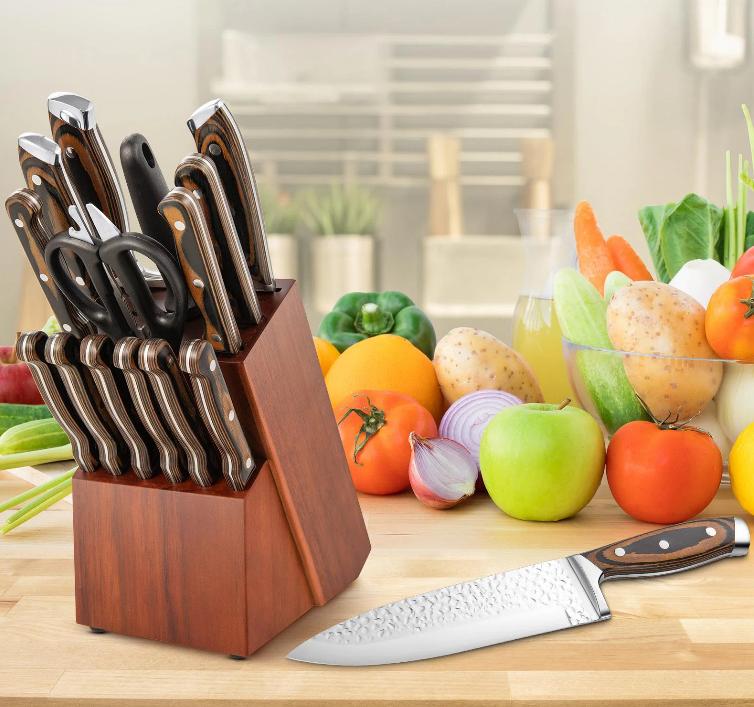
A conventional knife block provides organized storage. A self-sharpening version combines storage with built-in edge-maintenance components. ZWILLING describes ceramic stones inside designated slots, while Calphalon's SharpIN system sharpens compatible straight-edge knives when they are removed. Exact operation varies by model.
| Buying consideration | Conventional knife block | Self-sharpening knife block |
|---|---|---|
| Primary purpose | Storage and organization | Storage plus integrated edge maintenance |
| Maintenance method | Separate tools or professional service | Built-in mechanism, with additional care as needed |
| Knife compatibility | Depends on slot dimensions | Depends on dimensions and sharpening geometry |
| Sharpening control | Determined by your chosen tool or service | Largely determined by the block |
| Replacement flexibility | Check whether replacement knives fit | Check both fit and mechanism compatibility |
| Best starting point | Mixed collections and hands-on owners | Matched sets and convenience-focused owners |
Neither category automatically guarantees better knives. Evaluate blade quality, handle comfort, useful knife selection, and after-sales support separately from the block's headline feature.
The sharpening components sit inside specific knife slots. During the movement specified by the manufacturer, the blade contacts those components at a predetermined angle.
ZWILLING recommends knives specifically designed for its blocks because slot dimensions and sharpening mechanisms vary. Calphalon specifically describes its system as working on straight-edge kitchen knives. These details matter more than a broad "self-sharpening" label.
Think of the block and knives as a matched system, not a universal sharpener.
Honing generally maintains or realigns an existing edge. Sharpening removes steel to create a renewed cutting edge. WÜSTHOF distinguishes these functions in its maintenance guidance.
Product descriptions sometimes use both terms for integrated systems. Read the actual instructions rather than assuming every block performs identical work.
Also, routine maintenance is not the same as repairing damage. Do not assume a storage block can correct chips, restore a badly worn profile, or replace every form of professional sharpening.
A compatible system deserves consideration when:
- You want a coordinated knife set.
- You rarely maintain knives with separate tools.
- You prefer a repeatable, guided routine.
- You are comfortable using designated slots.
- You have checked replacement and cleaning arrangements.
The appeal is reduced friction: edge maintenance becomes part of taking a knife out or putting it away.
However, convenience is valuable only when the product suits its owner. A mechanism that does not match your knives is not an upgrade.
Start with conventional storage when:
- You already own knives from several brands.
- You want control over sharpening methods.
- You expect to replace individual knives over time.
- Your collection includes specialty blade shapes.
- You already have a maintenance routine that works.
For these buyers, separating storage from sharpening can simplify future choices.
Our product-selection recommendation is straightforward: choose the knives first, then choose storage and maintenance around them.
A meaningful self-sharpening knife block cost comparison must separate the block's premium from differences in the knives themselves.
Comparing a basic set with a more expensive set containing different steel, handles, and knife sizes does not isolate the value of built-in sharpening.
The following figures are hypothetical, not market averages or supplier quotations.
| Five-year expense | Conventional setup | Self-sharpening setup |
|---|---|---|
| Initial purchase | $120 | $190 |
| Separate maintenance tool | $30 | $0 assumed |
| Additional servicing allowance | $40 | $40 |
| Illustrative total | $190 | $230 |
In this example, the convenience premium is $40 over five years, or $8 annually.
Change the assumptions and the result changes. Someone who already owns sharpening equipment may see less financial benefit. A buyer who strongly values convenience may consider the premium reasonable.
Before purchasing, ask:
1. Am I comparing similar-quality knives?
2. Which maintenance costs genuinely disappear?
3. Can worn sharpening components be replaced?
4. What happens if one knife breaks or goes missing?
ZWILLING notes that replaceable sharpening mechanisms are model-dependent, making this an important ownership question.
Check the approved knife list, not just blade length.
A knife that physically enters a slot is not necessarily compatible with its sharpening geometry. Manufacturer guidance should determine which knives belong in the system.
For OEM projects, our recommendation is to document the intended knife-and-slot combinations before finalizing packaging or marketing claims.
Most self-sharpening blocks are designed around straight-edged knives. ZWILLING states that serrated knives typically require a different sharpening method.
This distinction is especially important for steak knife sets.
A set may include serrated steak knives without sharpening those knives in the block. Buyers should distinguish between:
- A slot that stores a knife.
- A slot that actively maintains its edge.
- A slot intended only for a particular blade.
Avoid assuming every piece benefits equally from the advertised feature.
Cheese tools can have unusual profiles, including perforated blades, forked tips, and broad spreading shapes. HELLOKNIFE's product range includes purpose-designed cheese knives alongside kitchen and steak knives. [helloknife]
Our recommendation is not to place specialty tools into sharpening slots unless compatibility is explicitly confirmed. For a coordinated cheese board collection, dedicated storage may be the more appropriate design choice.
Manufacturer listings can offer useful social proof. ZWILLING's category page displays customer ratings for several self-sharpening sets. However, those ratings describe complete products, not a controlled comparison of sharpening mechanisms.
A rating alone cannot establish:
- How much sharpness improved.
- Whether the block caused that improvement.
- How the system performed after years of use.
- Whether the reviewer used compatible knives correctly.
When evaluating reviews, look for specific ownership details: length of use, knife replacement experience, cleaning access, and performance after repeated maintenance.
For brands, the same standard applies to publishing testimonials. Use verified comments with permission, and preserve their original meaning. Do not turn a general statement such as "easy to use" into an unsupported claim about superior edge retention.
Before choosing either system, assess how it will work in your kitchen.
List the knives you use regularly. A larger piece count is not automatically better value if several pieces duplicate tasks.
Identify which slots sharpen and which only store. Confirm the placement of serrated knives and shears.
Measure the footprint and the space needed to withdraw the longest knife, especially beneath cabinets.
Look for clear guidance covering both the exterior and internal mechanism. ZWILLING advises wiping the exterior with a damp cloth, avoiding immersion and dishwashers, and following model-specific internal cleaning instructions.
Check availability of individual knives, inserts where applicable, and care documentation.
Integrated sharpening does not eliminate care requirements.
Follow this routine:
1. Use only approved knives in sharpening slots.
2. Follow the specified insertion or withdrawal motion.
3. Do not force a blade that catches.
4. Follow knife-washing instructions and dry before storage.
5. Clean the block using its manufacturer's method.
6. Inspect knives periodically rather than assuming storage guarantees sharpness.
WÜSTHOF recommends hand-washing knives after honing or sharpening to remove excess steel. For integrated systems, check how the manufacturer instructs you to handle cleaning after abrasive contact.
If cutting performance deteriorates, seek appropriate maintenance instead of repeatedly pulling the blade through the mechanism without guidance.
At HELLOKNIFE LTD, our editorial recommendation for overseas brands and wholesalers is to define the user experience before writing a premium-feature claim.
For a proposed knife-and-block project, the specification should address:
- Intended blade types and approved combinations.
- Slot identification and user instructions.
- Sharpening-component specifications.
- Block stability and knife access.
- Cleaning and replacement arrangements.
- Packaging claims and supporting evidence.
These are recommended development checkpoints, not claims that every HELLOKNIFE product includes integrated sharpening.
A useful validation plan would compare cutting performance before and after repeated maintenance cycles, inspect edge condition, and assess usability across representative samples. Any published claim should identify the tested model and conditions.
That approach creates a stronger product story than promising that a set "never needs sharpening."
A self-sharpening knife block is worth considering when you want a matched set and a convenient maintenance routine. A conventional block is often the better fit when flexibility, specialty knives, or independent sharpening control matter more.
For brands, the stronger commercial opportunity is not simply adding a feature. It is matching the knife, storage, instructions, and customer expectations.
Planning a private-label knife collection? Contact HELLOKNIFE LTD at sales@helloknife.com with your target market, knife assortment, storage concept, and price positioning. Ask for an OEM discussion covering product compatibility, branding, packaging, and sample requirements. Integrated-sharpening requirements should be assessed specifically rather than assumed.
No. Compatibility depends on the block's slot dimensions and sharpening mechanism. Use the knives approved for that system.
Usually not through standard straight-edge sharpening slots. Confirm whether the steak knife slots provide sharpening or storage only.
Systems that sharpen abrasively can remove steel. Honing and sharpening are different processes, so check the mechanism and manufacturer's explanation rather than relying on the product name.
Possibly. Maintenance needs depend on use, blade condition, and the system. Do not interpret built-in maintenance as a guarantee against future repair or sharpening.
Follow its instructions. ZWILLING advises against immersion and dishwasher cleaning and recommends a damp cloth for the exterior.
Choose according to the target customer. Conventional storage prioritizes independent maintenance choices; integrated systems require closer attention to compatibility, instructions, and replacement support.
- HELLOKNIFE LTD. "OEM Knife Manufacturer for Brands, Gifts & Retail Chains." Official company website; used for company positioning, product categories, OEM services, and contact information. [helloknife]
- HELLOKNIFE LTD. "About Us." Official mobile company website; used for the listed product scope, including cheese boards. [m.helloknifechina]
- ZWILLING. "Self Sharpening Knife Sets & Blocks." Official category page and FAQs; used for ceramic mechanisms, compatibility, serrated-blade limitations, cleaning, component replacement, and the limits of displayed customer ratings. [zwilling]
- Calphalon. "Self-Sharpening Knife Sets." Official product-category page; used for the SharpIN ceramic-sharpener description and straight-edge application. [calphalon]
- WÜSTHOF. "How To Sharpen Your WÜSTHOF Knives." Official care guide; used for honing versus sharpening and post-maintenance washing guidance. [wusthof]
- HELLOKNIFE. "Cheese Knife Manufacturer." Official category resource; used for specialty cheese-knife compatibility context. [helloknife]
Hot Tags: China, Global, OEM, private label, manufacturers, factory, suppliers, manufacturing company


