


Views: 255 Author: HELLOKNIFE Publish Time: 2026-11-24 Origin: Site


Content Menu
● Premium Cheese Accessories vs Entry-Level Products in 2026: The Essential Differences
● Start With HELLOKNIFE LTD: Define the Product Before the Price
● Cheese Knife Performance: Geometry Matters More Than Piece Count
>> Match each blade to the cheese
>> Specify steel and construction precisely
● Premium Cheese Boards: Evaluate Construction, Not Just Appearance
>> Distinguish serving features from practical value
● Food-Contact Safety Is a Baseline, Not a Premium Upgrade
● A Practical OEM Sample-Testing Protocol
>> Step 1: Compare equivalent configurations
>> Step 2: Test representative cheeses
>> Step 3: Follow the proposed care instructions
>> Step 4: Review packaging and repeatability
● Compare Total Cost, Not Just Factory Price
● Turn Customer Reviews Into Better Specifications
● Build a Good–Better–Best Range Without Wasteful Complexity
>> Good: Essential everyday function
>> Better: Noticeable usability improvements
>> Best: A complete premium experience
● Request an OEM Proposal Built Around Your Market
>> 1. Are premium cheese accessories always better?
>> 2. What should an OEM buyer upgrade first?
>> 3. Are more cheese knives better?
>> 4. Can wooden cheese boards go in the dishwasher?
>> 5. What documents should buyers request?
>> 6. How should brands substantiate premium claims?
At HELLOKNIFE LTD, we help overseas brands, wholesalers, and manufacturers develop OEM cheese knives, cheese boards, and steak knives. When comparing Premium Cheese Accessories vs Entry-Level Products in 2026, our starting point is simple: a higher price should purchase a better-defined product, not merely a more impressive presentation.
For buyers building private-label collections, the real differences appear in cutting performance, board construction, comfort, care requirements, and production consistency.
Entry-level products can offer excellent value. Premium products can justify stronger positioning. Neither category succeeds without a clear understanding of the customer.
This guide explains where an upgrade matters, where spending adds little value, and how to translate your positioning into a practical OEM specification.

"Premium" is not a standardized quality grade for cheese accessories. Buyers need to define what the term means for their own range.
A useful distinction is that entry-level products prioritize essential function and accessible pricing, while premium products should deliver meaningful improvements in performance, finish, usability, or presentation.
| Buying factor | Entry-level approach | Premium approach worth paying for |
|---|---|---|
| Cheese knives | Essential shapes and straightforward construction | Geometry matched to cheese textures and refined handling |
| Cheese boards | Practical serving surface | Better-controlled finish, flatness, detailing, and storage |
| Handles | Functional grip | Comfortable contours and carefully finished transitions |
| Product range | Limited customization | Coordinated materials, branding, and presentation |
| Packaging | Basic protection and identification | Protective packaging with clearer gifting appeal |
| Quality control | Defined essential requirements | More demanding cosmetic and functional acceptance criteria |
These are purchasing frameworks, not guarantees. A simple, well-made set can outperform an expensive collection with poorly chosen tools.
HELLOKNIFE LTD is a China-based OEM manufacturer serving international buyers across cheese knives, cheese boards, steak knives, and related kitchenware.
Our recommendation is to begin with the intended selling channel rather than a reference photograph alone.
A supermarket promotion, specialist cheese shop, restaurant supplier, and corporate gifting business may need very different products—even when all four request a "cheese board set."
Before requesting quotations, define:
- Your target customer and destination market.
- The intended retail price and purchasing budget.
- Whether the product is primarily for serving, cutting, gifting, or hospitality.
- Required materials, branding, packaging, and care instructions.
- Expected use frequency and cleaning conditions.
This brief helps your OEM partner recommend relevant options. It also makes competing quotations easier to compare.
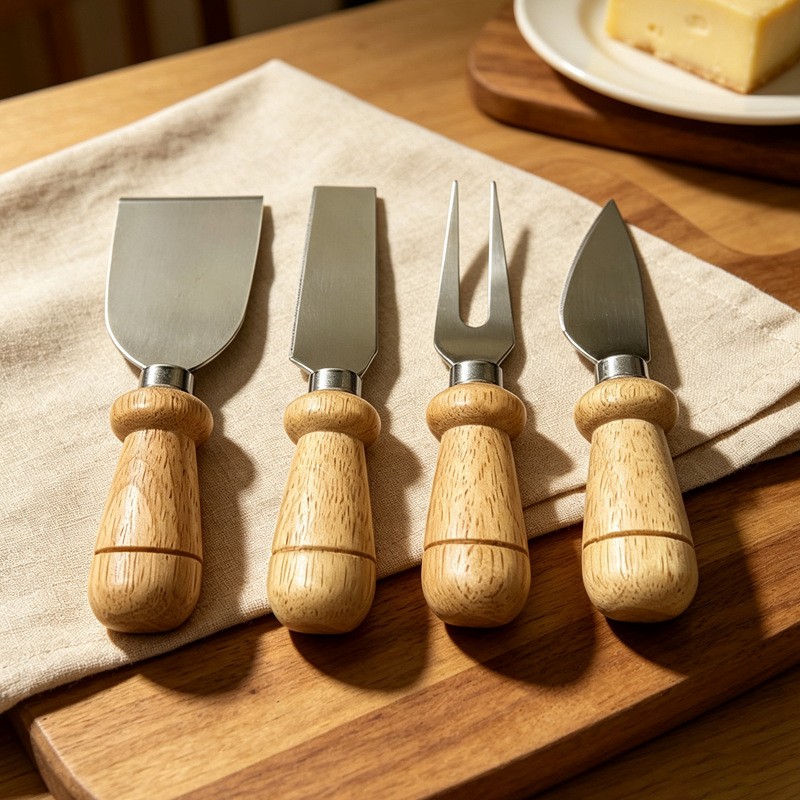
A cheese knife set should solve different cutting tasks, not simply contain several attractive shapes.
Soft cheeses such as Brie benefit from blades designed to limit contact and sticking. Narrow profiles or cutouts can help, although results also depend on the cheese's temperature and texture.
Firm cheeses need controlled slicing. Hard, aged cheeses may require a short, sturdy tool for breaking off portions. Spreadable cheeses need a suitable spreader rather than an unnecessarily sharp blade.
For many collections, a focused combination works well:
- A soft-cheese knife.
- A firm-cheese knife.
- A hard-cheese tool or spreader, selected for the audience.
More pieces are useful only when they add distinct functions.
"Stainless steel" describes a broad material category. It does not, by itself, establish edge quality, corrosion performance, or suitability for a particular blade.
Ask suppliers to identify the steel specification and explain how it fits the intended use.
For cutting blades, also discuss heat treatment where applicable, edge finishing, blade thickness, and inspection methods.
Avoid assuming that the highest hardness or thickest blade is automatically best. A spreader and a hard-cheese knife have different jobs.
Premium value comes from appropriate engineering and consistent execution—not technical language added to a product listing.
Wood species influences appearance and care, but species alone does not establish overall quality.
Inspect the actual board for:
- Flatness and stability.
- Smooth edges and comfortable handling.
- Open joints, cracks, splinters, or rough areas.
- Consistent finishing.
- Accessible corners and compartments.
- Clear cleaning and maintenance instructions.
Natural variation is normal. Structural defects and poorly finished food-contact surfaces are different issues.
A darker board is not automatically more luxurious, and a thicker board is not automatically more durable.
Drawers, ceramic dishes, grooves, and hidden tool compartments can improve a set. They can also add weight, cleaning effort, and production complexity.
Evaluate each feature against its purpose.
Does the drawer open smoothly? Can the compartment be cleaned? Does the board remain stable when loaded? Are knives restrained during transport?
For a compact retail range, a well-proportioned board with three useful tools may offer a better experience than a larger set crowded with accessories.
Premium and entry-level accessories both need to meet applicable requirements in their destination markets.
For EU-bound products, food-contact materials fall under the general framework of Regulation (EC) No 1935/2004 and relevant good manufacturing practice requirements. Additional material-specific or national rules may also apply.
Buyers should therefore request documentation appropriate to the actual product, material, and intended conditions of use.
A useful review should establish:
1. Which finished item or component the document covers.
2. Whether its material matches the proposed production specification.
3. Which requirements and test conditions were assessed.
4. Whether coatings, adhesives, inks, and other relevant components are addressed.
5. How production batches remain traceable.
Do not treat a generic "food-safe" statement as a substitute for product-specific assessment.
Similarly, the FDA Food Code is a model for retail and food-service practices. It is not a universal certification awarded to individual cheese boards.
Product photographs cannot show whether a handle becomes uncomfortable or a drawer catches after cleaning.
Use the same evaluation process for every shortlisted sample.
Keep the comparison fair. Record dimensions, materials, tool count, packaging, and intended care method.
Otherwise, you may mistake a larger set for a better-made one.
Use a soft cheese, a firm cheese, and a hard cheese appropriate to the tools supplied.
Keep conditions consistent. Record sticking, control, effort, crumbling, and grip comfort.
Wash and dry samples as directed. Inspect blade surfaces, handle connections, board joints, and moving parts.
Do not assume dishwasher suitability from appearance or material alone. Any dishwasher claim should be supported for the complete product.
Check blade restraint, abrasion protection, component movement, and unpacking safety.
Finally, convert observations into measurable acceptance criteria. Keep an approved reference sample so later inspections have a clear comparison point.
A lower quotation does not necessarily produce a more profitable SKU.
Your purchasing decision should consider total landed cost, packaging efficiency, inspection expense, and potential after-sales costs.
A practical framework is:
Product cost + customization + packaging + freight and duties + inspection + expected after-sales expense.
Consider this hypothetical example—not HELLOKNIFE pricing or customer performance data:
| Cost per sellable set | Entry-level option | Premium option |
|---|---|---|
| Landed product cost | $8.00 | $11.00 |
| Assumed after-sales allowance | $0.80 | $0.30 |
| Combined planning cost | $8.80 | $11.30 |
The premium option still costs more. The decision depends on whether its customer value supports the required selling price and margin.
Do not assume an upgrade will reduce returns. Test that assumption using your own sales and after-sales records.
Verified customer feedback can reveal weaknesses that a specification sheet misses. However, individual comments need context.
Without authenticated reviews, statements such as "customers love our durability" should not appear as evidence.
Instead, classify genuine feedback into actionable themes:
| Feedback theme | Question to investigate | Possible specification response |
|---|---|---|
| Uncomfortable handle | Which grip or edge causes discomfort? | Revise contour and finish criteria |
| Cheese sticking | Is the tool suitable for that cheese? | Review geometry and usage guidance |
| Difficult cleaning | Where does residue collect? | Simplify recesses or improve access |
| Board damage | When and how did damage occur? | Review construction, care, and packaging |
| Disappointing gift presentation | Which expectation was unmet? | Improve imagery, layout, or protection |
Separate product defects from shipping damage, unclear instructions, and mismatched expectations.
Then check patterns against sales volume. Ten complaints mean something different across one hundred orders than across ten thousand.
A tiered range works best when each level has a distinct reason to exist.
Choose useful tools, straightforward packaging, and clear care instructions. Protect basic safety and functional quality rather than cutting these to reach a price.
Invest in grip comfort, finishing, board proportions, and coordinated presentation. These improvements should be visible or demonstrable.
Add distinctive design, refined detailing, stronger gifting presentation, and tighter acceptance criteria where commercially justified.
Maintain a recognizable brand identity across the range.
For buyers also sourcing private-label steak knives, coordinated handles and packaging can create a coherent collection. However, shared styling should not replace product-specific cutting requirements.
The right choice is not premium at every opportunity. It is the product specification that fits your customer, channel, and margin.
Send HELLOKNIFE LTD a sourcing brief covering your target market, intended retail price, estimated order quantity, preferred materials, branding, and packaging.
Request two comparable proposals: an entry-level configuration and a premium alternative, with the differences clearly itemized.
Evaluate samples against the same checklist before approving your production specification.
No. Premium accessories are worth more when their design, construction, or presentation improves the intended experience. A simple, well-made entry-level set may be the better purchase for occasional use or price-sensitive retail.
Start with the weakest part of the user experience. Cutting geometry, comfortable handles, sound board construction, and protective packaging usually deserve attention before decorative extras. Use sample testing to identify the priority.
Not necessarily. Tool selection should reflect the cheeses customers serve. Three complementary tools can be more useful than six similar ones. Explain each tool's purpose through packaging or product-page guidance.
Do not assume so. Follow the instructions for the specific board. Many wooden boards require hand washing and prompt drying. For example, Schmidt Brothers specifies hand washing and no soaking for its Beacon board.
Request material specifications, relevant food-contact compliance evidence, care instructions, traceability information, and agreed inspection criteria. Requirements depend on the destination market and product construction; there is no single document that answers every compliance question.
Replace vague descriptions with verifiable details: named materials, dimensions, defined finishes, demonstrated functions, and relevant test results. Claims such as dishwasher-safe, responsibly sourced, or exceptionally durable need evidence appropriate to their scope.
The article's OEM evaluation frameworks, comparison tables, and hypothetical cost example are editorial recommendations, not published industry benchmarks. No customer testimonials or proprietary factory test results have been represented as verified evidence.
1. HELLOKNIFE LTD — "OEM Knife Manufacturer for Brands, Gifts & Retail Chains." Company-reported background, product categories, and OEM/ODM positioning. [helloknife]
2. HELLOKNIFE LTD — "Cheese Board with Knives." Company-reported cheese-board range and customization services. [helloknife]
3. Opinel USA — "Cheese Knives Guide: Shapes, Uses, What Actually Matters." Reference for knife geometry, cheese textures, materials, and care. [opinel-usa]
4. USDA Food Safety and Inspection Service — "Cutting Boards." Guidance on washing, maintenance, and replacing excessively worn boards. [fsis.usda]
5. U.S. Food and Drug Administration — "FDA Food Code 2022." Model food-service requirements covering cleanable food-contact surfaces and permitted wooden utensils and boards. [fda]
6. European Commission — "Food Contact Materials." Overview of the EU framework and applicable good manufacturing practice requirements. [food.ec.europa]
7. European Commission — "Legislation: Food Contact Materials." Explanation of Regulation (EC) No 1935/2004 and manufacturing quality-control responsibilities. [food.ec.europa]
8. Schmidt Brothers — "Beacon, 4-Piece Cheese Board and Knife Set." Product-specific example of material disclosure and hand-washing instructions. [schmidtbrothers]


