

Views: 280 Author: Site Editor Publish Time: 2026-08-04 Origin: Site


Content Menu
>> The Main Features of a Santoku
● Why Santoku Knives Are Good for Beginners
>> Compact and Easy to Control
>> Comfortable for Everyday Ingredients
>> Efficient Without Being Aggressive
● The Best Blade Length for Beginners
>> Seven-and-a-Half-Inch Santoku Knives
● What Blade Steel Should Beginners Choose?
>> High-Carbon Stainless Steel
>> Carbon Steel
● How Sharp Should a Beginner's Santoku Be?
● Handle Design and Ergonomics
>> Balance
● Damascus Santoku Knives: Are They Worth It?
● Beginner-Friendly Price Ranges
● The Best Beginner Santoku Knife Profile
● Santoku Versus Chef's Knife for Beginners
>> Choose a Santoku If You Prefer:
>> Choose a Chef's Knife If You Prefer:
● How to Use a Santoku Knife Correctly
>> Create a Stable Cutting Board
● What a Santoku Should Not Cut
>> Hand-Washing
>> Storage
● How Often Should a Santoku Be Sharpened?
>> Whetstones
● Common Beginner Buying Mistakes
>> Choosing by Appearance Alone
>> Buying the Largest Knife Available
>> Expecting One Knife to Do Everything
>> Using a Cheap Sharpener Incorrectly
>> Putting the Knife in the Dishwasher
● Recommended Santoku Types for Different Beginners
>> Best for the First-Time Home Cook
>> Best for a Vegetable-Focused Cook
>> Best for an Enthusiastic Beginner
>> Is a Santoku knife suitable for a complete beginner?
>> What is the best Santoku knife size for beginners?
>> Should beginners buy a Japanese-made Santoku?
>> Is Damascus steel better for beginners?
>> Can a Santoku replace a chef's knife?
>> Are hollow-edge Santoku knives worth buying?
>> How should a beginner sharpen a Santoku knife?
>> Can Santoku knives go in the dishwasher?
>> What cutting board is safest for a Santoku?
>> What should a beginner spend on a Santoku knife?
>> Is a Santoku better for vegetables than meat?
Choosing your first serious kitchen knife can feel surprisingly complicated. Online stores display hundreds of Santoku knives with different blade lengths, steel types, handle shapes, prices, and decorative finishes. Some are marketed as Japanese chef's knives, others as vegetable knives, and many promise professional performance at a very low cost.
For beginners, the best Santoku knife is not necessarily the sharpest, most expensive, or most visually impressive model. It is the knife that feels comfortable, remains practical after regular use, is easy to maintain, and matches the way you prepare food.
A well-chosen Santoku can become the most frequently used knife in a home kitchen. It is useful for vegetables, herbs, fruit, fish, and boneless meat. Its compact shape makes it especially attractive to beginners, apartment cooks, students, and anyone who prefers a controlled cutting motion. A typical Santoku is shorter than a Western chef's knife, and testing guides commonly place Santoku blades within a range of approximately five to 7.5 inches.
This guide explains what beginners should look for, which features matter most, how to use a Santoku safely, how to maintain it, and how to avoid common purchasing mistakes.
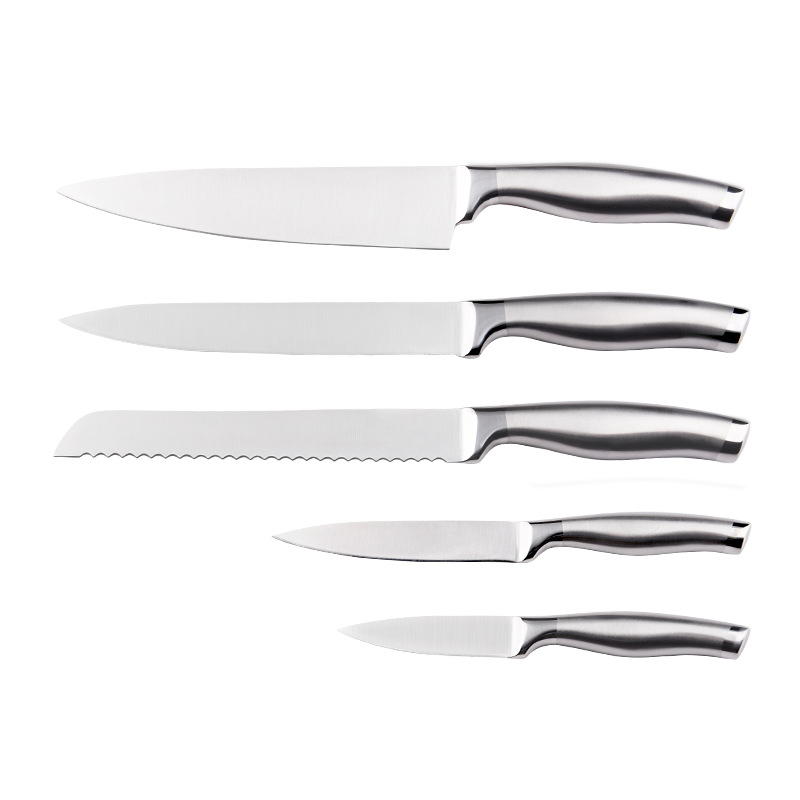
A Santoku is a Japanese-style multipurpose kitchen knife. The name is often associated with three broad culinary functions: preparing vegetables, fish, and meat. Unlike a traditional Western chef's knife, a Santoku usually has a shorter blade, a flatter cutting edge, and a spine that curves downward toward the tip.
The result is a compact knife designed for controlled slicing and chopping. It is not primarily intended for large rocking motions. Instead, many cooks use a push-cutting technique in which the blade moves forward and downward through the ingredient.
A beginner-friendly Santoku commonly includes:
- A blade between six and seven inches: This range offers a useful compromise between working space and control.
- A relatively flat edge: The flatter profile is comfortable for chopping and push-cutting.
- A sheep's-foot tip: The tip descends toward the cutting board and is useful for precision work.
- A double-bevel edge: Most beginner models are sharpened on both sides, making them easy for right- and left-handed users.
- A lightweight design: Lower weight can reduce fatigue during everyday preparation.
- A broad blade face: The blade provides knuckle clearance and can help transfer chopped ingredients.
The Santoku's design makes it suitable for common kitchen tasks, but it also has limitations. It should not be used to cut through bones, frozen food, hard shell, or other materials that can damage a relatively thin edge.
Many first-time knife buyers want one versatile tool rather than a complete professional knife collection. A Santoku often fulfills that role effectively.
A seven-inch Santoku is easier for many beginners to control than an eight- or ten-inch chef's knife. This is especially useful for cooks with smaller hands, limited cutting-board space, or little experience handling large blades.
A shorter blade also makes it easier to see the cutting edge while learning basic knife movements. Beginners can focus on steady hand placement, consistent slices, and safe cutting habits without feeling overwhelmed by excessive length.
Most home cooks prepare onions, garlic, carrots, potatoes, herbs, tomatoes, mushrooms, leafy greens, fruit, boneless chicken, and fish fillets. A Santoku is well suited to these ingredients.
Its edge can make clean cuts through soft tomatoes, while its height offers useful clearance when chopping dense vegetables. A hollow-edge version may also reduce friction when slicing sticky foods, although the effect varies by knife and ingredient.
A Santoku is designed for precision rather than force. This encourages a calm, controlled cutting style. Beginners should not need to swing the knife or press heavily. If the blade is sharp and the cutting board is stable, the knife should move through food with moderate pressure.
This controlled character is one reason Santoku knives are often recommended as beginner-friendly alternatives to traditional chef's knives. A comparison guide identifies Santoku as a strong option for beginners because of its manageable shape and practical cutting style.
Blade length affects comfort, cutting capacity, storage, and control. There is no single perfect size, but some lengths are more suitable for first-time users.
A six-inch Santoku is a good choice for:
- Small kitchens
- Smaller hands
- Light daily preparation
- Beginners who prefer maximum control
- Cooks who prepare limited quantities
The smaller blade is nimble and easy to store. However, it may feel cramped when cutting large cabbage, watermelon, squash, or wide vegetables.
A seven-inch Santoku is often the most balanced option for a beginner. It offers enough length for everyday vegetables and proteins without becoming difficult to maneuver.
A seven-inch model is particularly practical for cooks who want one primary knife. It provides a larger cutting surface than a six-inch knife while remaining more compact than many chef's knives.
Longer Santoku knives can suit users who have larger hands or frequently prepare bigger ingredients. They offer greater cutting capacity but may feel less agile to beginners.
If you are uncertain, a six-and-a-half- or seven-inch blade is usually a safer starting point than an unusually short or very long model.
Steel affects sharpness, edge retention, corrosion resistance, toughness, sharpening difficulty, and price. Beginners should prioritize balance rather than chasing the highest hardness rating.
Stainless steel is usually the easiest choice for beginners. It resists staining and corrosion, requires less maintenance than ordinary carbon steel, and performs reliably in a busy home kitchen.
High-quality stainless steel can hold an edge well while remaining relatively easy to sharpen. A beginner who sometimes forgets to dry a knife promptly may find stainless steel more forgiving.
High-carbon stainless steel combines stainless properties with added carbon for hardness and edge performance. Many modern Santoku knives use this type of steel.
It can offer a sharper, longer-lasting edge than basic stainless steel, but the user should still wash and dry the knife by hand. "Stainless" does not mean completely immune to discoloration, staining, or corrosion.
Carbon steel can take an exceptionally keen edge and is appreciated by experienced cooks. It is also more reactive. It may develop patina, discolor, or rust if left wet or exposed to acidic ingredients for long periods.
For a first Santoku, carbon steel is best for beginners who genuinely enjoy maintenance. If convenience is the priority, stainless or high-carbon stainless steel is usually more practical.
Premium powder steels can offer excellent edge retention and refined cutting performance. They may also be harder to sharpen and more expensive to replace.
Beginners do not need premium steel to learn good knife technique. A well-made mid-range stainless Santoku can teach more than an expensive knife that the owner is afraid to use.
A sharp knife is easier to control because it requires less force. A dull knife can slip, crush ingredients, and encourage unsafe pressure.
However, extreme sharpness is not the only goal. A beginner benefits from an edge that is:
- Consistent: It should cut evenly along the blade.
- Durable: It should tolerate ordinary kitchen use.
- Maintainable: It should be possible to sharpen without specialist equipment.
- Appropriate for the user: A highly delicate edge may not suit careless handling.
Testing references commonly describe Santoku edges as relatively acute, with some models using angles around 10 to 12 degrees. Actual edge geometry varies, so beginners should follow the manufacturer's sharpening guidance rather than relying on a number alone.
A beginner may focus on the blade and ignore the handle. That is a mistake. Comfort, grip security, and balance can determine whether a knife becomes a daily tool or remains in a drawer.
Western-style handles are often contoured and may include a bolster. They can feel familiar to users accustomed to European kitchen knives.
A full or substantial handle may suit cooks who prefer a secure grip. The disadvantage is that some large bolsters interfere with sharpening or make the knife feel heavier near the heel.
Traditional Japanese handles may be lighter and simpler. Some are oval, octagonal, or slightly tapered. They can provide excellent maneuverability but may feel unfamiliar at first.
A beginner should not assume that a traditional handle is automatically better. The correct handle is the one that allows a relaxed grip without pressure points.
Many beginners prefer a neutral or slightly blade-forward balance. A handle-heavy knife may feel disconnected from the cutting edge, while an extremely blade-heavy knife can cause fatigue.
Whenever possible, hold the knife before buying. If purchasing online, study the handle dimensions, weight, return policy, and user reviews. Weight alone does not determine comfort; the distribution of that weight matters just as much.
Some Santoku knives have hollow oval depressions along the blade. This design is often called a hollow edge or Granton edge.
The hollows can reduce contact between the blade and moist or sticky ingredients. This may help foods release more easily during slicing, but it does not guarantee that ingredients will never stick.
Beginners may appreciate the feature when cutting potatoes, cucumbers, apples, or other foods with high surface contact. Still, edge geometry, sharpness, blade thickness, and cutting technique usually matter more than the decorative appearance of the blade.
Damascus-style Santoku knives are popular because of their layered patterns and premium appearance. Some are made with genuine layered construction, while others use decorative surface patterns.
A Damascus pattern does not automatically prove that the knife is sharper or better. Beginners should evaluate:
- The core steel
- The blade thickness
- The handle construction
- The manufacturer's reputation
- The sharpening instructions
- The return and warranty policy
- The actual weight and balance
A simple-looking knife with good geometry may outperform a highly decorative model with poor construction. Visual appeal can be a bonus, but it should not be the main buying criterion.
The best beginner knife is often found in the middle of the market rather than at the cheapest or most expensive extreme.
Budget models can be useful for students, occasional cooks, and people who want to test the shape before investing further. Look for a secure handle, a straight blade, reasonable fit and finish, and clear care instructions.
Very cheap knives may have inconsistent edges, uncomfortable handles, or poor quality control. They can still be functional, but buyers should avoid assuming that every inexpensive model offers the same performance.
Mid-range knives usually offer the strongest value for beginners. They may include better stainless steel, improved balance, a more comfortable handle, and more reliable edge retention.
This category is often ideal for someone who cooks several times per week and wants a dependable primary knife without paying for artisanal finishing.
Premium models can provide excellent sharpness, refined grinds, attractive handles, and superior finishing. They may be worth considering when the user already understands personal preferences.
However, an expensive knife will not correct unsafe technique or poor maintenance. One specialist guide describes enthusiast-level Santoku knives in the approximate range of 100 to 200 dollars, with higher prices often reflecting artisanal work and premium materials.
For most first-time buyers, the following profile is a sensible target:
- Blade length: Approximately six-and-a-half to seven inches
- Steel: Stainless or high-carbon stainless
- Edge: Double bevel
- Weight: Light to moderate
- Handle: Comfortable, secure, and easy to clean
- Construction: Full-tang or reliably constructed according to the manufacturer
- Edge geometry: Fine enough for vegetables and boneless proteins but not excessively fragile
- Maintenance: Hand-washable and compatible with ordinary whetstone sharpening
- Price: Comfortable enough that the owner will use and maintain it regularly
This profile avoids unnecessary complexity. It also gives beginners enough performance to develop their skills before exploring specialized carbon-steel or handmade knives.
The Santoku and chef's knife overlap considerably, but they encourage different movements and offer different proportions.
A traditional chef's knife usually has a more pronounced curve, making it suitable for rocking cuts. A Santoku tends to have a flatter edge and is often better suited to push-cutting. Testing comparisons describe the chef's knife as commonly associated with a rocking motion, while the Santoku is associated with push cutting.
- A shorter blade
- A lighter knife
- A flatter cutting edge
- Compact kitchen equipment
- Precise vegetable preparation
- Push-cutting rather than rocking
- A longer blade
- A pronounced curved belly
- Rocking cuts
- Large ingredients
- A traditional European or Western profile
- One knife for broad professional-style preparation
Neither knife is universally superior. A beginner who naturally uses a rocking motion may feel better with a chef's knife. Someone who prefers controlled vertical or forward cuts may adapt more quickly to a Santoku.
Good technique improves both safety and performance.
Use a relaxed grip. Many cooks place the thumb and index finger near the blade's heel while wrapping the remaining fingers around the handle. Avoid gripping so tightly that your hand becomes tired.
The goal is control, not force. Your wrist should remain reasonably neutral, and the knife should move naturally from the arm and shoulder rather than only from the wrist.
Place a damp towel or nonslip mat beneath the cutting board. A moving board can turn ordinary preparation into a dangerous situation.
Use a board large enough to hold the ingredient and the knife comfortably. A crowded board makes it harder to maintain control.
Curl the fingers of the guiding hand inward and keep the knuckles forward. The side of the blade should gently contact the knuckles while the fingertips remain protected behind them.
Move the guiding hand gradually as the knife advances. Never place the fingertips flat in front of the blade.
Move the Santoku forward and downward through the food. Avoid forcing the knife straight down with excessive impact. Let the sharp edge do the work.
A smooth push cut produces cleaner slices and helps preserve the edge.
Beginners often damage knives by using them for tasks outside their design.
Do not use a Santoku for:
- Bones
- Frozen food
- Hard squash without proper preparation
- Coconut shells
- Thick cartilage
- Hard cheese blocks requiring forceful impact
- Opening packages
- Prying apart stuck ingredients
- Cutting directly on glass, stone, or ceramic surfaces
When a dense vegetable is difficult to cut, use a controlled technique and prepare it safely. If a task requires force, choose a knife designed for that work rather than risking a fine Santoku edge.
Proper maintenance is simple if performed consistently.
Wash the knife by hand with warm water, mild dish soap, and a soft sponge. Dry it immediately with a clean towel.
Do not leave the knife soaking in a sink. Besides increasing the risk of injury, soaking can damage handles, encourage corrosion, and expose the blade to contact with other utensils.
Even if a knife is labeled dishwasher-safe, hand-washing is usually better for long-term edge condition. Testing coverage specifically shows hand-washing as part of the care process for Santoku knives.
Use wood, soft plastic, or another knife-friendly cutting surface. Avoid glass, granite, marble, and ceramic boards because they can dull a fine edge quickly.
A good board should be stable, large enough for the task, and easy to clean. Replace or refinish it when deep grooves become difficult to sanitize.
Store the knife in a block, magnetic strip, protective sheath, or drawer organizer. Do not place it loose in a drawer where it can strike other utensils.
A blade guard is particularly useful for beginners, students, and cooks who transport knives between home and school or work.
Sharpening frequency depends on use, steel, cutting board, technique, and personal expectations. A home cook may need only occasional sharpening, while someone who prepares food daily may require more frequent attention.
A honing rod is not a substitute for sharpening. Honing can realign a slightly misaligned edge, but it does not remove enough material to restore a genuinely dull blade.
A whetstone provides the greatest control. It allows the user to set a consistent angle and gradually refine the edge. Beginners should practice carefully, use adequate water or lubricant according to the stone's instructions, and avoid rushing.
A testing guide identifies a whetstone as the preferred sharpening method for Santoku knives because it offers controlled edge maintenance.
Pull-through sharpeners are convenient but can remove more metal than necessary or create an unsuitable edge profile. If used, choose one designed for the knife's geometry and follow the instructions closely.
Professional sharpening is a good option for beginners who do not want to learn whetstone technique. Choose a service familiar with Japanese-style knives and fine edges.
A Damascus pattern or beautiful wooden handle can be attractive, but appearance does not guarantee performance. Evaluate geometry, balance, steel, and maintenance requirements first.
A longer blade is not automatically more useful. Beginners who lack experience may find a large knife harder to control. A seven-inch Santoku can provide substantial capacity without unnecessary bulk.
A knife that is sharp but uncomfortable will become frustrating. Handle shape, texture, circumference, and balance should be treated as essential features.
A Santoku is versatile but not universal. It cannot replace a bread knife, boning knife, paring knife, or heavy cleaver for every task.
Aggressive sharpening can shorten a knife's life. Beginners should learn the manufacturer's recommended angle and use a suitable maintenance method.
High heat, detergent, movement, and contact with other utensils can damage the edge and handle. Hand-washing is safer for the knife.
Choose a seven-inch stainless-steel Santoku with a comfortable Western-style handle and moderate weight. This design is familiar, versatile, and easy to maintain.
Choose a six-inch or compact seven-inch model. Prioritize maneuverability, storage, and a handle that does not feel oversized.
Choose an affordable stainless model with a blade guard. Students often need portability and durability more than decorative finishing.
Choose a thin-bladed Santoku with a fine edge and, optionally, a hollow-edge design. Make sure the blade is not so delicate that normal preparation becomes stressful.
Choose a mid-range high-carbon stainless model. It can offer improved edge retention and cutting feel without demanding the extensive maintenance of reactive carbon steel.
Choose a reputable brand with attractive packaging, a protective sheath, and clear care instructions. A practical gift is more valuable than a visually dramatic knife that is difficult to maintain.
When watching knife videos, pay attention to hand position, board stability, ingredient preparation, and the amount of force being used. Avoid copying fast professional demonstrations before you can perform the same motion slowly and safely.

Yes. A Santoku is often a strong first knife because it is compact, versatile, and relatively easy to control. A six-and-a-half- or seven-inch stainless model is a practical starting point for most home cooks.
A seven-inch blade is usually the most versatile beginner size. A six-inch model is better for smaller hands or limited kitchens, while a longer model can suit users who regularly prepare large ingredients.
Not necessarily. Japanese-made knives can be excellent, but European and American brands also produce reliable Santoku models. Beginners should compare comfort, steel, sharpening requirements, warranty support, and value rather than focusing only on country of origin.
Damascus steel is not automatically better. Its layered pattern can be attractive, but performance depends on the core steel, geometry, heat treatment, construction, and maintenance. A simple stainless model may be a better first purchase.
For many home cooks, yes. A Santoku can handle most vegetables, herbs, fish, fruit, and boneless meat. A chef's knife may be preferable for rocking cuts, very large ingredients, and users who want a longer curved blade.
Yes, a Santoku is suitable for boneless meat, poultry, and fish. It should not be used to cut through bones, large joints, frozen meat, or hard cartilage.
They can be useful because the hollows may reduce food sticking, but they are not essential. Sharpness, blade geometry, balance, and comfort are more important than hollow-edge decoration.
A whetstone offers the most control, but professional sharpening is also a good choice. Pull-through sharpeners should be used cautiously and only when compatible with the knife's edge design.
They may survive occasional dishwasher cleaning, but hand-washing is strongly preferable. Dishwasher heat, detergent, movement, and contact with other utensils can damage the edge and handle.
Use a stable wood, soft plastic, or knife-friendly composite board. Avoid glass, granite, marble, and ceramic because hard surfaces can dull the edge.
A dependable mid-range knife often offers the best balance of quality, comfort, durability, and price. Beginners should avoid both extremely cheap knives with poor construction and expensive models that require maintenance they are unwilling to perform.
It is especially comfortable for vegetables because of its broad blade and controlled cutting profile, but it also handles boneless meat and fish well. A separate butcher or boning knife is better for specialized meat preparation.
For most beginners, the best Santoku knife is a six-and-a-half- to seven-inch, double-bevel, stainless or high-carbon stainless model with a comfortable handle, moderate weight, and a reliable protective sheath. Choose function before decoration, and prioritize a knife that you can safely maintain.
A good first Santoku should make cooking easier, not create a new set of technical problems. With a stable cutting board, a safe grip, regular hand-washing, and occasional sharpening, it can become a dependable everyday knife for years.


