
Views: 290 Author: Site Editor Publish Time: 2026-09-04 Origin: Site


Content Menu
>> Typical Features of a Carving Knife
>> What a Carving Knife Does Best
>> Typical Features of a Chef's Knife
>> What a Chef's Knife Does Best
>> Blade Length
>> Blade Width
>> Flexibility
● Can a Carving Knife Replace a Chef's Knife?
>> When a Carving Knife Can Work as a Substitute
>> When It Should Not Replace a Chef's Knife
>> Why Substitution Can Be Frustrating
● Carving Meat with a Chef's Knife
>> Situations Where a Chef's Knife Works Well
>> Situations Where a Carving Knife Is Better
● How to Use a Carving Knife Safely
>> Use Long, Controlled Strokes
>> Avoid Cutting Toward Your Body
● How to Carve Different Foods
>> Turkey
>> Roast Beef
>> Brisket
>> Ham
>> Lamb
● Can a Carving Knife Cut Vegetables?
● Can a Carving Knife Chop Herbs and Aromatics?
● Can a Carving Knife Cut Through Bones?
● Carving Knife Versus Chef's Knife: Which Is More Versatile?
● Choosing One Knife for a Small Kitchen
>> Choose a Chef's Knife If You Cook Broadly
>> Choose a Carving Knife If You Serve Roasts Frequently
>> Consider a Slicing Knife as a Middle Ground
>> Avoid the Dishwasher When Possible
>> Use the Right Cutting Board
>> Sharpen Rather Than Over-Hone
>> Using the Knife as a Cleaver
>> Can a carving knife replace a chef's knife completely?
>> Can I use a chef's knife to carve turkey?
>> Is a carving knife better than a chef's knife for brisket?
>> Can I use a carving knife to cut vegetables?
>> Should a carving knife be flexible?
>> Is a carving fork necessary?
>> Can a carving knife cut through bones?
>> How should I sharpen a carving knife?
A carving knife can replace a chef's knife for a limited number of kitchen tasks, but it cannot fully replace one in a general-purpose kitchen. The two knives may look similar, yet they are designed around different cutting movements, foods, and forms of control.
A carving knife is made primarily for slicing cooked meats, poultry, fish, and other large foods into clean, even portions. A chef's knife is a broad, versatile kitchen tool designed for chopping, slicing, dicing, mincing, crushing, and preparing a wide range of ingredients. A carving knife can sometimes perform tasks normally assigned to a chef's knife, but it usually does so less efficiently and with greater risk of bending, slipping, or damaging the blade.
The practical answer depends on how you cook. If your kitchen work mostly involves roasted meat, a carving knife may be extremely useful. If you prepare vegetables, herbs, fruit, meat, poultry, and aromatics every day, a chef's knife remains the more capable primary tool.
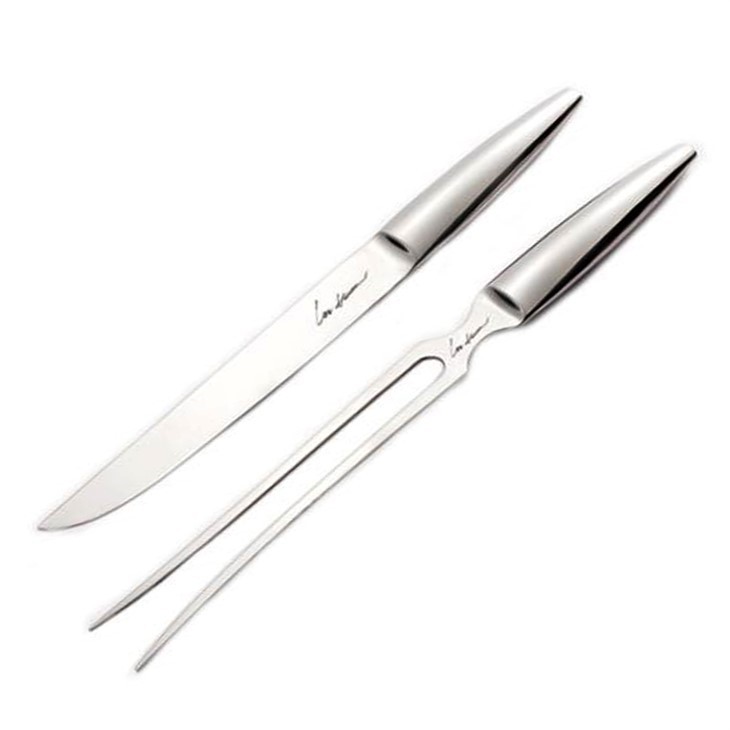
A carving knife is a long, narrow kitchen knife designed to cut cooked meat into smooth slices. It is commonly used for turkey, chicken, roast beef, ham, lamb, prime rib, brisket, and large baked fish.
The blade is usually thinner and longer than a standard chef's knife. This shape allows it to travel through a roast with long strokes instead of short chopping motions. The narrow blade also reduces resistance and helps the cook create slices with consistent thickness.
Many carving knives are used together with a carving fork. The fork holds the roast steady while the knife moves through the meat. This combination is especially helpful when carving a large turkey or bone-in roast.
A typical carving knife may include:
- A long blade designed for extended slicing strokes
- A narrow profile that reduces friction
- A sharp plain or Granton-style edge
- A relatively light construction
- A pointed or gently tapered tip
- A handle designed for controlled serving
- Moderate flexibility for following the shape of cooked meat
Some carving knives are stiff and strong, while others are flexible and delicate. A stiff carving knife is helpful for large roasts and cuts near bones. A flexible model can follow the curves of poultry and fish more easily.
A carving knife is sometimes called a slicer, carver, or meat-slicing knife. Naming conventions vary between manufacturers, so the actual blade design is more important than the label.
A carving knife performs especially well when you need to:
- Slice roast beef into thin portions
- Cut turkey breast without shredding it
- Separate broad slices of ham
- Slice brisket across the grain
- Cut cooked lamb into serving pieces
- Portion a large roasted chicken
- Slice smoked meats after resting
- Present uniform portions at the table
The long blade is its greatest advantage. Instead of repeatedly cutting back and forth over the same area, the cook can use one controlled pass across the meat.
A chef's knife is a general-purpose kitchen knife. It normally has a broad blade, a substantial heel, and a curved edge that supports rocking, chopping, and slicing motions.
Most chef's knives are designed to work with vegetables, herbs, fruit, boneless meat, poultry, and many other ingredients. Their broad blades can also be used to transfer chopped food from a cutting board into a pan or bowl.
A chef's knife is often the first serious knife purchased by a home cook because it can handle a large portion of daily food preparation.
A chef's knife commonly includes:
- A broad blade for stability
- A curved cutting edge
- A strong heel for heavier cutting
- A pointed tip for detail work
- A comfortable handle for repeated use
- A blade width that supports knuckle clearance
- Enough weight for chopping and rocking motions
Chef's knives are available in many styles, including French-profile knives, German-style knives, Japanese gyuto knives, and santoku knives. Their exact shapes differ, but all are intended to be broadly useful rather than dedicated to one task.
A chef's knife is particularly suitable for:
- Chopping onions
- Dicing carrots
- Slicing peppers
- Mincing herbs
- Cutting potatoes
- Preparing boneless meat
- Slicing fruit
- Crushing garlic with the side of the blade
- Cutting dense vegetables
- Breaking down larger ingredients into smaller pieces
Its broad blade provides leverage and control. Its heel can handle firmer foods, while its tip can perform detailed work.
Carving knives are usually longer and narrower than chef's knives. The length helps the blade pass through large cuts of meat without requiring repeated short strokes.
Chef's knives are generally shorter and wider. The width provides strength, balance, and a stable surface for chopping.
A long carving knife may be ideal for a turkey breast but inconvenient when dicing a small onion. A chef's knife may be perfect for that onion but less efficient when slicing an entire brisket.
A chef's knife has enough width to protect the user's fingers by creating space between the knuckles and the cutting board. A carving knife is typically much narrower, because its main goal is to move cleanly through meat.
The narrow shape of a carving knife makes it less suitable for scooping ingredients. It may also feel less stable when cutting hard vegetables.
A carving knife may have slight flexibility, particularly when it is designed for poultry, ham, or fish. This allows the blade to follow contours and separate meat from bones.
A chef's knife is usually more rigid. Rigidity improves control during chopping and helps the blade withstand contact with dense ingredients.
A flexible blade is not automatically better. Flexibility is useful for slicing, but it can make chopping uncomfortable and less predictable.
A carving knife is used mainly with long, forward-and-back slicing strokes. The knife should move through the food rather than forcefully chop downward.
A chef's knife supports several motions, including rocking, push cutting, chopping, and tip work. This makes it more versatile for everyday preparation.
Many carving knives have a thin cutting edge designed for low-resistance slicing. Chef's knives may have a thicker structure behind the edge to improve durability during chopping.
Using a thin carving knife against a cutting board with heavy downward force can damage the edge. Conversely, using a thick chef's knife to create delicate slices may produce more drag and less precision.
A carving knife can replace a chef's knife for slicing cooked meat, but it cannot replace a chef's knife for complete kitchen preparation.
If your main cooking task is carving a roast, the carving knife may perform better than a chef's knife. If you need one knife for vegetables, herbs, fruit, boneless meat, and general chopping, the chef's knife is the better choice.
The two tools overlap in some areas, but they are not interchangeable in every situation.
A carving knife can serve as a temporary substitute when you need to:
- Slice boneless cooked meat
- Cut soft fruit
- Portion sandwiches
- Slice large cakes
- Cut cooked vegetables
- Separate tender poultry meat
- Slice soft bread in an emergency
- Cut large pieces of cheese
These tasks do not place extreme stress on the blade. A sharp carving knife can often complete them successfully if the cook uses gentle, controlled movements.
A carving knife may also be sufficient for someone who prepares very few vegetables and mostly serves roasted meat. In a minimalist kitchen, one carefully selected knife can cover a limited range of tasks.
A carving knife is not a good substitute for a chef's knife when you need to:
- Chop hard vegetables
- Dice onions repeatedly
- Cut through dense squash
- Crush garlic
- Mince herbs quickly
- Split large root vegetables
- Cut foods with tough skin
- Process large quantities of ingredients
- Perform rapid meal preparation
The narrow blade may flex, twist, or slip during these tasks. The handle may also be less comfortable because carving knives are optimized for serving and slicing rather than repeated chopping.
A knife can be sharp and still be the wrong tool. Cutting performance depends on the relationship between blade geometry and the food.
When a carving knife is used for chopping, several problems may appear:
- The blade may feel unstable.
- The narrow profile may reduce knuckle clearance.
- The handle may not provide enough leverage.
- The edge may contact the board at an unsuitable angle.
- Hard foods may cause excessive flexing.
- The user may apply too much force.
- The blade may become dull more quickly.
- The cutting board may damage the thin edge.
This does not mean a carving knife is fragile. It means that every knife has a preferred operating range.
The reverse question is also important: can a chef's knife replace a carving knife?
Yes, in many home kitchens, a sharp chef's knife can carve meat. It may be perfectly acceptable for a small roast, chicken, pork loin, or turkey breast.
However, the result may not be as refined as it would be with a dedicated carving knife. A chef's knife is wider and may create more friction. It can also be harder to guide through a very large roast.
A chef's knife is often effective for:
- Small roast chicken
- Boneless pork loin
- Compact beef roast
- Turkey breast
- Cooked vegetables
- Small ham portions
- Meat cut into moderate-sized sections
The most important factor is sharpness. A dull chef's knife can tear meat and force the user to apply dangerous pressure.
A carving knife is usually preferable for:
- Whole turkey
- Large prime rib
- Full brisket
- Bone-in ham
- Large leg of lamb
- Wide roast beef
- Thin presentation slices
- Formal tableside carving
Its long, narrow shape provides cleaner movement and more consistent results.
Place the cutting board on a level surface. If it moves, place a damp towel or nonslip mat underneath it.
Make sure there is enough room for the roast, carving fork, serving platter, and knife hand. Remove unnecessary objects from the counter.
Grip the handle firmly but do not squeeze it excessively. Many cooks use a pinch grip, placing the thumb and index finger near the blade's bolster while wrapping the remaining fingers around the handle.
A secure grip improves control. Keep the fingers of the other hand behind the carving fork or away from the knife's path.
Do not hack downward into the meat. Instead, guide the knife forward and backward with smooth strokes. Let the sharp edge do the work.
Long strokes usually produce cleaner surfaces. Short, aggressive movements can create ragged slices and increase the chance of slipping.
Position the roast so the knife moves away from your torso. If the roast is large, rotate it rather than reaching awkwardly across it.
Never try to catch a falling knife. Step back and let it fall.
Do not cover the knife with a cloth or place it in a sink full of soapy water. Other people may not see it and could be injured.
When carrying the knife, hold it pointed downward with the cutting edge facing away from your body. Do not wave it or carry it loosely through a busy kitchen.
Allow the turkey to rest before carving. Remove large sections methodically rather than trying to slice the entire bird while it is still on the platter.
Begin by separating the legs and thighs if necessary. Then work on the breast meat, cutting slices against the grain. Keep the knife angle shallow and use long strokes.
The carving fork should hold the bird steady without pressing so hard that the skin tears.
Place the roast so the grain is easy to identify. Cut across the grain and aim for consistent slices.
For tender roast beef, thin slices may be desirable. For firmer cuts, slightly thicker slices may retain structure and moisture better.
Brisket commonly contains more than one muscle, and the grain can change direction. Identify the grain before cutting and adjust the roast as needed.
Use a long carving or slicing knife. Make deliberate strokes and avoid pressing down heavily. A resting period is especially important because it helps the brisket retain moisture during slicing.
If the ham has a glaze, keep the knife clean and wipe it when residue begins to accumulate. Slice according to the bone structure and desired thickness.
A stable fork is essential because glazed surfaces can be slippery. Use light pressure and allow the blade to separate the slices.
Follow the shape of the roast while maintaining an across-the-grain direction. If the leg has several muscle groups, the grain may not run identically throughout the cut.
Use the fork to stabilize thicker areas. Avoid using excessive force near the bone.
A carving knife can cut some vegetables, especially soft or already-cooked vegetables. It may slice tomatoes, cooked potatoes, roasted peppers, cucumbers, or large fruit.
However, it is not ideal for hard raw produce. Dense carrots, winter squash, turnips, and large potatoes can create twisting pressure. This pressure may damage the blade or cause the knife to slip.
A carving knife can be useful for:
- Tomatoes
- Roasted zucchini
- Cooked carrots
- Baked potatoes
- Eggplant
- Cucumbers
- Soft peppers
Use a stable cutting board and avoid forcing the blade through resistant areas.
Use a chef's knife or another sturdy kitchen knife for:
- Raw squash
- Sweet potatoes
- Large onions
- Cabbage
- Turnips
- Parsnips
- Dense pumpkins
- Hard carrots
The broader and more rigid blade of a chef's knife provides better control and leverage.
It is possible to chop herbs with a carving knife, but it is inefficient. The blade may lack the curved profile and broad surface that make rocking motions comfortable.
A chef's knife allows the user to keep the tip near the board while lifting and lowering the heel. This motion quickly turns herbs into a fine mince.
For garlic, a chef's knife is also preferable because its side can crush the clove. A narrow carving blade does not provide the same broad surface.
A carving knife should not be used to cut through bones. Its blade is designed to slice meat, not cleave hard structures.
When working around bones, use the carving knife carefully to separate meat along the natural seams. For joints or bones that need to be divided, use an appropriate cleaver, boning knife, poultry shears, or butcher's saw.
Striking a bone with a carving knife can chip or bend the edge. It can also cause the blade to glance unpredictably.
The chef's knife is more versatile because it handles a wider range of ingredients and cutting movements. It can chop, slice, mince, dice, crush, and portion.
The carving knife is more specialized. Its advantages become obvious when slicing large cooked foods, but its usefulness declines when the task changes to heavy chopping or detailed preparation.
A cook who owns only one knife will generally gain more everyday value from a chef's knife. A cook who already owns a chef's knife and frequently prepares roasts can benefit greatly from adding a carving knife.
Select a chef's knife if you often prepare:
- Fresh vegetables
- Herbs
- Fruit
- Boneless meat
- Stir-fry ingredients
- Soups and stews
- Salads
- Weeknight meals
- Large quantities of chopped ingredients
An eight-inch chef's knife is a practical starting point for many cooks. Smaller users may prefer a seven-inch model, while experienced cooks or people working with large ingredients may prefer nine inches or more.
A carving knife may be the better first purchase if you regularly cook:
- Holiday turkey
- Prime rib
- Brisket
- Bone-in ham
- Leg of lamb
- Large roast chicken
- Smoked meat
- Tableside meat presentations
In this situation, the specialized blade may provide more noticeable benefits than another general-purpose knife.
Some slicing knives have enough length and strength to handle meat while remaining useful for certain soft foods. A long slicer can be an excellent choice for brisket, roast beef, ham, and fish.
However, it still will not replace the chopping ability of a chef's knife. The middle-ground solution is useful only if your cooking priorities are focused primarily on slicing.
Wash the knife by hand with warm water and mild detergent. Dry it immediately with a clean towel.
Even stainless steel can develop spots or corrosion if left wet for long periods. Do not leave a sharp carving knife loose in a sink.
Dishwashers expose knives to heat, strong detergent, vibration, and contact with other utensils. These conditions can damage handles and dull edges.
Hand washing is usually the safest option for preserving both the blade and handle.
Wood and quality plastic boards are generally kinder to knife edges than glass, stone, ceramic, or very hard composite surfaces.
A cutting board should be stable, washable, and large enough for the food. Replace it when deep grooves make cleaning difficult.
A honing rod can help realign a slightly displaced edge, but it does not remove much metal or restore a seriously dull blade.
When the knife no longer slices smoothly, use a suitable sharpening system or consult a professional. Carving knives often have thinner edges, so aggressive sharpening can alter their geometry.
Use a blade guard, magnetic strip, knife block, or dedicated drawer insert. Do not store the carving knife loose in a drawer with other metal tools.
A carving fork should also be stored so its sharp tines cannot injure anyone reaching into the drawer.
A dull knife is more dangerous because it requires extra pressure. It may slip off the food instead of cutting through it.
Sharpness should be maintained regularly, but sharpening should match the blade type.
Fast, forceful sawing can tear meat. Slow, smooth strokes usually provide better results.
Very hard surfaces can rapidly dull the edge. They may also cause the blade to bounce during cutting.
Do not strike bones, frozen food, or dense materials with a carving knife. The thin edge is not designed for impact.
Slicing with the grain can make even tender meat seem tough. Identify the muscle fibers before cutting.
Pressure can crush delicate meat and squeeze out juices. Let the blade's sharpness perform most of the work.

No. A carving knife can replace a chef's knife for slicing cooked meat and some soft foods, but it is not designed for general chopping, mincing, crushing, and cutting dense vegetables. A chef's knife remains the more versatile everyday tool.
Yes. A sharp chef's knife can carve turkey effectively, especially if the bird is moderate in size. A dedicated carving knife may create cleaner and more uniform slices because its blade is longer and narrower.
Usually, yes. Brisket benefits from a long slicing blade that can move across the meat in smooth strokes. The knife should be sharp, and the brisket should be sliced across the grain after resting.
You can use it for soft or cooked vegetables, such as tomatoes, roasted zucchini, and baked potatoes. Avoid using it for hard raw vegetables that require force, including squash, turnips, and dense root vegetables.
Moderate flexibility can be useful for poultry, fish, ham, and irregular cuts. A stiffer blade is often better for large roasts and work near bones. The best choice depends on the foods you prepare most often.
A carving fork is not absolutely required, but it improves stability and safety. It helps hold large roasts in place while keeping the supporting hand away from the knife blade.
No. A carving knife should separate meat from bones, not cut through the bones themselves. Use poultry shears, a boning knife, a cleaver, or another appropriate tool for bone work.
Use a sharpening method suitable for thin kitchen blades, such as a quality whetstone, guided sharpener, or professional sharpening service. Avoid excessive pressure and do not remove more metal than necessary.
A carving knife can replace a chef's knife only within a narrow range of tasks. It is excellent for slicing cooked meats, poultry, brisket, ham, lamb, and large roasts. Its long, narrow blade creates clean portions and attractive presentation slices.
A chef's knife remains superior for everyday food preparation because it is broader, stronger, and designed for chopping, dicing, mincing, crushing, and general kitchen work.
The best choice depends on your cooking habits. If you prepare varied meals, choose a chef's knife as your primary tool and add a carving knife when you regularly serve large roasts. If your kitchen focuses on smoked meats, holiday poultry, and formal carving, a carving knife may become one of your most valuable specialized tools.
In short, a carving knife can supplement a chef's knife and occasionally stand in for it, but it cannot fully replace the versatility of a well-made chef's knife.


