

Views: 290 Author: Site Editor Publish Time: 2025-10-17 Origin: Site


Content Menu
>> H3: Characteristics of a Carving Knife
● How Is a Carving Knife Different From a Vegetable Knife?
>> H2: Vegetable Knives and Their Design
>> H3: Why Blade Shape Matters for Vegetables
● Can You Use a Carving Knife to Cut Vegetables?
>> H2: Pros of Using a Carving Knife on Vegetables
● Proper Knife Techniques for Vegetables
>> H2: Basic Cuts Common in Vegetable Prep
>> H3: Adapting Techniques with a Carving Knife
● When to Choose a Carving Knife vs. Vegetable Knife
>> H2: Use a Carving Knife When
>> H2: Use a Vegetable or Chef's Knife When
● Maintaining Your Carving Knife for Versatility
Many home cooks and professionals alike wonder if a carving knife — typically used for slicing meats — can double as a tool for cutting vegetables. This article dives deep into whether a carving knife is suitable for vegetable prep, exploring its design, advantages, limitations, and alternatives. To enhance your understanding, we'll include detailed guides, visual demonstrations, and video tutorials for proper knife use with vegetables.
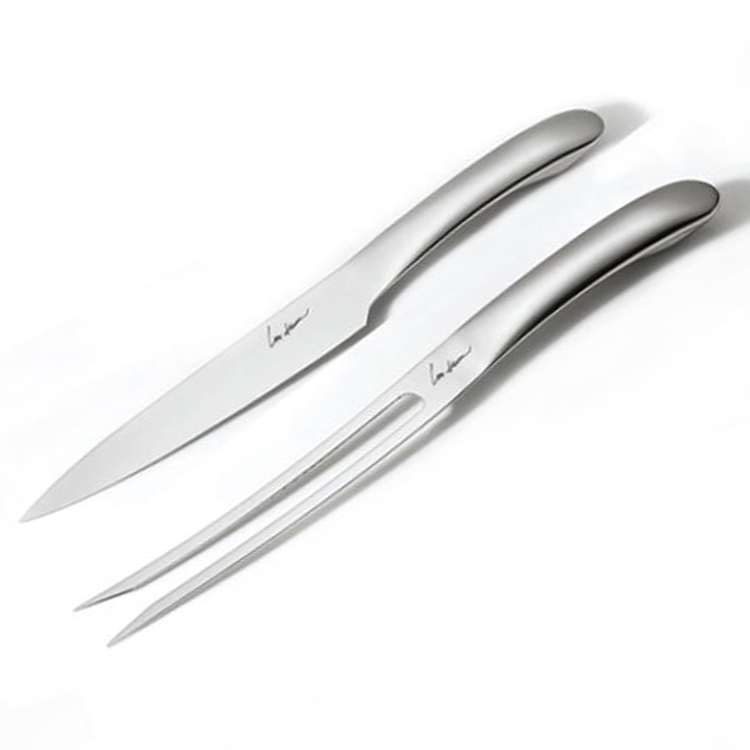
A carving knife features a long, narrow blade designed primarily for slicing cooked meats into thin, precise slices. Its blade typically ranges from 8 to 14 inches, is very sharp, and often has a pointed tip to help navigate around bones.
- Thin, slender blade to minimize resistance
- Long blade for smooth slicing strokes
- Sharp tip for detailed work
- Typically lightweight and well balanced
Vegetable knives, such as the Japanese Nakiri or Western chef's knives, feature broader, shorter blades ideal for chopping, slicing, and dicing vegetables efficiently. Their blades often have a straighter edge for clean cuts without rocking motions.
- Wide blades provide better control over chopping
- Straighter edges make clean cuts through firm vegetables
- Weight distribution helps with rapid chopping motions
- Sharp blade enables clean slicing
- Long blade can cut large vegetables in one stroke
- Good for thin filings or presentation work like ribbons
- Thin blade offers less control during chopping
- Harder to perform rocking cuts efficiently
- Not designed to handle heavy chopping or hard veggies
- Higher risk of blade damage or accidents due to shape
- Julienne: thin matchstick strips
- Dice: small cubes for even cooking
- Slice: thin flat pieces
- Chiffonade: thin ribbons of leafy greens
- Use smooth forward slicing motions instead of chopping
- Stabilize vegetables carefully to avoid slipping
- Avoid heavy downward cuts; use precise controlled slices
- You need very thin, delicate slices
- Preparing garnishes or vegetable ribbons
- Cutting large, soft vegetables where a long blade is helpful
- Performing rapid chopping or dicing
- Handling firm or hard vegetables
- Needing control for mincing or irregular cuts
- Regularly hone to maintain a razor-sharp edge
- Avoid dishwashers; hand wash only and dry immediately
- Use a sharpening stone designed for thin blades
- Store carefully to avoid blade damage
- Use knife guards or keep in knife blocks
Q1: Can a carving knife damage vegetables?
A1: It won't damage most vegetables, but its thin blade can be more delicate and vulnerable if used for hard chopping.
Q2: Is the carving knife better for presentation cuts?
A2: Yes. Its slender blade excels in creating thin, elegant slices and ribbons.
Q3: Can I use a chef's knife instead of a carving knife for vegetables?
A3: Absolutely. Chef's knives are more versatile and better suited for all types of vegetable cuts.
Q4: Are carving knives suitable for peeling vegetables?
A4: They can peel but are less safe and convenient than a peeler or smaller paring knife.
Q5: What are some alternative knives for cutting vegetables?
A5: Nakiri knives, Santoku knives, and chef's knives are popular vegetable-cutting choices.
While a carving knife can be used on vegetables, it is not the most practical or efficient choice for many vegetable-preparing tasks. Its design favors delicate, precise slicing over heavy chopping or diverse cuts. For best results, use your carving knife for thin slices, garnishes, or large soft vegetables, and opt for dedicated vegetable knives or chef's knives for most vegetable prep. Maintaining sharpness and using proper technique will ensure safety and efficiency regardless of your knife choice.
[1](https://www.youtube.com/watch?v=Q26qCZBcPhU&vl=en)
[2](https://www.youtube.com/watch?v=YrHpeEwk_-U)
[3](https://www.koiknives.com/blogs/news_updates/all-the-japanese-vegetable-cutting-techniques-you-need-to-know)
[4](https://www.escoffier.edu/blog/culinary-arts/8-knife-cuts-every-professional-cook-should-know/)
[5](https://www.reddit.com/r/chefknives/comments/12p0fmx/good_cutting_technique_video_for_beginners/)
[6](https://www.flavorish.ai/blog/a-guide-to-proper-vegetable-cutting-techniques)
[7](https://www.youtube.com/watch?v=PLk2NKzE6R0)
[8](https://www.reddit.com/r/Cooking/comments/13w9lyi/can_someone_explain_to_me_how_the_cutting/)
[9](https://www.reddit.com/r/ArtisanVideos/comments/8csedu/jacques_p%C3%A9pin_techniques_proper_knife_skills_for/)
[10](https://www.facebook.com/groups/dullmensclub/posts/2021238568532674/)


