

Views: 290 Author: Site Editor Publish Time: 2026-09-15 Origin: Site


Content Menu
>> Why Chinese Knife Brands Deserve Attention
● Leading High-Quality Chinese Knife Brands
>> 2. CIVIVI
>> 3. Sencut
>> 10. Ganzo
● High-Quality Chinese Kitchen Knife Brands
>> Dengjia
>> Shibazi
>> XYJ
>> Kaiyun
● How to Judge Quality in Chinese Knives
>> Steel Is Important, but Heat Treatment Matters More
● Choosing the Right Chinese Knife for Your Needs
● Maintaining a High-Quality Chinese Knife
>> Cleaning
>> Sharpening
>> Storage
● Common Mistakes Buyers Should Avoid
>> Confusing Decoration with Performance
>> Expecting One Knife to Do Everything
● Chinese Brands Compared with Japanese, American, and European Knives
>> Are Chinese knife brands good quality?
>> What is the best Chinese knife brand for beginners?
>> Which Chinese brand makes premium folding knives?
>> Are Chinese cleavers suitable for everyday cooking?
>> Is Damascus steel always better?
>> What steel should I choose for a Chinese folding knife?
>> How should I maintain a Chinese kitchen knife?
>> Are Chinese knives legal to carry?
China has become one of the most influential knife-manufacturing centers in the world. Its factories produce everything from affordable kitchen cleavers and stainless-steel chef knives to premium folding knives, precision-machined titanium models, hunting blades, and specialized professional cutlery. The modern Chinese knife industry combines traditional forging knowledge with computer-controlled machining, advanced heat treatment, powder metallurgy, and increasingly sophisticated design.
For buyers, however, the phrase "Made in China" does not automatically describe a single level of quality. China is home to both anonymous low-cost products and respected brands that compete successfully with established Japanese, American, and European manufacturers. The most important question is not whether a knife is Chinese, but whether the brand has reliable steel selection, consistent heat treatment, precise construction, quality control, and dependable after-sales support.
This guide explores high-quality knife brands from China, explains what makes them stand out, and offers practical advice for choosing the right knife for cooking, outdoor use, collecting, or everyday carry.
The Chinese knife market has changed dramatically. Earlier generations of inexpensive knives were often designed mainly around low production costs. Today, many Chinese manufacturers invest heavily in engineering, testing, materials, and international design collaboration.
Several factors explain this improvement:
- Advanced manufacturing: CNC machining, laser cutting, vacuum heat treatment, and automated polishing allow factories to achieve tight tolerances.
- Material access: Chinese brands increasingly use recognized steels such as VG-10, D2, 14C28N, S35VN, M390, S45VN, and various powder steels.
- Design development: Many companies now create their own designs instead of simply copying traditional or foreign patterns.
- Global competition: International customers expect better fit, finish, packaging, warranties, and documentation.
- Specialized production: Some factories focus exclusively on folding knives, kitchen knives, bushcraft tools, or premium custom production.
A good Chinese knife can offer excellent value because it may provide premium materials and precise construction at a lower price than an equivalent product made in a high-cost manufacturing region. Nevertheless, buyers should evaluate each brand and model individually.
WE Knife Co. is one of the best-known premium Chinese folding-knife manufacturers. The company has built a strong reputation for precise machining, sophisticated materials, and collaborations with well-known international designers.
WE knives commonly feature titanium handles, frame locks, ceramic ball bearings, sculpted handle contours, and premium blade steels. The brand's machining quality is particularly important. Even small details such as pocket-clip alignment, lock-bar movement, pivot adjustment, and handle finishing can distinguish a premium knife from an average one.
The company generally offers several product levels:
- WE Knife: The premium flagship line.
- CIVIVI: A more affordable line with strong performance and broad availability.
- Sencut: An entry-level line aimed at budget-conscious users.
This multi-brand structure allows the group to serve beginners, enthusiasts, and collectors without placing every product at the same price level.
WE's main strengths include:
- Excellent titanium machining
- Reliable modern locking systems
- Attractive original designs
- High-quality finishing
- Broad international distribution
- Strong designer collaborations
Its knives are especially suitable for collectors, office carry, urban everyday carry, and users who appreciate refined mechanical action. They may be less appropriate for people who want a simple, inexpensive work knife that can be heavily abused without concern for cosmetic damage.
CIVIVI has become one of the most popular Chinese knife brands for value-oriented buyers. It is associated with WE Knife Co. but focuses on accessible pricing. CIVIVI knives often combine D2, Nitro-V, 14C28N, or other practical steels with G10, micarta, stainless steel, or lightweight synthetic handles.
The brand is widely appreciated because it offers features once reserved for more expensive knives:
- Smooth bearing or washer pivots
- Reversible pocket clips
- Deep-carry clip designs
- Useful blade shapes
- Clean grinds
- Solid lock construction
- Attractive packaging
CIVIVI's catalog includes compact folding knives, larger utility folders, button locks, liner locks, frame locks, and fixed blades. Many models are designed for general everyday use rather than specialized tactical applications.
The biggest advantage is consistency. Although individual models naturally differ, CIVIVI has established a reputation for delivering dependable fit and finish at competitive prices. For someone buying a first modern folding knife, CIVIVI is often a practical starting point.
Buyers should still pay attention to blade thickness, edge geometry, and lock type. A thin slicer may excel at opening packages and preparing food, while a thicker folder may be better for rough utility work but less efficient for cutting.
Sencut occupies the affordable end of the WE Knife family. Its knives are usually simple, functional, and easy to recommend to beginners. The brand focuses on practical designs, accessible materials, and uncomplicated maintenance.
Many Sencut models use stainless steel handles or G10 scales, which can tolerate daily use without requiring special care. The company also produces button-lock and liner-lock folders in a variety of sizes.
Sencut is a good option for:
- First-time knife buyers
- Students and office workers
- Users who want a reliable backup knife
- People who prefer modest pricing
- Buyers who do not need premium titanium or exotic steel
The brand may not provide the same level of refinement as WE Knife, but that is part of its purpose. A less expensive handle and standard steel can make a knife easier to use without worrying about scratches, stains, or loss.
Kizer is another major Chinese brand with a long-standing presence in the international knife community. It is known for combining creative design, quality materials, and competitive pricing.
Kizer's product range spans several categories:
- Budget-oriented folding knives
- Mid-range everyday-carry models
- Premium titanium folders
- Fixed-blade outdoor knives
- Designer collaborations
- Automatic and button-lock designs where legally available
The brand is known for experimenting with blade shapes, locking mechanisms, handle materials, and opening systems. Many Kizer knives have strong ergonomics and distinctive visual identities.
Kizer often uses steels such as N690, S35VN, 154CM, 20CV, and other stainless or tool steels depending on the collection. The exact performance depends heavily on heat treatment and edge geometry rather than the steel name alone.
Kizer's strengths include:
- Broad product selection
- Comfortable handles
- Original styling
- Good value in titanium models
- Frequent collaboration with respected designers
- Strong enthusiast community
Because the catalog is large, quality and design preferences can vary between models. Researching individual reviews is worthwhile, especially when choosing between a thin slicer and a heavy-duty folder.
Bestech is widely recognized for producing a wide range of folding knives at different price points. It also operates sub-brands that target specific market segments, allowing customers to choose between budget-friendly and premium products.
Bestech knives often feature:
- D2 or stainless-steel blades
- G10, carbon fiber, titanium, or micarta handles
- Frame locks and liner locks
- Flipper tabs
- Ball-bearing pivots
- Decorative milling
- Distinctive blade profiles
The company has experience with both original models and OEM manufacturing. That production knowledge helps it deliver complex designs with attractive machining and reliable assembly.
For buyers, Bestech is appealing because it often provides more visual variety than conservative brands. Its catalog includes sleek gentleman's knives, aggressive tactical-inspired folders, large outdoor tools, and compact daily-use designs.
When evaluating a Bestech model, look closely at the blade-to-handle ratio and the pocket clip. A visually impressive design may not be comfortable in every pocket. Ergonomics should always be judged alongside appearance.
Reate is considered one of China's premium knife manufacturers. The company is especially respected for high-end machining, precise assembly, and advanced materials.
Reate-made knives may include:
- Titanium scales
- Integral handles
- Carbon-fiber components
- Ceramic bearings
- Hardened lock inserts
- Premium powder steels
- Complex internal milling
- Sophisticated anodized finishes
The brand is also known for producing knives for other designers and companies. Its reputation comes not only from its own branded products but also from its ability to manufacture demanding designs to a high standard.
Reate knives are generally aimed at enthusiasts and collectors who care about:
- Lockup precision
- Smooth deployment
- Handle symmetry
- Surface finishing
- Edge consistency
- Long-term mechanical reliability
They usually cost more than mainstream Chinese brands. The price is justified when the knife demonstrates superior machining and finishing, but the value depends on the buyer's priorities. Someone seeking a basic utility tool may not benefit from an expensive integral titanium folder.
Rike Knife is another premium Chinese brand associated with detailed machining and modern folding-knife design. Its models often feature sculpted titanium handles, unusual blade shapes, decorative milling, and premium steels.
Rike products appeal to collectors who enjoy distinctive aesthetics. Rather than relying only on traditional drop-point or clip-point patterns, the company frequently explores futuristic lines and elaborate handle construction.
Important strengths include:
- High visual originality
- Detailed titanium work
- Strong fit and finish
- Interesting mechanical designs
- Premium packaging and presentation
Because many Rike models are visually complex, buyers should examine how the knife feels in the hand. Decorative grooves and aggressive contours may look impressive but can create pressure points during extended use.
Artisan Cutlery offers a large selection of folding knives and fixed blades across budget, mid-range, and premium segments. It is known for bold designs, colorful finishes, and a strong emphasis on modern everyday-carry features.
The company's knives commonly include:
- D2 and stainless-steel blades
- G10, micarta, carbon fiber, and titanium
- Liner locks, frame locks, and button locks
- Flippers and thumb studs
- Compact and oversized models
- Limited editions and special finishes
Artisan Cutlery is also associated with CJRB Cutlery, a more affordable brand. CJRB has become popular among users who want practical performance without entering the premium price range.
Artisan's strengths are variety and accessibility. It is possible to find a simple daily-use knife, an eye-catching collector's piece, or a rugged outdoor folder within the broader brand family.
CJRB focuses on affordable performance. It frequently uses steels such as AR-RPM9, D2, and other practical materials, depending on the model. The brand has attracted attention for offering useful blade geometry, comfortable handles, and dependable action at moderate prices.
CJRB knives are especially useful for:
- Everyday carry
- Package opening
- General household work
- Light outdoor tasks
- Beginners who want modern features
The brand's designs are often less extravagant than high-end collector models, which can be an advantage. A simple handle and conventional lock may be easier to maintain and less expensive to replace.
The most important buying consideration is size. Some CJRB models are compact and discreet, while others are much larger. Buyers should also verify local laws concerning blade length, locking knives, and carrying methods.
Ganzo is known for affordable outdoor and everyday-carry knives. The brand has historically attracted users who want a functional tool for camping, hiking, fishing, or emergency use without spending heavily.
Ganzo products commonly emphasize:
- Practical blade shapes
- Stainless or tool steels
- G10 or synthetic handles
- Simple locking systems
- Compact multitools
- Outdoor-friendly construction
Ganzo is not usually positioned as a luxury brand, but its products can provide useful performance for casual users. It is best judged according to its price category. A budget knife should not be expected to deliver the same finishing or steel performance as a premium Reate or WE model.
Its practical value lies in affordability, easy replacement, and broad functionality.
China's kitchen-knife industry is enormous, and quality varies widely. Some factories produce inexpensive household cleavers, while others manufacture professional blades for restaurant suppliers and international brands.
Dengjia is associated with traditional Chinese kitchen knives, especially cleavers and forged blades. A Chinese cleaver is not necessarily a meat cleaver. Many models are designed for slicing vegetables, chopping herbs, portioning boneless meat, and transferring food from board to wok.
When selecting a Dengjia-style cleaver, consider:
- Blade thickness
- Overall weight
- Handle shape
- Balance near the pinch grip
- Carbon or stainless steel
- Ease of sharpening
A thin vegetable cleaver should not be used to cut through bones. A heavier bone cleaver is built for a different purpose and may feel cumbersome for delicate slicing.
Shibazi is one of the best-known Chinese kitchen-knife names, particularly in traditional cleavers and household cutlery. Its products are often valued for functional geometry, familiar Chinese blade profiles, and practical pricing.
A Shibazi cleaver can be a useful choice for cooks who want one versatile knife for:
- Vegetables
- Boneless poultry
- Fish preparation
- Herbs
- Slicing
- Crushing garlic with the broad side
The brand offers different quality levels, so buyers should not assume every model is identical. Thicker blades, forged construction, and better handles generally indicate a more robust product, while stamped budget models may be lighter and easier to sharpen.
XYJ has gained visibility in online kitchen-cutlery markets. Its products often include Chinese cleavers, chef knives, Damascus-style blades, and knife sets.
The appearance of Damascus-style patterns should not be treated as proof of superior performance. A decorative pattern may be created through layered steel, surface treatment, or etching. Buyers should verify the core steel, heat treatment, construction, and edge geometry.
XYJ can be attractive for gift buyers who want a visually impressive knife, but practical performance should remain the primary consideration.
Kaiyun and similar Chinese manufacturers supply a broad range of kitchen knives, including chef knives, slicing knives, cleavers, and custom-branded products. Some models are made for domestic use, while others are produced for export markets.
For professional cooking, the most important qualities are:
- Comfortable grip
- Consistent edge
- Appropriate blade thickness
- Easy sharpening
- Resistance to corrosion
- Secure handle construction
A reliable plain stainless-steel knife can be more useful than an ornate Damascus-style set that is difficult to maintain.
Knife steel receives considerable attention, but the same steel can perform very differently depending on heat treatment. A well-treated mid-range steel may outperform poorly treated premium steel.
Look for transparent specifications that identify:
- Blade steel
- Approximate hardness
- Blade thickness
- Edge angle
- Manufacturing location
- Warranty coverage
Be cautious when a listing uses vague terms such as "super steel," "military grade," or "razor steel" without identifying the actual alloy.
A sharp knife is not necessarily an efficient knife. Edge geometry determines how easily the blade passes through food or material.
- Thin geometry: Excellent for slicing and food preparation.
- Medium geometry: Balanced for general utility.
- Thick geometry: Better for impact resistance and rough work.
- Hollow grind: Can cut efficiently but may be more delicate.
- Flat or saber grind: Often provides stronger support behind the edge.
For kitchen use, thin and consistent geometry is usually more important than dramatic styling.
On a folding knife, inspect:
- Blade centering
- Lock engagement
- Smooth opening
- Absence of blade play
- Even handle scales
- Secure screws
- Pocket-clip alignment
- Clean machining
On a kitchen knife, inspect:
- Handle-to-blade transition
- Straightness of the edge
- Even bevels
- Secure rivets
- Comfortable balance
- Absence of sharp handle corners
A knife must fit the user's hand and intended task. Handle shape affects control, fatigue, and safety.
A handle that is too narrow may create pressure points. A handle that is too thick may reduce precision. Textured materials can improve grip but may feel abrasive during long sessions.
For kitchen knives, a pinch grip near the bolster often provides the greatest control. For outdoor knives, a secure full grip and effective guard may matter more.
Choose a chef knife, santoku, or Chinese vegetable cleaver with a comfortable handle and moderate weight. Stainless steel is convenient for users who do not want to wipe and oil the blade frequently.
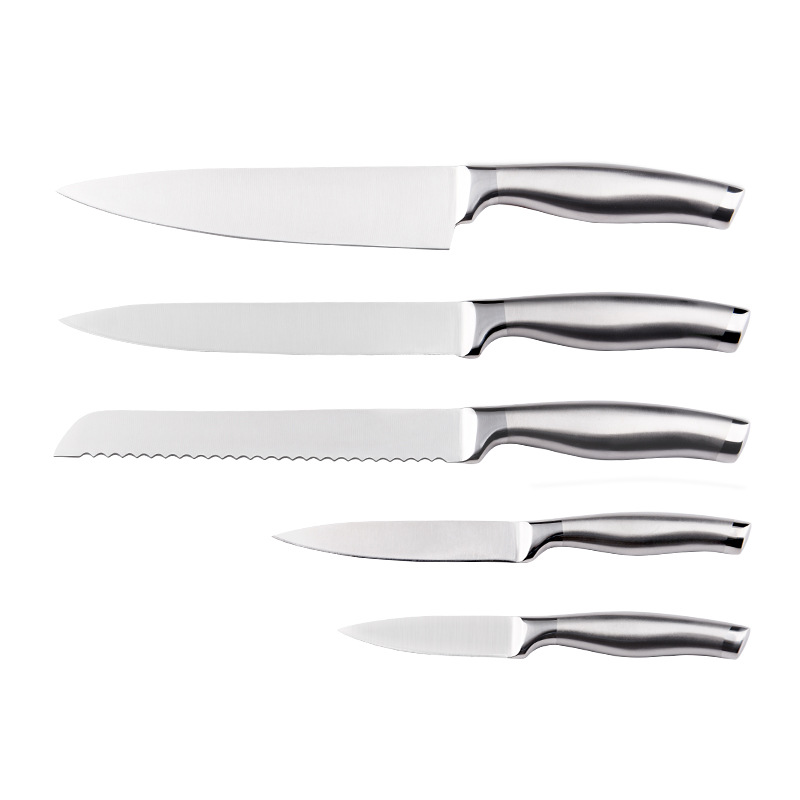
A practical starter setup could include:
- One chef knife or cleaver
- One small paring knife
- One bread knife
- A cutting board
- A honing tool or sharpening system
Avoid buying a large set simply because it appears economical. Many sets contain several knives that perform similar tasks.
Professional cooks should prioritize consistency, serviceability, and comfort. A knife that can be sharpened quickly and used for hours may be more valuable than one with an exotic steel that takes longer to maintain.
Important factors include:
- Repeated edge stability
- Corrosion resistance
- Handle comfort
- Weight distribution
- Availability of replacements
- Easy access to sharpening services
Outdoor users should consider a fixed blade with a strong tang, secure handle, corrosion-resistant steel, and a durable sheath. Folding knives are convenient, but a fixed blade is often easier to clean and more reliable for demanding tasks.
Choose blade thickness according to use. A thin blade is efficient for carving and food preparation, while a thicker blade is more resistant to lateral stress. No knife should be used as a pry bar or struck through material unless specifically designed for that purpose.
For everyday carry, size, legality, comfort, and discretion are more important than maximum toughness. A compact CIVIVI, CJRB, Kizer, or Sencut may be more practical than a large premium folder.
Check local regulations before carrying any locking, automatic, assisted-opening, or fixed-blade knife. Laws may differ by country, city, transport system, workplace, and intended use.
Wash kitchen knives by hand with warm water and mild detergent. Dry them immediately, especially if the blade contains carbon steel or a semi-stainless alloy.
Folding knives should be cleaned according to the manufacturer's instructions. Avoid forcing water into bearings or pivot assemblies unless the construction allows it. After exposure to moisture, dry the knife thoroughly and apply a small amount of suitable lubricant to the pivot if necessary.
Use a sharpening method appropriate to the blade:
- Whetstone: Offers excellent control and is suitable for kitchen knives.
- Ceramic rod: Useful for light edge maintenance.
- Diamond plate: Effective for harder steels and damaged edges.
- Guided sharpener: Helpful for maintaining a consistent angle.
- Pull-through sharpener: Convenient but may remove excessive material.
Do not wait until a blade is completely dull. Regular light maintenance is usually easier than repairing a neglected edge.
Store knives in a block, magnetic strip, saya, sheath, or protective pouch. Do not leave sharp blades loose in a drawer. Loose storage can damage edges and create a safety hazard.
For folding knives, avoid carrying keys or metal objects against the blade and handle. They can scratch decorative finishes and damage pocket clips.
Damascus patterns, bright anodizing, carbon fiber, and elaborate milling can enhance appearance, but they do not automatically improve cutting ability.
Steel type matters, but grind, heat treatment, geometry, ergonomics, and maintenance requirements are equally important.
Even reputable manufacturers can have occasional defects. A reliable seller with a clear return policy provides additional protection.
A kitchen slicer, camping chopper, and everyday-carry folder are designed for different stresses. Using the wrong knife can damage the edge or create a dangerous situation.
Knife regulations can be strict and highly specific. Buyers should verify the rules in their jurisdiction before purchasing, importing, or carrying a knife.
Chinese brands often compete strongly on value and manufacturing variety. Japanese kitchen knives may be especially attractive for refined edge geometry and traditional craftsmanship. American brands are often associated with outdoor durability, domestic manufacturing, and established warranty networks. European brands frequently emphasize classic kitchen profiles, stainless-steel practicality, and long-standing culinary traditions.
The best choice depends on the user's priorities:
- Choose Chinese brands for broad selection, modern features, and strong price-to-performance ratios.
- Choose Japanese brands for specialized culinary geometry and traditional or highly refined cutting styles.
- Choose American brands for certain outdoor designs, domestic production, and rugged utility.
- Choose European brands for classic kitchen ergonomics and established professional patterns.
These categories are not absolute. Chinese factories manufacture products for international companies, and many Chinese brands now develop designs that stand independently in the global market.

Yes. Several Chinese brands produce excellent knives, including WE Knife, Reate, Kizer, Rike, CIVIVI, Bestech, Artisan Cutlery, and CJRB. Quality varies by brand and model, so buyers should evaluate steel, heat treatment, construction, geometry, and warranty support.
CIVIVI, Sencut, and CJRB are strong choices for beginners because they offer practical designs, accessible prices, and broad model selections. A simple liner-lock or button-lock folder with a comfortable handle is usually easier to learn than an oversized or highly specialized knife.
WE Knife, Reate, and Rike are among the strongest choices for premium folding knives. They are known for precise machining, titanium construction, advanced steels, and refined mechanical action.
Yes. A properly selected Chinese vegetable cleaver can handle vegetables, herbs, boneless meat, and many routine kitchen tasks. It should not be used to cut through large bones unless it is specifically designed as a heavy-duty bone cleaver.
No. Damascus-style appearance does not guarantee superior cutting performance. Buyers should verify the actual steel layers, core material, heat treatment, edge geometry, and manufacturing quality.
For general use, stainless steels such as 14C28N, Nitro-V, VG-10, S35VN, or similar options can provide a useful balance of corrosion resistance, toughness, and edge retention. The best choice depends on maintenance habits and intended work.
Wash it by hand, dry it immediately, store it safely, and sharpen it before the edge becomes severely dull. Carbon-steel blades may also require occasional oiling to reduce corrosion.
Legality depends on location and knife type. Blade length, locking mechanisms, opening systems, and intended use may all matter. Always check the laws applicable to your area before carrying a knife.
High-quality knife brands from China now cover nearly every part of the market, from affordable daily-use tools to premium collector-grade folders and professional kitchen cutlery. WE Knife, CIVIVI, Sencut, Kizer, Reate, Rike, Bestech, Artisan Cutlery, CJRB, Ganzo, Shibazi, and other manufacturers demonstrate that Chinese knife production can deliver strong design, reliable construction, and excellent value.
The smartest purchase is based on intended use rather than country of origin. Examine the steel, heat treatment, edge geometry, ergonomics, fit and finish, maintenance requirements, legal restrictions, and seller support. With careful selection, a Chinese knife can be a dependable cooking tool, outdoor companion, everyday-carry product, or long-term collection piece.


