

Views: 257 Author: HELLOKNIFE LTD Publish Time: 2026-08-25 Origin: Site


Content Menu
● Why Material Choice Determines Cheese Slicer Life
● Stainless Steel Cheese Slicer: Best for Long-Term Durability
>> Advantages of Stainless Steel Cheese Slicers
>> Limitations of Stainless Steel Cheese Slicers
● Zinc Alloy Cheese Slicer: Flexible Design at a Competitive Cost
>> Advantages of Zinc Alloy Cheese Slicers
>> Limitations of Zinc Alloy Cheese Slicers
● Stainless Steel vs Zinc Alloy: Durability Comparison
● What Actually Fails First in a Cheese Slicer?
>> 2. Pivot, Roller, and Fastener Loosening
>> 3. Plating Damage on Zinc Alloy
● How OEM Buyers Should Choose the Right Material
>> Choose Stainless Steel If Your Brand Needs:
>> Choose Zinc Alloy If Your Brand Needs:
● Our OEM Durability Checklist
● Expert Verdict: Which Cheese Slicer Lasts Longer?
● FAQ
>> 1. Is stainless steel better than zinc alloy for a cheese slicer?
>> 2. Is a zinc alloy cheese slicer food safe?
>> 3. What stainless steel grade is best for cheese slicers?
>> 4. Why do cheese slicer wires break?
>> 5. Can zinc alloy cheese slicers go in the dishwasher?
>> 6. What is the best OEM construction for a mid-price cheese slicer?
>> 7. How can a brand improve cheese slicer durability?
At HELLOKNIFE LTD, we manufacture OEM cheese slicers for overseas brands, wholesalers, and kitchenware producers. One question comes up repeatedly during product development: Stainless Steel Cheese Slicer vs Zinc Alloy Cheese Slicer: Which Lasts Longer?
The short answer is clear: a well-designed stainless steel cheese slicer generally lasts longer, especially when it is repeatedly exposed to moisture, salt, acidic foods, dishwashing, and frequent cleaning. A zinc alloy cheese slicer can still be an excellent commercial product, particularly when buyers want die-cast shapes, ergonomic handles, decorative finishes, and competitive pricing. However, its long-term durability depends heavily on the coating quality, internal design, and how much moisture reaches the base metal.
For OEM buyers, the real decision is not simply "stainless steel or zinc alloy." It is about selecting the right material system for your target price, user expectations, product positioning, and warranty promise.
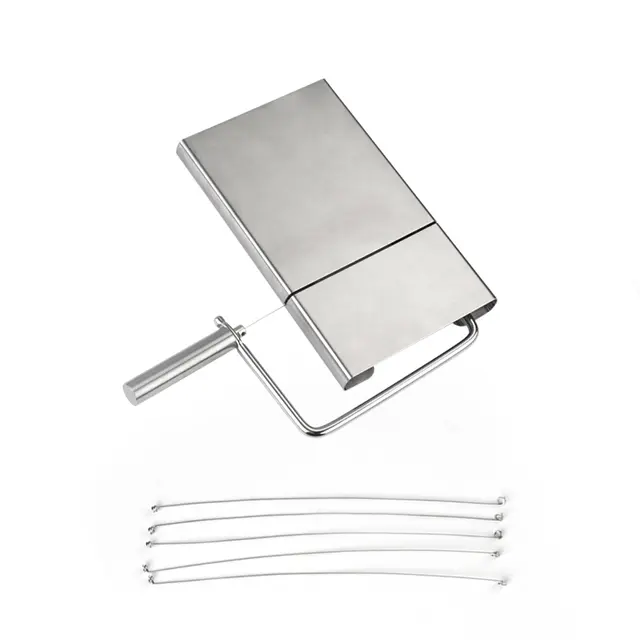
A cheese slicer looks simple, but it faces several daily stress factors:
- Moisture exposure from cheese, rinsing, dishwashers, and humid kitchens
- Salt and acids from aged cheeses, food residue, and cleaning products
- Mechanical stress when slicing hard cheddar, parmesan, gouda, or cold butter
- Wire tension in adjustable wire cheese slicers
- Repeated hand pressure on handles, rollers, pivots, and fastening points
- Cosmetic expectations, because kitchen tools are often displayed on cheese boards
From our OEM manufacturing experience, a slicer fails in more ways than "breaking." It may become difficult to clean, develop surface staining, lose a plated finish, bend under pressure, loosen at the handle joint, or cause complaints because replacement wires are hard to install.
That is why the best material is the one that delivers the right balance of corrosion resistance, strength, manufacturability, food-contact suitability, appearance, and cost.
A stainless steel cheese slicer is typically the stronger choice for premium and long-life kitchenware programs. Stainless steel's corrosion resistance comes from its chromium content, which forms a protective passive oxide layer on the surface. This layer helps the metal withstand moisture and routine exposure to many food environments.
For cheese slicers, stainless steel may be used in the whole body, the cutting wire, the blade, the roller, the handle frame, or selected high-stress components. A fully stainless steel construction usually provides the most consistent long-term performance.
- Better resistance to rust and staining in wet kitchen conditions
- Strong structural performance for repeated slicing
- Suitable for frequent cleaning when the correct grade and finish are selected
- Premium appearance that can fit modern, professional, and gift-oriented kitchenware brands
- Less reliance on decorative plating to protect the base material
- Good compatibility with food-contact applications when properly specified, fabricated, and used
Grade matters. For many food-related applications, 304 stainless steel is commonly selected because of its strong corrosion resistance and practical cost-performance balance. For environments with more salt exposure, aggressive cleaning chemicals, or demanding commercial use, 316 stainless steel can offer improved resistance to pitting corrosion.
Stainless steel is not automatically "maintenance-free." Poor finishing, rough welds, low-grade material, trapped moisture, or inconsistent polishing can still create corrosion risks. Stainless steel can also cost more than zinc alloy and can be more difficult to form into highly sculptural die-cast handle designs.
For OEM projects, we recommend defining the material grade, thickness, surface finish, wire specification, and corrosion-test requirement before sampling—not after mass production begins.
Zinc alloy cheese slicers are common in the market because zinc die casting allows manufacturers to create detailed, ergonomic, and visually distinctive handle forms efficiently. Many popular cheese slicers use a zinc alloy frame or handle combined with a 304 stainless steel cutting wire.
This hybrid structure can be a smart commercial solution. The user receives a strong cutting wire and a comfortable die-cast body, while the brand can offer an attractive retail price.
- Excellent die-casting capability for complex shapes and comfortable grips
- Lower material and processing cost than many stainless steel constructions
- Good weight and hand feel, especially for roller-style slicers
- Decorative flexibility, including chrome, black, gold, copper, matte, and branded finishes
- Suitable for mid-market retail programs when coating and assembly are properly controlled
For a zinc alloy cheese slicer, the key performance factor is the protective finish. A high-quality plating or coating system can make the product visually appealing and help improve surface protection. However, the coating becomes part of the durability equation.
Compared with stainless steel, zinc alloy is generally more dependent on surface coating for moisture protection. If the coating is scratched, thin, poorly bonded, or damaged by harsh dishwasher detergents, corrosion or surface degradation may appear more quickly. Zinc alloys are also commonly described as more susceptible to corrosion in wet environments than stainless steel.
This does not mean every zinc alloy cheese slicer is low quality. It means an OEM supplier must control:
- Base alloy composition
- Die-casting density and porosity
- Surface polishing
- Plating adhesion
- Coating thickness
- Salt-spray performance
- Assembly design
- Dishwasher-use instructions
A visually beautiful zinc alloy slicer can disappoint users if its plating cracks near hinges, roller holes, screw locations, or sharp edges. These are the areas we inspect closely during OEM quality control.
| Factor | Stainless Steel Cheese Slicer | Zinc Alloy Cheese Slicer |
|---|---|---|
| Long-term corrosion resistance | Excellent, especially with 304 or 316 grades | Moderate; strongly dependent on plating or coating |
| Resistance to dishwasher wear | Generally better, though care instructions still matter | Can be less reliable if coating is damaged |
| Structural durability | Strong for frames, blades, wires, and high-stress components | Good for die-cast bodies, but design and wall thickness are critical |
| Design freedom | Best for clean, modern, metal-forward designs | Excellent for shaped handles, logos, and decorative forms |
| Surface finish dependency | Lower; stainless steel has inherent corrosion resistance | Higher; coating quality is essential |
| OEM cost level | Medium to high | Low to medium |
| Best retail positioning | Premium, professional, sustainable, long-life | Value, gift, decorative, and mid-market products |
| Expected longevity | Usually longer with proper material and maintenance | Can last well, but coating damage may shorten service life |
For brands that want to make a strong durability claim, stainless steel is usually the safer platform. For brands prioritizing visual design and price competitiveness, zinc alloy can be a practical choice when paired with durable 304 stainless steel wire and validated surface treatment.
Material selection matters, but product lifespan is often determined by the weakest component. In our factory development work, the most common failure points are not always the main body.
A cheese slicer wire experiences tension, bending, food resistance, and repeated cleaning. A poor-quality wire can snap before the body shows any wear.
For a wire cheese slicer, specify:
- 304 stainless steel wire or a suitable upgraded grade
- Consistent wire diameter
- Smooth end fixing
- Reliable tension geometry
- Replacement-wire compatibility
- Wire-change instructions for end users
Many retail cheese slicers combine a zinc alloy body with 304 stainless steel wire because the wire is the true cutting component.
Roller slicers and adjustable slicers contain moving parts. If rivets, screws, shafts, or roller axles are poorly engineered, the slicer may wobble, cut unevenly, or become difficult to operate.
A durable OEM cheese slicer should use:
- Tight dimensional tolerances
- Stable pivots or corrosion-resistant fasteners
- Smooth roller rotation
- Controlled wire alignment
- Repeated cycle testing before production approval
For zinc alloy models, scratches and micro-cracks can create a pathway for water and cleaning chemicals. This is particularly relevant near joints, corners, logo recesses, and hanging holes.
A plating specification should include measurable standards, not vague terms such as "high quality." OEM buyers should request a defined coating system, adhesion testing, visual inspection criteria, and corrosion-testing requirements.
At HELLOKNIFE LTD, we advise brands to start with the customer, not the metal. Ask what the consumer expects after one year, three years, or hundreds of uses.
- A premium, durable kitchen tool
- Strong corrosion resistance
- A minimalist or professional visual identity
- Lower dependence on coatings
- A stronger sustainability and long-service-life story
- More confidence for frequent-use and hospitality-oriented buyers
A stainless steel cheese slicer is especially suitable for brands selling premium cheese board accessories, wedding gifts, gourmet kitchen tools, restaurant supplies, and long-warranty product lines.
- Detailed die-cast styling
- A comfortable heavy handle at a controlled price
- Chrome, gold, black, or decorative finishes
- A giftable retail presentation
- High-volume value positioning
- A hybrid design with a stainless steel wire or blade
For many brands, the best commercial choice is a zinc alloy body + 304 stainless steel wire + durable protective coating. This combination can offer a good user experience when quality controls are properly built into the specification.
Before approving a cheese slicer for mass production, our team recommends validating more than appearance. Use this practical checklist during sampling and pre-production inspection:
1. Confirm the material grade for the wire, blade, frame, and fasteners.
2. Check surface finish consistency, especially at edges, holes, joints, and engraved logos.
3. Test wire tension with soft, semi-hard, and hard cheese blocks.
4. Run repeated-use cycle tests to identify loose rollers, shifting wires, and handle movement.
5. Evaluate corrosion resistance after cleaning and humidity exposure.
6. Inspect plating adhesion on zinc alloy components.
7. Verify food-contact documentation for the finished product and intended markets.
8. Test packaging protection, because scratches during shipping can damage plated surfaces before the customer even opens the box.
9. Include clear care instructions, especially if a decorative zinc alloy product should be hand washed.
10. Provide replacement wire options for wire slicer models where appropriate.
Food-contact compliance should never be assumed based solely on a material name. Regulatory suitability depends on the precise alloy, product construction, manufacturing process, finish, intended use, and destination-market requirements.
For most long-term use cases, a stainless steel cheese slicer lasts longer than a zinc alloy cheese slicer. Stainless steel offers more inherent corrosion resistance and does not rely as heavily on an external decorative coating for protection. This makes it a stronger choice for consumers who wash their tools frequently, use dishwashers, live in humid environments, or expect a product to remain functional and attractive for years.
However, zinc alloy should not be dismissed. A well-engineered zinc alloy cheese slicer with a high-quality coating, robust die-cast structure, and 304 stainless steel wire can perform very well in the mid-market and giftware categories. The best choice depends on whether your brand's priority is maximum service life or design flexibility at a more competitive cost.
At HELLOKNIFE LTD, we help brands develop cheese slicers, cheese boards, steak knives, and related kitchen accessories based on real product-use requirements—not generic material claims. From material selection and custom tooling to logo application, packaging, inspection, and OEM production, we build solutions around your target market.
Ready to develop a durable cheese slicer for your brand? Contact HELLOKNIFE LTD to discuss your material options, custom design, MOQ, sample requirements, and OEM manufacturing plan.
For long-term corrosion resistance and repeated use, stainless steel is usually better. Zinc alloy can still be effective when it has a durable coating and is used in a well-designed hybrid product.
Food-contact suitability depends on the exact alloy, coating, manufacturing process, and intended use. It should be evaluated for the destination market and finished-product application rather than assumed from the term "zinc alloy."
304 stainless steel is a common practical choice for food-related kitchen tools. For more demanding conditions involving salts or harsher cleaning exposure, 316 stainless steel may provide additional corrosion resistance.
Wires can break because of poor material quality, excessive tension, incorrect anchoring, misalignment, repeated bending, or using the slicer on very hard foods beyond its intended use. A replacement-wire design can significantly improve the product's service life.
It depends on the finish and the manufacturer's care instructions. Decorative plated zinc alloy products are often better protected by hand washing and drying promptly, because dishwasher detergents and long moisture exposure can damage coatings over time.
A strong mid-price option is a zinc alloy die-cast body, a high-quality 304 stainless steel cutting wire, controlled surface plating, reliable wire anchors, and clear hand-wash care instructions. This construction balances cost, design freedom, and user performance.
Specify the material grade, use corrosion-resistant wire and fasteners, validate coating adhesion, perform cycle tests, reinforce high-stress joints, protect the product during shipping, and provide user care instructions.
1. Nickel Institute. "The Role of Nickel in Food Contact Materials." [https://nickelinstitute.org/en/nickel-applications/food-contact-materials/]
2. Astro Pak. "What Determines the Best Food Grade Stainless Steel?" [https://astropak.com/food-grade-stainless-steel/]
3. Boulder Engineering Studio. "Food Contact Safe Stainless Steel." [https://www.boulderes.com/resource-library/food-contact-safe-stainless-steel]
4. Precision Cast. "Zinc Alloys vs Stainless Steel: What Are the Pros and Cons?" [https://precisecast.com/zinc-alloys-vs-stainless-steel/]
5. EAZALL / Zinc Die Casting Industry. "Zinc Die Casting Alloys and Food Contact." [https://www.eazall.com/Download/GetFileUpload?downloadId=2a1beb4f-3a52-47de-8a88-ae10b740717e]
6. Action Stainless. "FDA & NSF Compliance for Stainless Steel Food Contact: A Specifier's Checklist." [https://www.actionstainless.com/is-stainless-steel-fda-and-nsf-compliant-for-food-contact-a-specifiers-checklist]
7. Amazon. "TOPULORS Wire Cheese Slicer Product Listing." [https://www.amazon.com/Stainless-Cheese-Adjustable-Thickness-Perfectly/dp/B07SR19MT8]
Hot Tags: China, Global, OEM, private label, manufacturers, factory, suppliers, manufacturing company


