
Views: 280 Author: Site Editor Publish Time: 2026-10-13 Origin: Site


Content Menu
● What "Titanium-Coated" Means
>> A coating over a base metal
>> Titanium and titanium nitride are not interchangeable labels
>> It is usually not solid titanium
● How It Differs From a Plain Stainless Steel Butter Knife
>> Appearance
● What Is a Titanium-Coated Butter Knife Used For?
>> Read the coating description
>> Consider how you will wash it
>> Choose a useful blade shape
>> Consider the set and intended use
● Cleaning and Caring for a Titanium-Coated Butter Knife
>> Follow the product's instructions
>> "Titanium-coated" means the whole knife is titanium
>> The coating makes it a better spreader
>> Coated cutlery cannot scratch
>> Stainless steel never rusts
>> Color tells you what the coating is
● Is a Titanium-Coated Butter Knife Safe for Food?
>> What is a titanium-coated butter knife?
>> Is a titanium-coated butter knife made entirely of titanium?
>> Does a titanium coating make butter easier to spread?
>> Can I put a titanium-coated butter knife in the dishwasher?
>> Is a titanium-coated knife better than stainless steel?
>> What should I do if the coating is damaged?
A titanium-coated butter knife is a table utensil whose blade or outer surface has a titanium-based coating over a core made from another material, commonly stainless steel. It is designed for the same everyday purpose as a conventional butter knife: serving and spreading butter and other soft foods. The coating mainly affects the knife's finish and surface, not the basic way it spreads.
The word "titanium" can sound as though the entire knife is made from titanium. That is often not what "titanium-coated" means. A coated knife is typically a layered product: a base metal provides the utensil's structure, while a thin surface treatment gives it a particular color or finish. Some table knives, for example, are marketed as stainless steel with titanium-nitride coating. Always check the product description for the core material and coating details rather than relying on the name alone.

A coated knife has at least two material layers to consider: the underlying utensil and the coating on its surface. The core gives the knife its shape and strength; the coating changes the exposed surface. Many products described as titanium-coated cutlery have a stainless-steel base, but the precise construction differs by manufacturer.
The coating may cover the blade, the handle, or most of the utensil. It may be added for a colored appearance, a particular surface finish, or other properties claimed by the maker. The phrase "titanium-coated" alone does not tell you the coating's precise chemistry, thickness, application method, or expected lifespan.
Some cutlery is described as titanium-coated, while other products specify a titanium-nitride coating. These terms are not necessarily identical. A listing may use "titanium" broadly as a marketing description, so look for detailed technical information if the coating composition matters to you.
Likewise, a gold or black color does not identify the coating material. A knife's appearance is not enough to establish whether it is titanium-based, titanium nitride, or another surface treatment. Check the manufacturer's own specifications.
A titanium-coated butter knife should not be assumed to be made entirely of titanium. The utensil's base material should be listed separately. If the listing simply says "titanium," check whether it means solid titanium, a titanium alloy, or a coating applied over another metal.
This distinction matters when comparing cost, weight, strength, care instructions, and possible surface wear. For practical buying decisions, the full construction description is more useful than the headline product name.
A plain stainless steel butter knife has a stainless steel surface rather than a separate decorative coating. A titanium-coated knife may also have a stainless steel core, but its visible surface includes an added layer.
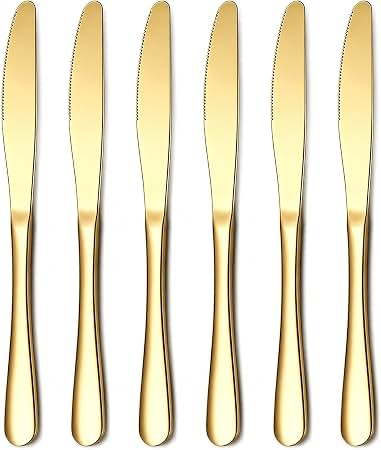
Stainless steel cutlery is usually silver-toned, with polished or brushed finishes. Titanium-coated knives may be sold in gold, black, bronze, rainbow, or other colors. The main immediate difference may therefore be visual: coated designs offer more variety, while plain stainless steel has a familiar, neutral look.
With uncoated stainless steel, the exposed surface is the stainless steel itself. With a coated utensil, the exposed surface is a layer applied to the core. That layer may be durable, but it can show wear differently from plain steel. If the finish is scratched or damaged, the underlying material may become visible.
This does not mean a coating will necessarily fail quickly. Its durability depends on the coating, how it was applied, the quality of the product, and how the knife is used and cleaned.
For spreading butter, blade shape and comfort usually matter more than the coating. Blade width, edge smoothness, curvature, thickness, and handle balance affect how easily the utensil moves butter across bread. A titanium-colored surface does not automatically spread better than stainless steel.
Some coated products have care instructions intended to preserve their finish. Others may be labelled dishwasher-safe. Do not assume all coated knives have the same requirements: follow the instructions for the specific product. Plain stainless steel is also not indestructible; it can become scratched, stained, or corroded under certain conditions. Stainless steels are generally more corrosion-resistant than many other steels, but they may still stain or rust in the right conditions.
A titanium-coated butter knife is generally used for the same soft foods as a conventional table butter knife. Its coating does not change its basic role as a blunt spreading utensil.
Use it to spread softened butter on toast, rolls, pancakes, or crackers. A smooth blade is suitable for light, even strokes. If the blade is broader, it may cover a larger surface more quickly; if it is narrow, it may offer more control on small foods.
A butter knife can also handle many spreads, including jam, preserves, cream cheese, soft cheese, pâté, hummus, and similar foods. Whether a particular knife feels comfortable depends on the blade shape and sturdiness. Dense nut butter or thick dips may need a firm blade and a comfortable grip.
Some people choose coated cutlery because it coordinates with colored dishes, serving pieces, or a particular dining style. Gold-colored or dark-finished knives can create a distinctive table setting. In this case, appearance may be a primary reason to choose the product, rather than a different spreading function.
Look for a clear statement about what the knife is made from beneath the coating. If it is stainless steel with a coating, the manufacturer should ideally say so. If the material is not specified, contact the seller or choose a product with a more transparent description.
Check whether the maker identifies the coating as titanium, titanium nitride, or another finish. Look for information about where the coating is applied and whether the product has been tested or described for food-contact use. Avoid treating vague phrases such as "titanium finish" as a complete technical specification.
If you regularly put cutlery in a dishwasher, confirm that the product is explicitly dishwasher-safe. If the manufacturer recommends hand-washing, consider whether you are willing to follow that routine. Coated finishes may benefit from gentler handling, but the product's own instructions should take priority.
A wide, flat blade can help cover toast or a sandwich efficiently. A narrower blade offers more precision for crackers or small portions. A rounded tip and blunt edge are typical for a spreading utensil. The knife should feel comfortable in your hand and should not flex excessively during normal spreading.
A single knife may be sufficient for occasional use. If you frequently serve several spreads, a matching set can be convenient. For everyday family meals, a durable, easy-care design may matter more than a decorative finish. For special occasions, color and coordination may matter more.
Care requirements vary. Some coated knives may be dishwasher-safe, while others may require hand-washing to help preserve the finish. Look at the packaging or manufacturer's product page and follow its directions.
Butter, jam, cheese, and other foods are easier to remove before they dry onto the blade. Wash the knife with dish soap and a non-abrasive sponge, rinse it well, and dry it if the instructions recommend doing so.
Scouring pads, abrasive powders, and rough contact with other utensils can scratch surfaces. To preserve a colored finish, avoid scraping the blade against hard plates or using it to pry open lids. Store it so it is not continually rubbing against sharp or abrasive tools.
If you notice the coating peeling or flaking, stop using the knife for food and ask the manufacturer or seller for advice. A scratch does not automatically reveal the coating's composition or establish a health risk, but visible coating damage deserves attention rather than being ignored.
Not necessarily. The term usually describes a coating over a base material. Check the construction details to find out what the utensil is made from.
Not by itself. Spreading depends primarily on blade dimensions, edge, balance, and how the knife feels in use. A coating may affect appearance and surface characteristics, but it does not inherently improve the spreading action.
Any surface can show wear. Coatings may resist some kinds of everyday wear, but performance depends on the product and conditions. Avoid assuming that a marketing claim means a utensil is scratch-proof.
Stainless steel is corrosion-resistant, not completely immune to staining or rust. Food residues, moisture, salt, and care conditions can affect the surface. Clean and store it as directed.
A gold, black, or rainbow finish does not prove which coating was used. The product specifications—not the color—are the reliable place to look.
A product's suitability for food use depends on its materials, construction, and compliance with applicable requirements—not simply on the word "titanium." Choose a reputable manufacturer that identifies the utensil as intended for food contact and provides care instructions.
Use the knife only for its intended purpose. It is not designed to cut hard ingredients, pry, or scrape cookware. If the coating is visibly peeling or flaking, discontinue food use until the manufacturer advises you. If you have a particular allergy or material sensitivity, consult the product information or contact the manufacturer rather than guessing from the finish.
It is a butter knife with a titanium-based or titanium-described surface coating over a base material, often stainless steel. The precise materials vary, so check the product specifications.
Usually, "coated" means there is a surface layer over a different core material. Confirm the base material with the manufacturer.
Not necessarily. Blade shape, width, edge, and handle comfort have more direct effects on spreading. The coating mainly changes the utensil's surface and appearance.
Only if the maker says it is dishwasher-safe. Care instructions differ among products, and following them can help preserve the finish.
Neither is automatically better. Stainless steel offers a classic, straightforward option; a coated knife may provide a distinctive finish. The right choice depends on materials, care needs, design, and personal preference.
Stop using a visibly peeling or flaking utensil for food and contact the seller or manufacturer for guidance. Do not assume the damage is harmless or try to repair the coating yourself.
A titanium-coated butter knife is best understood as a spreading utensil with a coated surface, not necessarily as a knife made entirely from titanium. Its main advantages may be its distinctive finish and design, while its performance still depends on the underlying material, blade shape, and workmanship. Check the product details and care instructions, and choose the knife that suits your everyday use.


