


Views: 255 Author: HELLOKNIFE Publish Time: 2026-11-20 Origin: Site


Content Menu
● Why a Bread Knife Works Differently
● 8 Bread Knife Uses Beyond a Basic Loaf
>> 1. Slicing Crusty Sourdough and Artisan Bread
>> 2. Cutting Soft Sandwich Bread and Brioche
>> 3. Splitting Bagels, Buns, and Rolls
>> 5. Leveling and Splitting Cakes
>> 6. Portioning Pastries and Crusty Baked Goods
>> 7. Cutting Filled Sandwiches
>> 8. Starting Cuts Through Citrus Peel
● How to Use a Bread Knife Without Crushing Bread
● What Should You Not Cut With a Bread Knife?
● How to Choose a Bread Knife for Real Kitchen Tasks
>> Match Blade Length to the Food
>> Compare Serration Geometry, Not Just Appearance
>> Check Handle Control and Knuckle Clearance
● An OEM Buyer's Practical Bread Knife Evaluation
● Cleaning, Storage, and Sharpening
● Frequently Asked Questions About Bread Knife Uses
>> What is a bread knife used for besides bread?
>> Can a bread knife cut meat?
>> Is a bread knife the same as a serrated knife?
>> Can you sharpen a bread knife?
>> Why does my bread knife tear bread?
>> What bread knife should a private-label brand choose?
● Build a Kitchenware Range Around Real Uses
At HELLOKNIFE LTD, we provide OEM services for overseas brands, wholesalers, and manufacturers sourcing cheese knives, cheese boards, and steak knives. For businesses building a coordinated kitchenware collection, understanding bread knife uses helps connect product design with real customer needs.
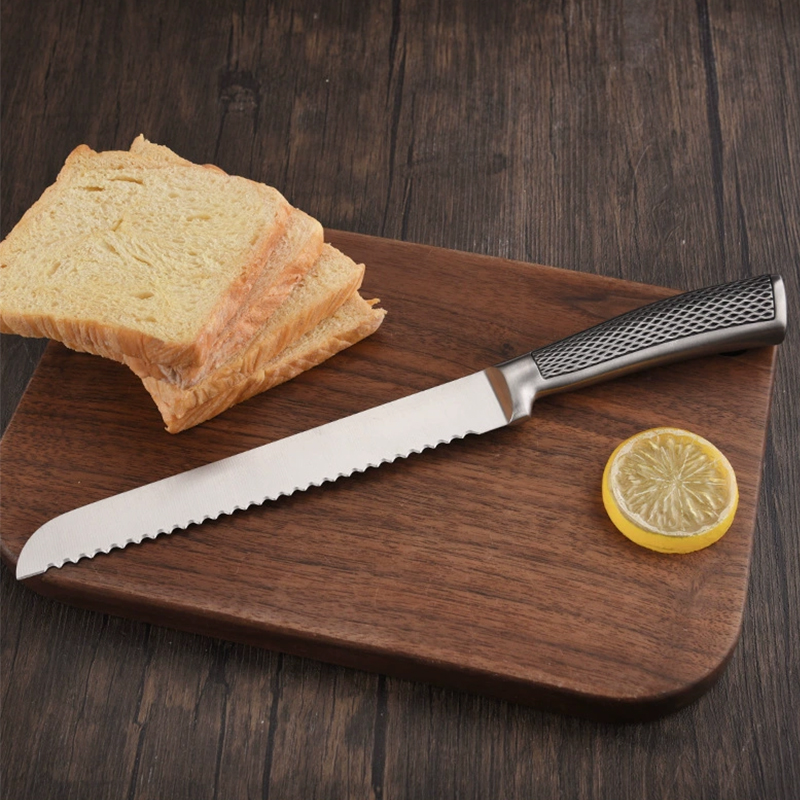
A bread knife is primarily used to slice bread without crushing its soft interior. Its serrated edge also makes it useful for bagels, tomatoes, cakes, and certain pastries. However, it is not a replacement for every kitchen knife.
This guide explains where a bread knife performs best, how to use it safely, and what buyers should evaluate before selecting one for a kitchen or private-label range.

A bread knife uses teeth or scallops along its cutting edge to catch the food's surface. A gentle back-and-forth motion then carries the edge through the food.
This combination is particularly useful when the outside resists cutting but the inside compresses easily. Think of a crusty sourdough loaf or a ripe tomato.
Most bread knives have relatively long blades. That length provides room for a controlled slicing stroke across wider foods.
The important distinction is motion: a bread knife generally works through light sawing rather than forceful downward chopping. Even a well-designed blade can produce poor results when pushed too hard.
| Food or task | Why a bread knife helps | Main limitation |
|---|---|---|
| Crusty bread | Engages a firm crust | Excess pressure compresses the crumb |
| Soft sandwich bread | Cuts with less downward force | Aggressive strokes can tear delicate slices |
| Bagels and rolls | Cuts through chewy exteriors | Small, rounded shapes require careful positioning |
| Tomatoes | Starts through resistant skin | A shorter knife may offer better control |
| Cake layers | Provides reach for horizontal slicing | Precision depends on technique |
| Pastries | Cuts through crisp outer layers | Fragile toppings may still break |
| Filled sandwiches | Handles contrasting textures | Loose fillings can shift |
| Citrus | Can start through the peel | A straight edge is better for detailed preparation |
Crusty bread is the classic application. The serrations engage the exterior while the slicing motion helps preserve the softer crumb.
Place the loaf on a stable cutting board. Start with short, light strokes to establish the cut, then lengthen the motion.
Avoid bearing down when the crust feels resistant. Greater pressure can flatten the loaf or make the blade harder to control.
For wide sourdough rounds, choose a blade with enough usable length to move comfortably across the loaf.
Soft bread presents a different challenge: compression rather than crust resistance.
Use a light grip on the loaf and smooth, gentle strokes. The goal is to support the bread, not squeeze it into position.
A bread knife can be useful for sandwich loaves and brioche, but results still depend on edge condition and serration design. A coarse or damaged edge may tear delicate bread.
Let freshly baked bread cool before slicing when practical. A knife cannot fully compensate for a loaf that is still too fragile to cut cleanly.
A serrated blade can work through the chewy exterior of a bagel or bread roll without requiring a hard downward push.
The main concern is stability. Never hold a bagel in your palm while cutting toward your hand.
Keep the food supported on a board, with fingers outside the cutting path. If its shape prevents secure positioning, use an appropriate holder or another safer cutting method.
A shorter serrated knife may be easier to control than a long bread knife for small rolls.
Tomato skin can resist an edge while the flesh underneath yields easily. Serrations help begin the cut without pressing heavily on the fruit.
A bread knife is useful for larger tomatoes when a suitable smaller knife is unavailable.
Use shallow, controlled strokes and keep the tomato stable. For cherry tomatoes or detailed preparation, a shorter serrated utility knife often offers more manageable control.
The advantage is not that tomatoes always require serrations. A properly sharpened straight-edged knife also cuts them effectively.
A long bread knife can trim a domed cake top or divide a cooled sponge into layers.
Mark the intended height around the cake. Begin with a shallow cut around the perimeter, rotating the cake gradually before working inward.
Keep the blade level and avoid trying to force the entire cut in one movement.
For repeated production where layer thickness must be closely consistent, compare a bread knife with a dedicated cake leveler rather than assuming they deliver identical precision.
Some pastries combine a crisp shell with a soft interior. A serrated knife can help cut through this contrast using less downward pressure.
Use small, deliberate strokes for filled pastries and delicate baked goods.
However, crumbs are not automatically evidence of a poor knife. Brittle pastry naturally flakes, and fragile decorations may break regardless of blade quality.
For presentation-sensitive products, test the actual pastry before deciding which knife belongs in a serving set.
A bread knife can handle sandwiches that combine crusty bread, soft fillings, and slippery ingredients.
Support the sandwich gently and saw through it without squeezing. Avoid excessively tall stacks that can slide during the cut.
If the filling starts moving, stop and reposition the food rather than increasing pressure.
A cleaner sandwich cut depends on assembly and stability as well as the knife. No edge design can reliably hold loose ingredients together.
A serrated knife can begin cuts through citrus peel and slice larger citrus fruits into rounds or wedges.
Nevertheless, this is a secondary use. A chef's knife or utility knife is usually more versatile when the preparation includes trimming, peeling, or precise segmenting.
Choose the tool that gives adequate control for the whole task, not simply the tool that can penetrate the skin.
Follow this sequence:
1. Stabilize the board. Use a nonslip mat or damp cloth underneath if necessary.
2. Position the food securely. Avoid unsupported overhangs and unstable rounded surfaces.
3. Keep fingers clear. Curl fingertips back and maintain distance from the blade's path.
4. Establish the cut. Begin with a few light strokes.
5. Lengthen the motion. Use the available blade length rather than rapid, tiny movements.
6. Reduce force. Let the serrations work instead of pushing down.
7. Finish carefully. Maintain control as the blade reaches the board.
If cutting becomes difficult, stop. Check the food position, blade condition, and suitability of the knife before continuing.
A serrated edge does not make a knife suitable for every hard material.
Avoid using an ordinary bread knife for:
- Bones or similarly hard materials.
- Frozen-solid food unless the manufacturer explicitly approves that use.
- Hard squash that requires substantial force or twisting.
- Fine chopping, mincing, and other precision tasks.
- Prying lids, opening packaging, or cutting nonfood materials.
A bread knife is also not automatically the best cheese knife. Cheese varies greatly in firmness and stickiness; blade shape, surface contact, and portioning requirements all matter.
For a coordinated collection, bread knives, cheese knives, and steak knives should have distinct roles rather than interchangeable marketing claims.
Many bread knives fall around the eight-to-ten-inch range, although shorter and longer models exist.
Choose based on the foods customers actually prepare. A compact roll and a wide artisan loaf place different demands on blade reach.
Longer is not universally better. The knife must also fit the user's workspace, storage, and handling preferences.
Pointed and scalloped designs can feel different during cutting. Tooth spacing, depth, sharpness, and overall geometry influence how the edge engages crust and moves through softer food.
Avoid promising that one serration pattern is best for every application.
A more useful comparison asks whether the blade starts cleanly, tracks predictably, and limits unnecessary tearing on the intended foods.
Consider grip comfort, handle transitions, and the space between the user's fingers and the board.
Offset designs can provide additional clearance, but overall suitability depends on the complete knife.
For commercial purchasing, evaluate the handle in realistic use rather than judging comfort from photographs alone.
For HELLOKNIFE LTD customers planning a coordinated kitchenware range, a useful starting point is a written performance brief.
Instead of specifying only "a sharp bread knife," define the intended foods, users, price position, packaging, and care instructions.
Then compare samples under consistent conditions.
| Evaluation area | Practical sample check |
|---|---|
| Crust engagement | Does the blade start a cut without excessive pressure? |
| Soft-bread performance | Does the slice retain its shape? |
| Cutting consistency | Can users repeat similar slice thicknesses? |
| Handling | Does the grip remain comfortable and controlled? |
| Finish and assembly | Are edges, joints, and surfaces appropriately finished? |
| Care communication | Are cleaning and sharpening instructions clear? |
Use comparable foods and slicing conditions across samples. Record observations instead of relying on impressions such as "premium feel."
This is a proposed evaluation framework, not a claim that HELLOKNIFE LTD has performed or certified these tests.
Follow the manufacturer's care instructions. When handwashing, clean carefully, rinse, and dry promptly. Do not leave a knife concealed in a sink.
Store it in a suitable block, sheath, or other protective system. Avoid loose storage where the edge can contact utensils or hands.
Serrated knives eventually need maintenance. A conventional pull-through sharpener is not automatically compatible with their edge geometry.
Some designs can be maintained using appropriately sized specialist tools. Others are better handled by a professional sharpening service. Victorinox specifically recommends professional sharpening for larger wavy blades such as bread knives.
Do not apply generic straight-edge sharpening advice without checking the blade's requirements.
Common secondary uses include slicing larger tomatoes, leveling cooled cakes, portioning certain pastries, and cutting filled sandwiches. Suitability depends on food stability, blade size, and the control required.
It can physically cut some cooked meat, but it is not the preferred all-purpose meat knife. Choose an appropriate carving, slicing, chef's, or steak knife for the task. Never use an ordinary bread knife to cut bones.
A bread knife is a type of serrated knife. Serrated knives also include shorter utility knives and some steak knives. Their lengths, tooth patterns, and intended uses differ.
Yes, many can be sharpened. The correct method depends on the serration geometry and manufacturer's guidance. Professional sharpening is a practical option, especially for larger wavy blades.
Possible causes include a worn edge, excessive pressure, short jerky strokes, unsuitable serrations, or bread that is still too warm and fragile. Check technique and food condition before assuming the knife is defective.
Start with the target customer and intended foods. Compare samples for cutting performance, grip, finish, storage compatibility, and clear care instructions. Confirm product specifications and substantiation before making performance claims.
Useful kitchenware starts with a clear task. Bread knives handle crust-and-crumb contrasts; cheese knives and steak knives address different serving and cutting needs.
Contact HELLOKNIFE LTD to discuss OEM cheese knives, cheese boards, and steak knives for your brand, wholesale business, or manufacturing program. Share your target market, intended use, design preferences, packaging requirements, and order expectations so the discussion begins with a practical product brief.
1. Cangshan Cutlery — "A Guide to Serrated Knives and Their Uses." Supports bread-knife dimensions, bread and tomato applications, cake slicing, and controlled sawing technique. [cangshancutlery]
2. Shun Cutlery — "The Cutting Edge of Serration." Explains serrated-edge applications, including bread, tomatoes, citrus, cakes, and pastries. [shun.kaiusa]
3. Victorinox — "How to Sharpen Your Knife." Supports the recommendation that larger wavy blades, including bread knives, should be professionally sharpened. [victorinox]
4. Samura — "How to Choose a Bread Knife That Cuts Cleanly." Discusses blade length, serration characteristics, stable cutting surfaces, and light slicing strokes. [samura]
5. Sharpy Knives — "What To Cut & NOT To Cut With A Bread (Serrated) Knife." Provides supplementary discussion of secondary uses, cake preparation, and the control limitations of long blades on small foods. [sharpyknives]


