

Views: 280 Author: Site Editor Publish Time: 2026-06-03 Origin: Site


Content Menu
>> H2: The Anatomy of a Wire Cheese Slicer
>>> H3: The Physics of Friction
>> H2: Why Parmesan Requires a Different Approach
>>> H3: The Importance of Breaking vs. Slicing
>> H2: The Right Tools for the Job
>> H2: The Risks of Forcing the Issue
>> Conclusion
When you are preparing a sophisticated Italian pasta dish or assembling a gourmet charcuterie board, the quality of your cheese presentation is paramount. Many home cooks reach for their versatile wire cheese slicer, wondering if this convenient tool can handle the challenge of an aged, crystalline block of Parmesan or Pecorino. The short answer is a definitive no. Understanding why this mismatch occurs—and learning which tools to use instead—is essential for preserving your kitchen equipment and achieving the perfect texture for your culinary creations.
To understand why wire slicers fail when faced with hard cheese, we must first look at how they are designed. A wire slicer relies on a thin, high-tension metal wire to "part" the cheese. It is designed to cut through semi-soft and semi-hard cheeses like Havarti, Gouda, or Cheddar by creating minimal friction. As the wire passes through, it separates the cheese molecules with gentle force, resulting in clean, smooth slices.
When a wire encounters a semi-hard cheese, it moves through the paste with relatively little resistance. However, very hard, aged cheeses like Parmesan are structured differently. They are dense, brittle, and often contain crystalline deposits that provide that characteristic crunch. A thin wire simply lacks the structural integrity to force its way through such a dense matrix. Instead of slicing, the wire will either stall, get stuck, or, most likely, snap under the pressure of the operator's hand.
Parmesan, or Parmigiano-Reggiano, is an "extra-hard" cheese. It is aged for months or even years, during which time moisture evaporates, leaving behind a highly concentrated, granular structure. Using a slicing motion on Parmesan is fundamentally at odds with its nature.
Because Parmesan is brittle, it is meant to be broken or shaved, not sliced like deli meat. When you use a traditional knife or a specialized cheese tool to "crack" a wedge of Parmesan, you are following the cheese's natural fracture lines. This releases the complex aromas and retains the integrity of the texture, which is a hallmark of high-quality aged cheese. If you force a wire through it, you are effectively crushing the granules rather than letting them fracture naturally, which can result in a dull, unappealing texture.
Since the wire slicer is off the table, what should you use to prepare your hard cheeses? Depending on your culinary goal, there are several superior alternatives.
The cheese chisel, sometimes called a Parmesan knife, is the gold standard for hard cheeses. It features a short, sturdy, pointed blade. You insert the tip into the cheese and use a levering motion to break off bite-sized chunks. This tool respects the crystalline nature of the cheese and is the traditional method used by cheesemongers in Italy.
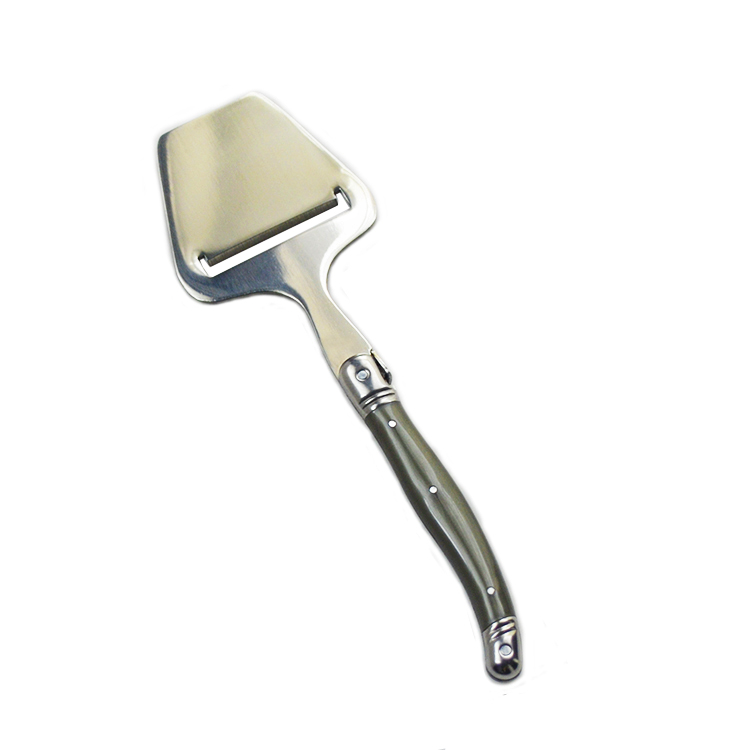
If you need thin curls of Parmesan to top a salad or pasta, skip the slicer and grab a dedicated cheese shaver or a high-quality vegetable peeler. These tools are designed to take off thin layers from the surface without requiring the deep penetration that a wire slicer would demand.
For those who want a fine dusting of cheese that melts instantly into a sauce, the Microplane is the absolute best choice. It shaves the cheese into tiny, feather-light particles that offer maximum surface area, providing an intense burst of flavor with every bite.
Once you have invested in the right tools for your hard cheeses, maintaining them is straightforward compared to a wire slicer.
1. Chisel Maintenance: Keep your chisel sharp by honing the blade periodically. Because it is a heavy-duty tool, it can withstand more aggressive sharpening than delicate wire-based implements.
2. Storage: Because these tools often have sharp points, ensure they are stored in a knife block or a sheath. Never let them rattle around in a drawer where the tip can become dulled or where you might accidentally injure yourself.
3. Cleaning: Most hard-cheese tools are made of durable stainless steel and can be washed more vigorously than wire slicers, though hand-washing is still the best practice to keep the edges sharp and the handles in good condition.
Attempting to use a wire slicer on Parmesan doesn't just damage the slicer. It also risks personal injury. When a wire snaps under tension, it can whip backward or create jagged metal edges. Furthermore, the frustration of a tool failing mid-preparation often leads to unsafe cutting practices, such as using too much force at an awkward angle. By choosing the right tool, you not only protect your equipment but also ensure a safer and more enjoyable kitchen experience.
Q: Will a wire slicer work on an aged Gouda?
A: Aged Gouda is semi-hard, not extra-hard. While it is much firmer than a young Gouda, a high-quality, taut wire slicer can usually handle it if you move slowly and ensure the cheese is at room temperature.
Q: Can I use a regular chef's knife for Parmesan?
A: Yes, but use a thick-bladed chef's knife rather than a thin, flexible one. Use the heel of the knife to score the cheese, then apply pressure to break off the wedge.
Q: Why does my wire slicer keep breaking?
A: If your wires are snapping frequently, you are likely either using the slicer on cheese that is too cold and hard, or you are putting too much downward pressure on the wire. Try letting the cheese sit out for 15 minutes before slicing.
Q: What is the best tool for Pecorino Romano?
A: Like Parmesan, Pecorino Romano is a hard, salty cheese. A cheese chisel or a heavy-duty shaver is the most appropriate tool for this variety.
Q: Is there any scenario where a wire is okay for hard cheese?
A: Only if you are using a professional-grade, heavy-duty wire cutter that is specifically designed for hard blocks, but even then, a chisel or plane is generally preferred for quality and safety.
Using the right tool for the right cheese is the hallmark of a skilled cook. While wire slicers are wonderful for their intended purpose—creating clean slices of semi-soft cheeses—they are simply not built for the dense, crystalline structure of extra-hard cheeses like Parmesan. By embracing the use of chisels, shavers, and graters, you honor the integrity of the cheese and elevate your culinary presentation, all while keeping your kitchen tools in perfect working order.


