

Views: 270 Author: Site Editor Publish Time: 2026-08-20 Origin: Site


Content Menu
● Why a Good Kitchen Knife Set Matters
● Understanding the Main Knives in a Kitchen Knife Set
>> Chef's Knife
>> Paring Knife
>> Boning Knife
● Blade Materials and What They Mean
>> High-Carbon Stainless Steel
>> Laminated and Damascus-Style Steel
>> Edge Angle
>> Smooth Versus Serrated Edges
● Full Tang, Bolsters, and Handles
● How to Choose the Right Set for Your Cooking Style
>> For Families and Frequent Cooks
>> For Vegetable-Focused Cooking
>> For Meat and Fish Preparation
● Storage Options for a Kitchen Knife Set
>> Blade Guards and Knife Rolls
● Cleaning and Daily Maintenance
>> Hand Washing
>> Honing
>> Sharpening
>> Use a Controlled Cutting Motion
>> Focusing Only on Appearance
>> Buying Without Checking Handle Comfort
>> Using the Wrong Knife for Hard Tasks
● How to Build a Set Instead of Buying One
>> Premium Sets
● Sustainability and Longevity
>> What knives should every kitchen knife set include?
>> Is a larger kitchen knife set always better?
>> Which is better, a chef's knife or a santoku?
>> Can kitchen knives go in the dishwasher?
>> How often should a kitchen knife be sharpened?
>> Is Damascus steel automatically better?
>> What is the safest way to store a knife set?
>> Should beginners buy an electric sharpener?
>> How should a chef's knife be held?
>> Is buying knives individually better than buying a set?
Choosing a kitchen knife set is one of the most practical decisions a home cook can make. The right collection of knives can make chopping faster, slicing cleaner, and everyday food preparation more enjoyable. However, a large block filled with many blades is not automatically better than a small set of carefully selected knives.
A useful kitchen knife set should match your cooking habits, hand size, storage space, maintenance routine, and budget. For many home cooks, an eight-inch chef's knife, a paring knife, and a serrated bread knife form the essential foundation. Additional pieces such as a utility knife, boning knife, kitchen shears, honing rod, or carving knife can be valuable when they serve a genuine purpose.
This guide explains how to choose a kitchen knife set, what each knife does, how blade materials affect performance, how to maintain sharpness, and how to use knives safely. It also discusses common buying mistakes and provides practical answers to frequently asked questions.

Knives influence nearly every stage of meal preparation. A dull or poorly balanced blade can crush tomatoes, tear herbs, slip on onions, and require excessive pressure. A well-designed knife makes the same tasks more controlled because the edge contacts the ingredient efficiently and the handle remains comfortable during repeated movement.
A good set can also create consistency. When the chef's knife, paring knife, and bread knife are designed as part of the same collection, they often share similar handle shapes, balance, and visual styling. This makes it easier to move between tasks without constantly adapting to a completely different grip.
The most important principle is not the number of pieces. Serious testing has found that a smaller set containing useful, high-performing knives can be more valuable than a large block containing duplicates or blades that rarely leave the storage block.
Most kitchens can accomplish a large percentage of routine preparation with three primary knives:
- Chef's knife: Used for vegetables, herbs, meat, fish, and general chopping.
- Paring knife: Designed for small ingredients, peeling, trimming, and detailed work.
- Serrated bread knife: Useful for bread, cakes, delicate pastries, and soft-skinned produce.
A practical knife set should include these three before adding specialized pieces. Some guides describe this combination as capable of handling roughly 90 percent of common kitchen preparation tasks.
The chef's knife is usually the central piece of a kitchen knife set. The most common length is eight inches, although six-inch and ten-inch versions are also available.
An eight-inch chef's knife offers a useful balance between cutting capacity and control. It is long enough to handle large onions, cabbage, carrots, chicken breasts, and many other ingredients, while remaining manageable for most home cooks.
The blade profile matters. German-style chef's knives generally have a more pronounced curve, making them suitable for rocking cuts. Japanese-style gyuto knives often have a flatter edge, which supports push-cutting and precise slicing. A hybrid profile can provide a compromise between these approaches.
When choosing a chef's knife, pay attention to:
- Blade length: Select a length that fits your cutting board and comfort level.
- Weight: Heavier knives can feel stable, while lighter knives may reduce fatigue.
- Balance: The knife should feel controlled rather than handle-heavy or blade-heavy.
- Clearance: Your knuckles should remain comfortably above the cutting board.
- Handle shape: The handle should allow a secure grip without pressure points.
A santoku knife is a Japanese-style all-purpose blade with a shorter, wider shape and a relatively flat edge. It is popular among cooks who prefer compact tools or who mainly prepare vegetables, boneless meat, and fish.
Santoku knives are often easier to control for cooks with smaller hands. Their flatter edge encourages a straight up-and-down or push-cutting motion rather than a large rocking motion.
A santoku can replace a chef's knife for many cooks, but it is not always the ideal tool for large cuts, heavy squash, or tasks requiring a substantial curved belly. If a set includes both a chef's knife and a santoku, consider whether you will genuinely use both.
The paring knife is small but extremely useful. Its short blade gives the cook control when peeling apples, removing strawberry tops, trimming vegetables, deveining shrimp, or making decorative cuts.
A three-and-a-half-inch blade is a common size. Some cooks prefer a slightly longer four-inch blade for extra versatility, while others choose a shorter blade for precision.
The paring knife is also helpful when a large chef's knife would feel awkward. For example, trimming a mushroom, scoring a peach, or removing a blemish from a potato is often easier with a small blade.
A serrated knife cuts through foods with a hard exterior and soft interior without compressing them excessively. Its teeth grip the surface instead of requiring the smooth slicing pressure used by a chef's knife.
A bread knife is useful for:
- Crusty bread
- Soft sandwich loaves
- Layer cakes
- Ripe tomatoes
- Melons
- Citrus fruits
- Large pastries
Because sharpening a serrated edge requires specialized equipment or professional service, choose a bread knife with durable teeth and a comfortable handle. Avoid using it for ordinary chopping, as the long serrations are not designed for that motion.
A utility knife sits between a chef's knife and a paring knife. It is usually five to seven inches long and can be helpful for slicing small sandwiches, cutting medium-sized fruit, trimming meat, or handling ingredients that feel too large for a paring knife but too small for a chef's knife.
Some cooks find a utility knife indispensable. Others rarely use one because their chef's knife and paring knife already cover the same tasks. Before buying a set because it contains a utility knife, consider your actual cooking routine.
A boning knife has a narrow blade designed to separate meat from bones. Flexible versions work well for poultry and fish, while stiffer versions are useful for larger cuts of meat.
This knife is valuable for cooks who regularly buy whole chickens, prepare fish, or break down meat at home. For someone who mostly purchases boneless cuts, it may remain unused.
A carving knife has a long, narrow blade for slicing cooked meat, poultry, smoked fish, or large roasts. Its length allows the cook to make fewer strokes and produce broad, even slices.
Some carving knives have a Granton edge with shallow indentations that can reduce sticking. However, the design is not essential for every kitchen. A long chef's knife can sometimes perform similar work.
Kitchen shears are often included in larger knife sets. They can cut herbs, poultry joints, packaging, parchment paper, twine, and leafy greens.
Look for shears that come apart for cleaning if possible. Separate blades allow food residue to be removed more thoroughly, which is particularly important when the shears are used on raw poultry.
Stainless steel is popular because it resists corrosion and is relatively easy to maintain. It is a practical choice for busy households, shared kitchens, and cooks who do not want to wipe and dry blades constantly.
Stainless steel does not mean the blade can be neglected. Food acids, salt, moisture, and improper storage can still cause discoloration or corrosion over time.
High-carbon steel can produce a sharp, responsive cutting edge and is often easy to sharpen. Its main disadvantage is maintenance. It may develop a patina and can rust if left wet or exposed to acidic ingredients for long periods.
High-carbon blades are appealing to cooks who enjoy sharpening and do not mind drying their knives immediately after use.
High-carbon stainless steel combines some of the edge performance associated with carbon steel with improved resistance to staining. It is widely used in modern kitchen knives.
The exact performance depends on heat treatment, blade geometry, hardness, and manufacturing quality. Steel type alone should not determine a purchase.
Some Japanese knives use a hard central core surrounded by softer stainless layers. This construction can provide edge retention while making the blade less difficult to maintain than a fully exposed carbon-steel edge.
Damascus-style patterns are visually attractive, but the pattern does not automatically guarantee superior cutting performance. The important questions are whether the blade is well heat-treated, properly ground, comfortable to hold, and suitable for your cutting technique.
The edge angle affects sharpness, durability, and cutting feel. A thinner edge can slice with less resistance, but it may be more vulnerable to chipping or damage if used on hard foods or cutting boards.
A thicker edge may be more forgiving and durable for general household use. The best angle depends on the steel, blade construction, intended food, and technique.
Smooth edges are ideal for chopping, slicing, and most precision work. They can be honed and sharpened with common tools.
Serrated edges are excellent for foods with tough surfaces and soft centers. They are less convenient to sharpen at home, so they should be reserved for their intended tasks.
Hollow-edge or granton-style blades include shallow indentations along the side. These may reduce food sticking during slicing, particularly with potatoes, apples, or other moist foods.
They do not make a knife permanently nonstick, and they should not be treated as a replacement for good technique.
A full-tang knife extends the metal through the handle. It is often associated with strength and durability, especially in knives used for heavy preparation.
However, full tang is not the only measure of quality. A well-made partial-tang or hidden-tang knife can also perform effectively, particularly when designed for light or precise work.
A bolster is the thicker section between the blade and handle. A full bolster can protect the hand and add weight, while a half bolster or minimal bolster can make sharpening the full edge easier.
Some cooks prefer a large bolster because it feels secure. Others find it obstructs a pinch grip or makes sharpening near the heel more difficult.
Common handle materials include:
- Polymer: Durable, easy to clean, and often affordable.
- Wood: Warm and attractive, but may require more careful cleaning.
- Composite material: Designed to combine durability with a traditional appearance.
- Stainless steel: Hygienic and modern, though some users find it slippery.
- Micarta or resin-based materials: Stable and resistant to moisture.
A handle should feel secure when dry and wet, but it should never be tested casually near the cutting edge. Hold the knife normally and assess whether your fingers feel cramped, stretched, or forced into an unnatural position.
A compact three-piece set is usually a strong starting point. Choose a chef's knife, paring knife, and bread knife, then add a cutting board and a basic sharpening solution.
A smaller collection teaches you how to use and maintain each blade. It also avoids spending money on specialized knives before you understand your preferences.
A medium-sized set may include:
- Chef's knife
- Paring knife
- Serrated bread knife
- Utility knife
- Kitchen shears
- Honing rod
- Storage block
This configuration provides flexibility without excessive duplication. If several people cook at the same time, an additional chef's knife may be more useful than a carving knife that is used only occasionally.
Vegetable-heavy kitchens may benefit from a santoku or nakiri knife. A nakiri has a straight edge and rectangular profile that works well for repetitive vegetable preparation.
The cook should still have a small paring knife and a serrated blade. A vegetable knife does not replace every other tool.
Consider a set containing a chef's knife, boning knife, slicing knife, and kitchen shears. A flexible fillet knife may also be useful for cooks who prepare whole fish.
Do not use a fine slicing knife to cut through bones. Even an expensive blade can be damaged by tasks for which it was not designed.
A block can consume valuable counter space. A three-piece set with blade guards, a wall-mounted magnetic strip, or a drawer organizer may be more suitable.
Storage should protect both the blade and the user. Loose knives in a drawer can strike other utensils, become dull, or cause accidental cuts.
Wooden blocks are convenient and visually familiar. They hold knives upright and keep blades separated.
The slots should be clean and appropriately sized. Do not force a thick blade into a narrow slot, and avoid placing a wet knife inside the block.
Magnetic strips keep knives visible and free counter space. They also make it easy to select a blade quickly.
Install the strip securely and position it away from children's reach. Place the spine or flat side against the magnet first, then rotate the edge away to reduce the chance of scraping the cutting edge.
Blade guards are useful for drawers, travel, and compact kitchens. Knife rolls are especially practical for culinary students, caterers, and professionals who transport their tools.
Each blade should have an individual protective cover. Never place uncovered knives loose inside a drawer.
Hand washing is generally the safest maintenance method for quality kitchen knives. Use warm water, mild dish soap, and a soft sponge.
Wash one knife at a time, keeping the blade pointed away from your hand. Dry it immediately with a clean towel before storage.
Dishwashers expose knives to heat, detergents, vibration, and contact with other items. These conditions can damage handles, dull edges, and increase the risk of injury while unloading.
Even when a manufacturer labels a knife dishwasher-safe, hand washing is usually the more protective routine for long-term performance.
Use a wood, bamboo, or quality plastic cutting board. Avoid glass, ceramic, stone, and metal surfaces because they can damage the edge quickly.
A stable cutting board is essential. Place a damp towel or non-slip mat underneath it so the board does not move while cutting.
Honing realigns a slightly displaced edge. It does not remove significant amounts of metal and does not replace sharpening.
Use a honing rod gently and follow the angle recommended for your knife. Excessive pressure or a rough rod can damage a thin edge.
Sharpening removes a small amount of metal to create a new edge. It may be done with a whetstone, manual sharpener, electric sharpener, or professional service.
A whetstone offers control but requires practice. Manual and electric sharpeners are more convenient, but some aggressive models remove more material than necessary.
The correct method depends on the knife's edge geometry and steel. Read the manufacturer's instructions before using a sharpening device.
Hold the blade near the handle by gently pinching the blade between your thumb and index finger while wrapping the remaining fingers around the handle.
This grip gives better control than holding only the end of the handle. Keep the other hand in a claw position, with fingertips curled inward and knuckles guiding the side of the blade.
Allow the knife to move through the ingredient instead of forcing it downward. A sharp knife should require limited pressure.
Do not rush. Speed should develop from consistent technique, not from swinging the blade rapidly.
Remove packaging, towels, clutter, and unnecessary utensils from the cutting area. Wipe spills promptly and keep the cutting board stable.
Never attempt to catch a falling knife. Step back and let it fall.
When carrying a knife, hold it by the handle with the tip pointed downward and the sharp edge facing behind you. Announce that you are moving behind someone in a busy kitchen.
Never carry an exposed knife while distracted or while holding other objects.
The safest practice is to place the knife on a surface and allow another person to pick it up. If passing is unavoidable, offer the handle with the blade facing away from both people.
Large sets often appear better value because they contain many items. Yet several steak knives, duplicate paring knives, and rarely used specialty blades may add cost without improving your cooking.
Count useful functions rather than pieces.
A polished block or decorative Damascus pattern can be attractive, but appearance cannot reveal balance, edge geometry, comfort, or durability.
Use aesthetics as a secondary factor after performance and fit.
A knife that feels impressive for thirty seconds may become uncomfortable after twenty minutes of chopping. If possible, hold the knife before purchasing.
Pay attention to pressure points, grip security, wrist position, and whether your knuckles clear the board.
Every knife becomes less effective when neglected. Before buying, understand how the blade should be washed, dried, stored, honed, and sharpened.
The best knife set is one you are willing to maintain.
Do not use a chef's knife to pry open containers, twist through bones, cut frozen food, or scrape hard surfaces. These actions can roll, chip, or bend the edge.
Use appropriate tools for heavy-duty work.
Buying knives individually can be a better strategy for experienced cooks. Start with the blade you use most often, usually a chef's knife or santoku. Add a paring knife and serrated knife afterward.
This approach lets you compare different handle shapes, blade profiles, and weights. It also prevents you from paying for accessories that do not match your needs.
A custom collection may include knives from different manufacturers. That is perfectly acceptable if each tool performs well and feels comfortable.
Affordable sets can provide excellent value when they include a decent chef's knife, a paring knife, and a serrated blade. Look for comfortable handles, reliable construction, and replacement or warranty support.
A budget knife may require more frequent sharpening, but that is not necessarily a problem if maintenance is simple.
Mid-range sets often improve balance, edge retention, handle quality, and storage design. They are suitable for cooks who prepare meals frequently and want dependable performance without paying for luxury materials.
At this level, compare the actual contents carefully. A six-piece set with useful tools may be better than a twelve-piece set with duplicates.
Premium collections may offer advanced steel, refined geometry, hand finishing, distinctive handles, and long-term service. They can be worthwhile for dedicated cooks who appreciate particular cutting characteristics.
Premium pricing does not eliminate the need for careful technique. A costly knife can still be dulled by a glass cutting board or damaged by the dishwasher.
A durable kitchen knife set can reduce waste because well-maintained blades may remain useful for many years. Choose products with replaceable or serviceable components when available.
Avoid replacing a knife merely because it has lost sharpness. In many cases, professional sharpening can restore performance.
When a handle becomes loose, a blade develops a serious crack, or corrosion compromises the structure, replacement may be safer than repair. Dispose of damaged knives responsibly by wrapping the blade securely before placing it in an appropriate waste container.
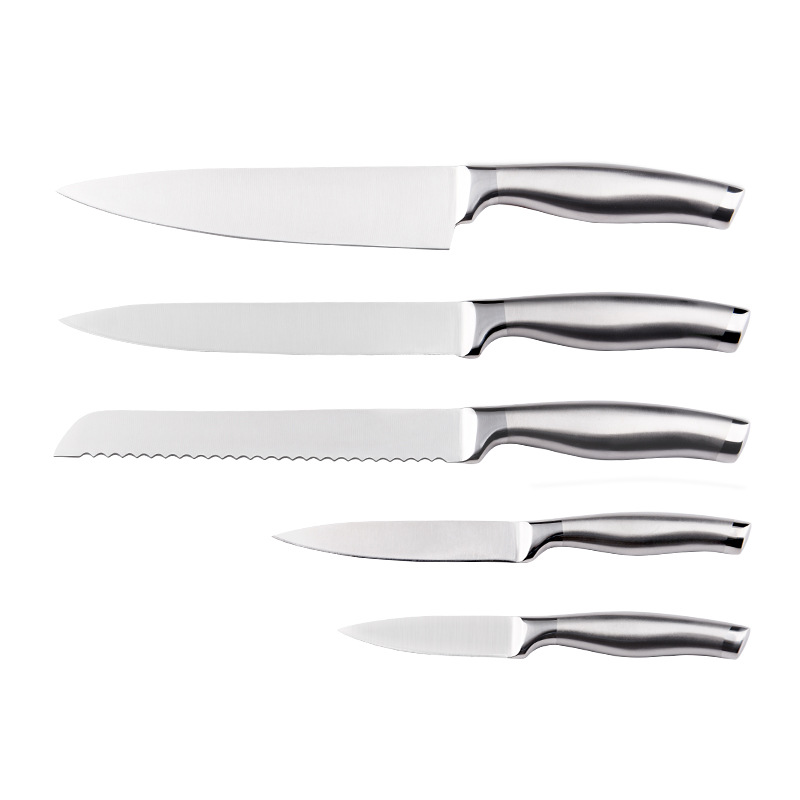
A useful basic set should include an eight-inch chef's knife, a paring knife, and a serrated bread knife. These cover general chopping, detail work, and bread or soft-skinned foods. Additional knives should be selected according to your cooking habits rather than the size of the storage block.
No. A larger set is better only when you regularly use the additional knives. A compact collection of carefully chosen blades can outperform a large set containing duplicates or low-use specialty pieces.
Neither is universally better. A chef's knife usually offers more length and a more pronounced curve, while a santoku is shorter, flatter, and often comfortable for vegetable preparation and smaller hands. Choose according to your cutting motion, ingredients, and comfort.
Although some knives are labeled dishwasher-safe, hand washing is generally preferable. Dishwasher heat, detergent, vibration, and contact with other objects can dull edges and damage handles.
The schedule depends on use, steel, cutting board, and technique. Hone the edge when it begins to feel less responsive, and sharpen it when honing no longer restores cutting performance. Frequent cooks may need sharpening several times a year, while occasional cooks may need it less often.
No. Damascus-style patterns are mainly an appearance feature unless the underlying construction and heat treatment are also high quality. Evaluate edge geometry, steel, balance, comfort, maintenance requirements, and manufacturer reputation.
Use a stable knife block, secure magnetic strip, individual blade guards, or a knife roll. Never leave uncovered knives loose in a drawer, and always store knives clean and dry.
An electric sharpener can be convenient, but beginners should first understand the knife manufacturer's recommendations. Some aggressive sharpeners remove more material than necessary. A manual system, whetstone, or professional service may be more suitable depending on the blade.
Use a controlled pinch grip near the blade and keep the fingers of the opposite hand curled inward in a claw position. Keep the cutting board stable and use deliberate movements rather than excessive force.
Buying individually can be better when you already know your preferred blade style and want to avoid unnecessary pieces. A complete set is convenient for beginners who want coordinated knives and storage, provided the contents are genuinely useful.
The best kitchen knife set is not necessarily the largest, most expensive, or most decorative option. It is the collection that fits your hands, matches your cooking style, includes the knives you will actually use, and remains easy to clean, sharpen, and store.
For most households, begin with a comfortable chef's knife, a precise paring knife, and a dependable serrated knife. Add a santoku, utility knife, boning knife, carving knife, shears, or sharpening tool only when your cooking routine justifies it. Prioritize balance, edge quality, handle comfort, safe storage, and long-term maintenance over the number of pieces in the box.


