

Views: 290 Author: Site Editor Publish Time: 2026-09-07 Origin: Site


Content Menu
>> Introduction
>> Salad Servers Versus Serving Tongs
>> Stainless Steel Salad Servers
>> Ceramic and Porcelain-Handled Servers
>> Decorative and Mixed-Material Sets
● How to Choose the Best Salad Servers
>> Match the Set to Your Dining Style
● Using Salad Servers Correctly
>> Serving Individual Portions
>> Caring for Plastic and Silicone
>> Cleaning Decorative Handles
● Salad Servers for Different Occasions
>> Restaurant and Buffet Service
>> Choosing Appearance Over Function
>> Buying a Set That Is Too Short
>> Failing to Consider Storage
>> Buying Only for a Single Salad
● Sustainability Considerations
● Styling a Salad Bowl With Salad Servers
>> What are salad servers used for?
>> Are wooden salad servers safe?
>> Can salad servers go in the dishwasher?
>> Which material lasts the longest?
>> How long should salad servers be?
>> Are salad tongs better than salad servers?
>> Can salad servers be used for hot food?
>> How often should wooden salad servers be oiled?
>> How should salad servers be stored?
>> What makes a good salad server set?
Salad servers are among the simplest tools in a kitchen, yet they can have a noticeable effect on how food is prepared, presented, and enjoyed. A typical pair includes a serving spoon and a serving fork. Together, these utensils make it easier to lift delicate lettuce, mix ingredients evenly, distribute toppings, and serve dressing without crushing fresh produce.
Although salad servers are often treated as decorative tableware, their design has a practical purpose. The spoon gathers ingredients, while the fork helps grip leafy greens and guide food into a bowl or onto a plate. A well-designed pair should feel balanced, provide a comfortable grip, and suit the type of salad being served. Wooden sets bring warmth to a casual table, stainless steel offers durability and a clean modern appearance, and decorative materials can create a more formal presentation.
A quality salad servers set can also become part of a broader dining style. It may complement a ceramic salad bowl, coordinate with flatware, or provide an attractive finishing detail for a dinner party. The best choice depends on your habits, preferred materials, cleaning routine, storage space, and budget.
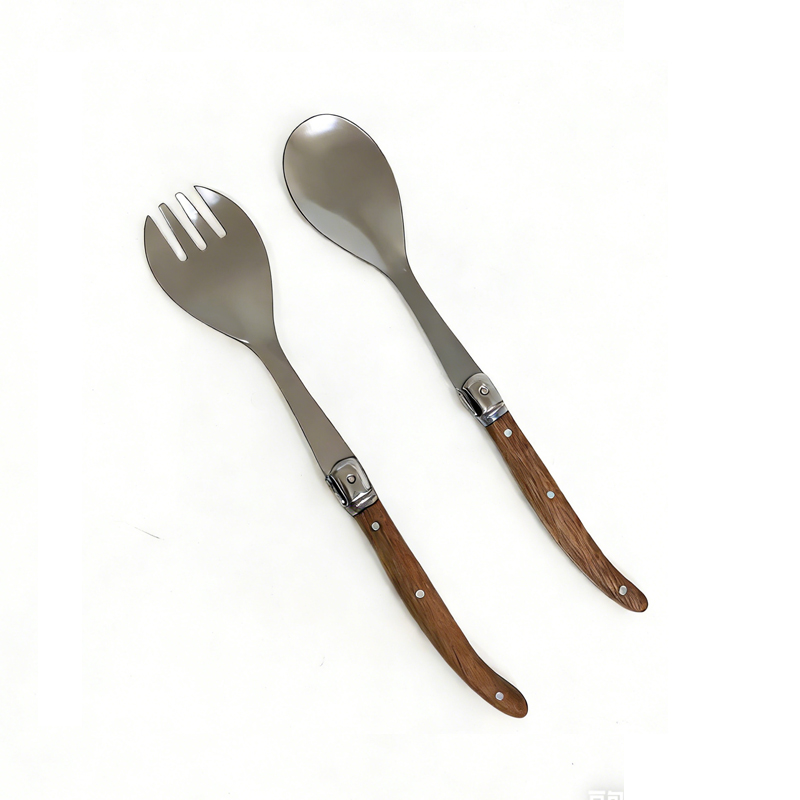
A large salad can be difficult to serve with ordinary tablespoons or dinner forks. Small utensils may not reach the bottom of a deep bowl, while a single spoon may allow leaves and toppings to slide away. Salad servers solve this problem by combining two complementary shapes.
The serving spoon acts as a broad scoop. It can collect lettuce, grains, vegetables, pasta, beans, cheese, and other ingredients. The serving fork provides additional control. Its tines catch slippery or layered ingredients and help separate portions without compressing the salad.
Salad servers are also helpful when dressing has been added. Instead of stirring aggressively with a small spoon, the user can lift and fold ingredients with the two utensils. This method distributes dressing while preserving the texture of delicate greens.
A dedicated set also improves hygiene and presentation. Guests do not need to use personal forks to serve themselves, and the salad bowl remains visually organized. At a formal meal, matching salad servers can make the table setting look intentional. At a casual family dinner, they provide a practical tool that remains easy to use.
Most salad servers consist of:
- A serving spoon: A wide, slightly curved utensil designed to scoop ingredients.
- A serving fork: A long-handled utensil with tines designed to grip and lift food.
- Matching handles: These may be made from wood, stainless steel, plastic, resin, ceramic, or another material.
- A balanced length: The handles should reach comfortably into the bowl without being difficult to control.
The spoon and fork are normally used together in opposite hands. The user places them around a portion of salad, lifts the food, and transfers it to a plate. For tossing, the utensils are used to lift ingredients from the bottom and fold them back toward the top.
Serving tongs and salad servers perform similar tasks, but their movement and feel are different. Tongs grip food by closing two connected arms, while traditional salad servers use separate spoon-and-fork movements.
Tongs are convenient for firm ingredients, buffet service, and quick portioning. Salad servers are often better for fragile lettuce, mixed greens, pasta salads, and salads containing soft toppings. Because the spoon can support food from underneath, it may cause less pressure than a pair of narrow tongs.
The choice is not necessarily exclusive. Many kitchens keep both tools available. Tongs are useful for simple serving, while a spoon-and-fork set is preferable for tossing and controlled presentation.
Wooden salad servers are popular because they provide a natural, warm appearance. Olive wood, bamboo, acacia, beech, and other hardwoods are commonly used for kitchen utensils.
Olive wood is especially attractive because it often features varied grain patterns and rich color. Some products are made from branches that no longer produce fruit, giving the utensil a strong sustainability story. Wooden utensils are generally gentle on non-stick cookware and bowls with delicate finishes.
However, wood requires more care than stainless steel. It should usually be hand-washed, dried promptly, and kept away from prolonged soaking. A food-safe mineral oil may occasionally help prevent excessive dryness, cracking, or roughness.
Wooden servers work particularly well with:
- Rustic dining rooms
- Ceramic or stoneware salad bowls
- Outdoor meals
- Farmhouse-inspired interiors
- Casual family dinners
- Natural or sustainable kitchen styles
Stainless steel is one of the most durable choices. It resists staining, does not absorb dressing, and is easy to sanitize. Many stainless steel sets are dishwasher-safe, although the care instructions should always be checked.
The appearance can range from mirror-polished to brushed or matte. Polished steel creates a bright, formal effect, while brushed steel looks more understated and contemporary.
The main advantage of stainless steel is versatility. It can serve green salad, pasta salad, fruit salad, grain bowls, roasted vegetables, and many other dishes. It also pairs easily with existing flatware.
Potential disadvantages include heat transfer, weight, and scratching. A thin, lightweight set may feel inexpensive, while a thick, well-balanced set may be heavier but more comfortable. Stainless steel can also show water spots if it is not dried properly.
Plastic salad servers are lightweight and usually affordable. They may be made from polypropylene, nylon, or other food-safe plastics. Their low weight makes them useful for children, outdoor picnics, and large gatherings.
Plastic can also provide more color choices than metal. Bright colors may coordinate with a themed party, while neutral tones can blend into everyday kitchenware.
The drawbacks are durability and heat resistance. Low-quality plastic may stain, warp, or develop scratches. Some plastic utensils should not be placed near hot cookware or used with very hot food. They are most suitable for cold salads and occasional use.
Silicone servers offer a soft, flexible surface. This can be useful when serving from coated cookware or delicate bowls. Silicone is also resistant to many stains and can be easier to grip than smooth metal.
A silicone serving spoon may bend slightly under pressure. This flexibility can be helpful for scraping the bottom of a bowl, but it may feel less precise when serving heavy ingredients such as potatoes, beans, or dense pasta.
When buying silicone utensils, look for a firm core and a smooth, non-porous surface. The silicone should not have a strong chemical odor, and the product should clearly indicate that it is intended for food contact.
Some salad servers feature ceramic or porcelain handles attached to metal serving ends. These designs are chosen mainly for their decorative appearance.
They can coordinate with dinnerware patterns, floral motifs, coastal themes, or traditional table settings. Because the handles may be heavier and more fragile, they are best suited to careful indoor use.
The metal portion should still be examined closely. A beautiful handle does not compensate for a thin, poorly finished spoon or fork. Check whether the connection feels secure and whether the joint is easy to clean.
Mixed-material salad servers may combine wood and metal, metal and resin, or stainless steel with colored handles. These sets can provide a distinctive accent on the table.
A decorative design should still be evaluated for function. Look for:
- Smooth edges
- A secure connection
- Comfortable handle thickness
- A spoon that is deep enough to scoop
- Fork tines that are strong but not excessively sharp
- A finish that will not flake or peel
Decorative servers are especially effective when the salad is served as part of a celebration, holiday meal, wedding reception, or themed dinner.
The bowl is one of the most important factors. A shallow bowl requires shorter utensils, while a deep bowl benefits from longer handles. If the servers are too short, your hands may touch the food or the rim. If they are excessively long, they may be awkward to control.
Measure the bowl's depth and diameter before purchasing. A set should reach the bottom comfortably while leaving enough handle above the rim for a secure grip.
Many salad servers are approximately ten to twelve inches long, but actual dimensions vary. The ideal length depends on:
- Bowl depth
- Hand size
- Storage space
- Serving style
- Whether the tools will be used for tossing
- Whether children will use them
Long handles are convenient for large bowls and buffet service. Shorter handles are easier to store and may feel more precise in smaller containers.
A good serving spoon should have enough surface area to support a portion of salad. It should not be so shallow that ingredients slide off immediately.
The bowl of the spoon should be smooth and free from sharp seams. A gently curved shape is usually easier to use than an extremely flat design.
For pasta salad, bean salad, or grain bowls, choose a spoon with enough depth to carry heavier food. For delicate greens, a lighter and broader spoon may be preferable.
The fork should have tines that can catch lettuce and other ingredients without tearing them excessively. Tines that are too short may struggle with large leaves. Tines that are overly pointed may feel uncomfortable during handling.
The fork does not need to look exactly like an eating fork. It is a serving tool, so its proportions are often longer and wider. Strong, smoothly finished tines are more important than a highly decorative profile.
The handle should feel secure without requiring excessive pressure. A rounded or gently contoured grip may be more comfortable than a completely flat handle.
For frequent use, consider:
- Weight: Heavy enough to feel stable but not tiring.
- Texture: Smooth but not slippery.
- Thickness: Large enough to hold comfortably.
- Balance: The serving end should not pull the utensil sharply downward.
- Finish: No splinters, sharp metal edges, loose joints, or peeling coatings.
A salad servers set can either blend into the table or act as a visual accent.
Natural wood complements linen napkins, handmade bowls, and earthy colors. Stainless steel suits modern kitchens and formal flatware. Gold-toned or decorative designs may emphasize a celebratory table. Colorful plastic or silicone is useful for outdoor dining and casual events.
The best choice is not always the most expensive one. It is the set that matches your actual use, care routine, and serving environment.
To toss a salad, place the spoon and fork into opposite sides of the bowl. Lift a portion from underneath, then gently fold it over the ingredients near the surface.
Repeat the motion around the bowl rather than stirring in tight circles. This helps distribute dressing without crushing tomatoes, avocado, berries, or tender leaves.
If the salad contains fragile ingredients, toss fewer times and serve immediately. Overmixing can make greens wilt and soft ingredients break apart.
For serving, place the spoon beneath the portion and use the fork to guide ingredients onto the plate. This method is more controlled than using the fork alone.
Try to include a balanced mix of greens, toppings, and dressing in each portion. Avoid repeatedly digging through the bowl, which can disturb the presentation and make the remaining ingredients unevenly distributed.
Potato salad, pasta salad, lentil salad, and grain salad require more support. Use a sturdy spoon and apply gentle pressure with the fork to keep the portion together.
A very flexible utensil may bend when lifting dense food. For these dishes, stainless steel or a reinforced silicone design may provide better control.
Layered salads are often intended to preserve visual structure. Instead of tossing the full bowl, use the serving spoon to reach downward and the fork to support ingredients as they are lifted.
If the salad is displayed in a transparent bowl, serve from the side when possible. This preserves the appearance of the remaining layers.
Wooden salad servers should generally be washed by hand with warm water and mild dish soap. Do not leave them soaking in a sink, because prolonged moisture can cause swelling, roughness, or splitting.
After washing, rinse away soap and dry the utensils immediately with a clean towel. Allow them to finish drying in an open area rather than placing them inside a closed drawer while damp.
Do not normally put wooden servers in the dishwasher unless the manufacturer specifically approves it. High heat and repeated moisture cycles can shorten their useful life.
If the wood becomes dry or rough, apply a small amount of food-safe mineral oil according to the manufacturer's recommendations. Rub the oil into the surface, allow it to absorb, and wipe away any excess.
Avoid using cooking oils that can become rancid. A strong odor, sticky surface, deep cracks, or persistent discoloration may indicate that the utensil needs replacement.
Stainless steel is usually easy to clean. Wash it with warm water and dish soap, or place it in the dishwasher if permitted.
Drying after washing helps prevent water marks. Avoid harsh abrasive products if the finish is polished or decorative. If discoloration appears, use a cleaner suitable for stainless steel and follow the care instructions.
Plastic and silicone servers should be rinsed soon after use, especially after contact with oily dressing, tomato-based sauces, turmeric, or strongly colored ingredients.
Inspect them regularly for deep scratches, cracks, melting, or changes in texture. Damaged surfaces are harder to clean and may hold food residue.
Decorative handles may require special attention. Food can collect around the joint between the handle and serving end, so use a soft brush or cloth to clean the connection.
Do not assume that a decorative set is dishwasher-safe. Printed patterns, metallic finishes, painted details, and glued components may deteriorate in high heat.
Salad servers can be stored in a utensil drawer, crock, tray, or dedicated holder. Wooden sets should be completely dry before storage. Avoid placing heavy tools directly on delicate handles.
If the set has a hanging hole, it may be displayed near the salad bowl or preparation area. However, open storage exposes utensils to dust, so they should be washed before use if they have been displayed for a long period.
For compact kitchens, choose a set with a smooth profile that can sit inside a standard drawer. A magnetic or wall-mounted storage system may be useful for metal designs, provided the tools are protected from unnecessary contact and moisture.
For everyday use, durability and easy cleaning are more important than decoration. Stainless steel, silicone, or sturdy wood are reliable options.
Choose a size that fits the bowl most often used in your kitchen. A medium-length set is usually versatile enough for weekday meals.
For entertaining, appearance becomes more important. Select a coordinated set that complements the serving bowl, plates, glasses, and napkins.
A polished metal pair can create a formal look. Handcrafted wood can produce a relaxed, welcoming atmosphere. If several salads are being served, using different but coordinated sets can help guests identify each bowl.
Outdoor meals benefit from lightweight and durable materials. Plastic and silicone are easy to transport, while bamboo may suit casual picnics.
Avoid fragile ceramic handles if the utensils will travel in a crowded basket. A protective cloth or separate pouch can reduce scratches and prevent contamination.
Commercial use requires frequent cleaning and repeated handling. Stainless steel is often a practical choice because it is durable, non-porous, and simple to sanitize.
The handle should be long enough for a deep serving bowl. If guests serve themselves, choose a design that is easy to grip and not overly slippery. Color coding may help distinguish utensils used for different dishes.
A beautiful set may be uncomfortable, too short, or difficult to clean. Always examine the spoon depth, fork shape, handle texture, and connection quality.
Short servers may be acceptable for a small bowl but frustrating in a deep one. Measure before purchasing, especially if the bowl has tall sides.
Wood, painted metal, ceramic handles, and silicone may have different cleaning requirements. Ignoring those instructions can lead to cracking, fading, warping, or loose components.
Thin metal may bend under pressure and can feel uncomfortable during serving. A slightly thicker design is often more stable, especially for dense salads.
Oversized servers may not fit in a drawer or utensil holder. Check the overall length before ordering online.
A highly specialized design may not be useful for pasta, fruit, bean, or grain salads. If you want one versatile set, choose a medium-length pair with a sturdy spoon and well-shaped fork.
Sustainability depends on the full life of the product, not only the material name. A long-lasting utensil that is used for many years may be more practical than a fragile product that needs frequent replacement.
Wood can be an appealing choice when sourced responsibly and maintained correctly. Bamboo grows quickly, but manufacturing, adhesives, coatings, and shipping also influence environmental impact.
Stainless steel is durable and reusable. Its production requires energy, but its longevity can reduce the need for repeated purchases. Recycled content and responsible manufacturing may improve the overall profile.
Plastic is lightweight and affordable, but its environmental value depends on durability, reuse, and disposal options. A reusable, high-quality plastic set used regularly may be preferable to many single-use utensils.
When evaluating sustainability, consider:
- Product lifespan
- Repairability
- Packaging
- Material sourcing
- Cleaning requirements
- Recyclability
- Frequency of replacement
- Whether the item is genuinely reused
A salad bowl is usually the visual center of a shared meal. The servers should support that presentation rather than compete with it.
For a natural look, pair a wooden bowl with olive wood servers, linen napkins, and neutral ceramics. For a modern table, use a glass or white ceramic bowl with matte stainless steel. For a festive table, select polished or warm metallic finishes.
Color balance is also important. If the salad contains vivid greens, tomatoes, peppers, and fruit, a simple serving set may allow the food to remain the focus. If the bowl is plain, decorative handles can add visual interest.
Place the servers either inside the bowl, on a small rest beside it, or on a folded napkin. Avoid placing wet utensils directly on an unprotected wooden surface, especially when using oil-based dressing.

Salad servers are used to toss, lift, and distribute salad. The spoon supports ingredients from below, while the fork helps grip and guide them. They are also useful for pasta salad, fruit salad, grain salad, roasted vegetables, and other shared dishes.
Yes, wooden salad servers are generally safe when they are made from food-safe wood, properly finished, and maintained correctly. Wash them by hand, dry them promptly, and replace them if they develop deep cracks, splinters, or persistent odors.
Some stainless steel, plastic, and silicone sets are dishwasher-safe, but not every product is. Wooden, painted, ceramic-handled, and decorative sets often require hand washing. Always follow the manufacturer's instructions.
Stainless steel is typically one of the most durable choices because it resists moisture, staining, and repeated use. Longevity still depends on construction quality, finish, cleaning methods, and storage.
Many sets fall within a medium length suitable for everyday bowls, but the correct size depends on bowl depth and hand comfort. The utensils should reach the bottom without forcing your hand close to the food or rim.
Neither is universally better. Tongs are quick and convenient for firm ingredients, while traditional spoon-and-fork servers offer more control for tossing delicate greens and handling mixed salads.
It depends on the material and product instructions. Stainless steel is generally suitable for hot food, while some plastics and decorative finishes may warp or deteriorate. Use heat-resistant tools when serving hot dishes.
There is no universal schedule. Oil them when the surface looks dry, feels rough, or begins to lose its smooth finish. Use only a food-safe product recommended for wooden kitchen utensils.
Store them clean and fully dry in a drawer, utensil holder, serving tray, or hanging system. Keep wooden servers away from prolonged moisture and avoid placing heavy objects on delicate decorative handles.
A good set has a comfortable handle, suitable length, a stable spoon, strong fork tines, smooth edges, secure construction, and care requirements that fit your routine. It should also suit the size of your bowl and the foods you serve most often.
Before purchasing salad servers, check the following:
- Length: Does the set fit your main salad bowl?
- Material: Is it appropriate for your cleaning routine?
- Comfort: Do the handles feel secure and balanced?
- Spoon: Is it broad and deep enough for your preferred salads?
- Fork: Are the tines strong, smooth, and practical?
- Construction: Are the joints tight and well finished?
- Care: Is it dishwasher-safe if that matters to you?
- Storage: Will it fit in your drawer or serving area?
- Style: Does it complement your tableware?
- Durability: Can it withstand the frequency of use you expect?
Salad servers are small but highly useful additions to a kitchen and dining table. The right pair makes tossing easier, protects delicate ingredients, improves portion control, and adds a polished touch to shared meals.
Wood offers warmth and natural character, stainless steel provides durability and easy maintenance, silicone delivers flexibility, and decorative materials create a more distinctive presentation. The best choice depends on bowl size, intended food, cleaning habits, storage, and personal style.
A thoughtful purchase should balance appearance with practical details such as length, weight, grip, spoon depth, fork strength, and construction quality. With proper care, a well-made set can remain useful for everyday meals, special occasions, outdoor dining, and buffet service for many years.


