

Views: 280 Author: HELLOKNIFE LTD Publish Time: 2026-09-30 Origin: Site


Content Menu
● Quick Answer: Which Knife Set Has Higher Wholesale Value?
● Why Damascus Knife Sets Cost More to Produce
>> Multi-layer blade construction raises labor and material cost
>> The pattern has commercial value—but only if it is authentic
>> Premium packaging increases perceived wholesale value
● Traditional Chef Knife Sets Still Win in Some Wholesale Projects
● Wholesale Pricing: The Real Cost Drivers
>> 1. Blade material and construction
>> 2. Heat treatment and cutting performance
>> 3. Handle materials and assembly
>> 5. Quality-control requirements
● A Practical Pricing Framework for Buyers
● How HELLOKNIFE LTD Builds Higher-Value OEM Knife Programs
>> Our recommended OEM development process
● How to Sell a Damascus Knife Set at a Premium
>> Build a clear product story
>> Use visual merchandising to justify price
>> Protect the premium after sale
● FAQ
>> 1. Do Damascus knife sets always have a higher wholesale price?
>> 2. Are traditional chef knife sets lower quality than Damascus knife sets?
>> 3. What should a buyer ask before ordering a Damascus knife set from an OEM factory?
>> 4. Can HELLOKNIFE LTD add a custom logo to knife sets?
>> 5. Which knife set is better for premium gifting?
>> 6. Can a Damascus knife set be sold as food-safe just because it uses stainless steel?
>> 7. What is the best minimum order quantity for a custom knife set?
For brands, wholesalers, and kitchenware distributors, the question is not simply whether a Damascus knife set costs more than a traditional chef knife set. The real question is whether a Damascus knife set can support a higher wholesale price, stronger retail positioning, and healthier margin after manufacturing, packaging, quality control, freight, and customer-service costs are included.
At HELLOKNIFE LTD, we manufacture OEM cheese knives, cheese boards, steak knives, chef knife sets, and customized kitchenware for international brands, wholesalers, and product manufacturers. From our experience working with private-label buyers, Damascus knife sets usually command higher wholesale pricing than conventional chef knife sets—but only when the blade construction, finish, story, packaging, and quality consistency justify the premium.
A Damascus-pattern knife should not be treated as a decorative version of an ordinary kitchen knife. It should be built and presented as a complete premium product platform. When that happens, it can help buyers move from price-led competition to value-led selling.

In most OEM sourcing projects, a genuine layered Damascus knife set has a higher wholesale price than a standard traditional chef knife set.
However, the premium is not automatic. A buyer will pay more only when the Damascus product has a credible material specification, visible craftsmanship, reliable cutting performance, and premium-ready packaging.
| Comparison area | Damascus knife set | Traditional chef knife set |
|---|---|---|
| Typical wholesale position | Mid-premium to premium | Entry-level to mid-market |
| Main selling driver | Patterned blade, craftsmanship, gift value, exclusivity | Utility, familiarity, everyday use |
| Production complexity | Higher | Lower |
| Visual differentiation | Very strong | Often limited |
| Customization potential | High for blade pattern, handles, gift boxes, logos | High for logos and handles, but less distinctive |
| Retail storytelling | Strong | Usually functional and price-driven |
| Margin opportunity | Higher when positioned correctly | More dependent on volume and cost control |
| Buyer risk | Higher if material claims are unclear | Lower due to simpler specifications |
The strongest conclusion is this: Damascus knife sets command higher wholesale pricing when they are engineered as premium branded products, not when they are sold merely as patterned blades.
Market examples also show that Damascus kitchen knives are commonly positioned as specialty and premium products, with retailers emphasizing layered construction, distinctive patterns, sharpness, and visual individuality.
A traditional chef knife set is usually built around repeatable manufacturing: stock removal or stamping, heat treatment, grinding, polishing, handle assembly, and packaging. This structure is efficient, scalable, and suitable for buyers pursuing competitive opening prices.
A Damascus knife set adds complexity before the knife even reaches final sharpening.
For a true Damascus-style kitchen knife, the blade often combines multiple steel layers around a core steel. The blade is forged, ground, polished, and etched so that the layered pattern becomes visible. Modern Damascus kitchen knives commonly use a hard cutting core combined with layered exterior steels.
That additional construction can require:
- More material handling
- More forging or bonding control
- More grinding time
- More polishing and surface-finishing work
- More inspection for pattern consistency
- More care during etching and corrosion protection
- Higher rejection risk if the pattern or blade geometry is inconsistent
For an OEM buyer, this means the unit cost may rise before packaging, branding, product testing, freight, or margin are added.
The visual pattern is one of the most powerful reasons Damascus knife sets can command a premium. It communicates craftsmanship at first glance, particularly in e-commerce product images, retail shelf displays, holiday gift sets, and premium kitchenware collections.
But buyers should distinguish between three very different products:
| Product type | What it means | Wholesale implication |
|---|---|---|
| Genuine layered Damascus construction | Multiple steel layers create the pattern | Highest material and craftsmanship value |
| Damascus-clad blade | A cutting core with layered exterior cladding | Premium value when clearly specified |
| Laser-etched or printed Damascus appearance | Surface decoration imitates a pattern | Lower-cost option, but claims must be transparent |
At HELLOKNIFE LTD, we recommend that brands define the blade construction in writing before sampling begins. A beautiful pattern cannot compensate for vague specifications or misleading claims. Premium pricing is sustainable only when the product description matches the actual product.
Wholesale pricing is not based on the blade alone. Buyers often underestimate how much packaging affects the commercial success of a knife set.
A Damascus knife set can support a premium retail experience when paired with:
- Magnetic gift boxes
- Wooden presentation cases
- Custom knife blocks
- Branded blade sleeves
- Care cards and sharpening guidance
- Premium handle materials
- Foil-stamped logos
- Custom inserts for e-commerce protection
For gift-oriented knife sets, packaging can make the difference between a product that competes on discount and a product that earns a premium position.
A higher price does not always mean a better sourcing decision. Traditional chef knife sets remain the right choice for many brands because they are easier to standardize, easier to replenish, and more accessible to price-sensitive consumers.
Traditional sets are particularly effective when the buyer's goal is:
- High-volume retail programs
- Promotional or seasonal sales
- Starter kitchen knife collections
- Restaurant supply channels
- Private-label supermarket programs
- Value-focused online marketplaces
- Lower minimum-risk product launches
A traditional chef knife set can also deliver excellent performance. The key variables are not the pattern on the blade but the steel selection, heat treatment, blade geometry, handle construction, sharpness, and finishing quality.
For example, a well-designed stainless-steel chef knife set with full-tang construction, stable handles, clean grinding, and reliable sharpening may outperform a poorly made Damascus-style set. Buyers should never purchase a Damascus product solely for appearance.
When comparing a Damascus knife set vs traditional chef knife set, the purchase price is only one part of the decision. The better question is: which product produces the stronger overall commercial result?
Damascus-style construction generally costs more because of layered materials and additional processing. Traditional blades can be more economical because the material workflow is simpler and easier to automate.
For both product categories, heat treatment determines whether the knife holds an edge, resists chipping, and performs reliably. A premium-looking knife without consistent hardness and sharpening performance can create complaints, returns, and brand damage.
At HELLOKNIFE LTD, we advise OEM customers to define target requirements during development, including:
- Blade steel and construction
- Target hardness range
- Blade thickness
- Edge angle
- Blade finish
- Tang construction
- Handle material
- Corrosion-resistance expectations
- Packaging drop-test requirements
- Inspection standards
A standard polypropylene or basic wood handle supports an accessible price point. A stabilized wood, G10, resin, forged bolster, or premium composite handle can elevate both Damascus and traditional knife sets.
For Damascus sets, handle selection matters even more because the buyer expects visual balance. A high-end patterned blade combined with a weak-looking handle lowers perceived value immediately.
The number and type of knives have a major influence on wholesale cost and retail value. A three-piece chef set, a five-piece kitchen set, a steak knife collection, and a ten-piece block set all serve different channels.
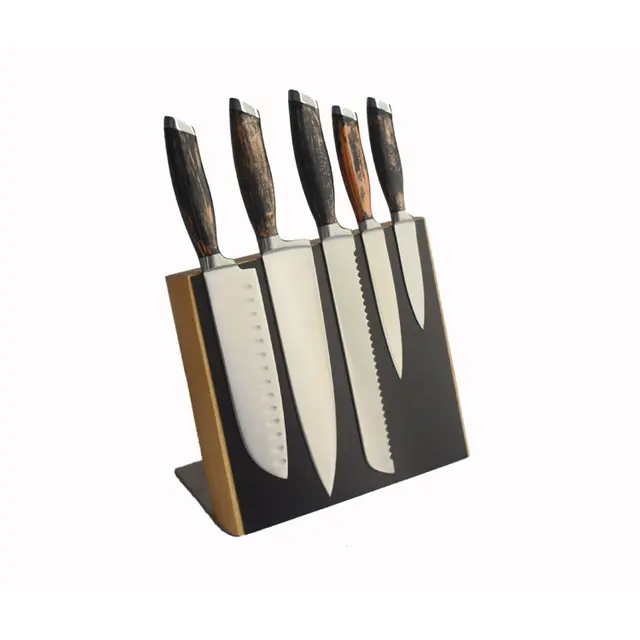
A practical premium set may include:
1. 8-inch chef knife
2. 8-inch bread knife
3. 7-inch santoku knife
4. 5-inch utility knife
5. 3.5-inch paring knife
6. Custom storage block, tray, or gift box
For steak knife projects, a four-piece or six-piece Damascus-pattern steak knife set can be especially attractive for gift retailers, specialty food brands, grilling brands, and premium homeware channels.
The more premium the positioning, the more important inspection becomes. Premium customers notice small differences in blade centering, edge consistency, handle gaps, logo alignment, packaging quality, and surface marks.
A food-contact product also needs attention to material suitability, fabrication quality, surface condition, and intended use. FDA guidance explains that food-contact substances and food-contact articles are regulated based on their intended use and safety requirements; manufacturers are responsible for meeting applicable specifications and limitations.
Instead of asking only, "What is your best price?" we recommend that buyers use a total-value sourcing framework.
| Buyer question | Why it matters |
|---|---|
| Is the Damascus pattern forged, clad, etched, or printed? | Prevents misleading product claims |
| What steel is used for the cutting core? | Helps evaluate edge retention and positioning |
| Is the knife full tang, partial tang, or another construction? | Affects strength, balance, and perceived quality |
| What is the target hardness and edge angle? | Influences performance and durability |
| What inspection points are included? | Reduces quality disputes and returns |
| Can the logo be added to the blade, handle, and packaging? | Builds private-label ownership |
| What packaging options protect the knives in transit? | Limits damage and improves unboxing |
| Can the factory support repeat orders? | Protects continuity after launch |
| What documentation is available for materials and testing? | Supports import, retail, and compliance planning |
This approach prevents a common mistake: choosing the lowest quote for a premium-looking knife set, then discovering that the blade construction, finish, packaging, or consistency does not match the brand's claims.
HELLOKNIFE LTD puts the buyer's brand first. We do not treat OEM knife manufacturing as simply adding a logo to a standard product. We help buyers build a product that matches their target retail channel, brand story, pricing strategy, and quality expectations.
Our OEM capabilities can support customized:
- Damascus-style chef knife sets
- Traditional kitchen knife sets
- Steak knife sets
- Cheese knife collections
- Cheese boards and serving boards
- Custom handles, blade finishes, logos, and packaging
- Gift-ready and retail-ready presentation solutions
1. Define the target customer and retail price.
Decide whether the product is for value retail, premium gifting, specialty culinary retail, online marketplaces, hospitality, or branded direct-to-consumer sales.
2. Choose the right blade platform.
Select either a traditional stainless-steel construction or a Damascus-style construction based on the intended price tier and product story.
3. Develop a complete specification sheet.
Confirm blade material, finish, dimensions, hardness expectations, handle construction, logo placement, packaging, and inspection criteria.
4. Review physical samples before mass production.
Evaluate sharpness, balance, blade pattern, handle feel, packaging, and visual consistency under real lighting.
5. Align quality control with brand expectations.
Define acceptable tolerances for blade scratches, etching variation, handle fit, logo placement, and packaging defects.
6. Create retail assets before the order ships.
Prepare product photography, care instructions, material claims, package copy, and comparison charts for your sales channels.
This process creates a better product and reduces expensive changes after production begins.
The brands that earn the best margins do not simply say "Damascus steel." They give customers a reason to care.
Good product copy should explain:
- The blade's visible layered pattern
- The intended cutting performance
- The handle material and comfort
- The set's kitchen functions
- The gift-ready presentation
- Proper care expectations
- The brand's quality-control commitment
Avoid exaggerated language such as "indestructible," "never needs sharpening," or "professional-grade" unless the claim is supported by your documented product specifications and testing.
Damascus knives sell visually. High-quality photography should show the blade pattern, edge profile, handle texture, box opening, and the set in a kitchen or entertaining environment.
Useful content assets include:
- A close-up blade-pattern photo
- A short slicing demonstration video
- A comparison chart against standard knife sets
- A packaging-unboxing video
- A care-and-maintenance graphic
- A chef, grilling, cheese-board, or dinner-party lifestyle image
A premium knife set should include clear care guidance. Explain hand washing, prompt drying, safe storage, correct cutting-board use, and occasional sharpening. The goal is not only to reduce returns; it is to reinforce the customer's feeling that they purchased a product worth caring for.
Damascus knife sets generally command higher wholesale pricing than traditional chef knife sets because they involve more complex construction, offer stronger visual differentiation, support premium packaging, and create a better brand story for retail customers.
But the highest-value choice depends on your market position.
Choose a Damascus knife set when your brand needs premium shelf impact, gift appeal, visual distinction, and a stronger margin opportunity.
Choose a traditional chef knife set when your strategy prioritizes volume, repeatable specifications, accessible pricing, and broad everyday appeal.
The best OEM program is not necessarily the most expensive one. It is the one where material construction, design, quality control, packaging, product claims, and retail pricing all work together.
Ready to develop a private-label Damascus knife set, traditional chef knife set, steak knife set, cheese knife collection, or cheese board program? Contact HELLOKNIFE LTD with your target market, product concept, quantity, and branding requirements. We will help you turn the concept into a commercially viable OEM product.
Usually, yes. Genuine layered Damascus or Damascus-clad construction typically requires more material processing and finishing than conventional knife production. However, a decorative etched pattern may not justify the same premium as a true layered construction.
No. Quality depends on steel selection, heat treatment, blade geometry, sharpening, handle construction, and quality control. A well-engineered traditional chef knife set can be an excellent product for retail and professional use.
Ask about the blade construction, core steel, layer configuration, hardness target, blade thickness, tang construction, handle material, logo options, packaging, sample process, inspections, and documentation for the intended market.
Yes. HELLOKNIFE LTD can support OEM branding solutions such as blade logos, handle logos, laser marking, etched marks, custom packaging, care cards, labels, and gift-box presentation, subject to the product design and order requirements.
A Damascus knife set is often the stronger option for premium gifting because the patterned blade creates immediate visual impact and works well with gift boxes, wooden cases, steak knife sets, and culinary lifestyle marketing.
No. Food-contact suitability should not be assumed based on a marketing term or raw material name alone. The final product, material specification, fabrication, finish, intended use, and applicable market requirements should all be evaluated.
The right MOQ depends on blade type, custom tooling, handle design, packaging, logo method, and the degree of customization. A factory should evaluate the full project specification before giving an MOQ recommendation.
1. U.S. Food and Drug Administration. "[Food Packaging & Other Substances that Come in Contact with Food]." Explains FDA oversight of food-contact substances and articles. [fda]
2. U.S. Food and Drug Administration. "[How FDA Regulates Substances that Come into Contact with Food]." Describes the regulatory pathways and manufacturer responsibility associated with food-contact materials. [fda]
3. FDA Food Code 2022, Chapter 4. "[Equipment, Utensils, and Linens]." Covers principles for durable, corrosion-resistant, smooth, and cleanable food-contact surfaces and utensils. [c-uphd]
4. The Forged Blade. "[Damascus Steel Kitchen Knives]." Illustrates contemporary retail positioning around layered patterns, sharpness, durability, and complete kitchen knife sets. [theforgedblade]
5. The Cooking Guild. "[Best Damascus Knives]." Discusses the use of hard cutting cores and layered forge-welded steels in Damascus-style kitchen knives. [thecookingguild]
6. Hocho Knife. "[Damascus Knife]." Explains modern Damascus knife construction as layered material with a hard core and patterned outer layers. [hocho-knife]
Hot Tags: China, Global, OEM, private label, manufacturers, factory, suppliers, manufacturing company


